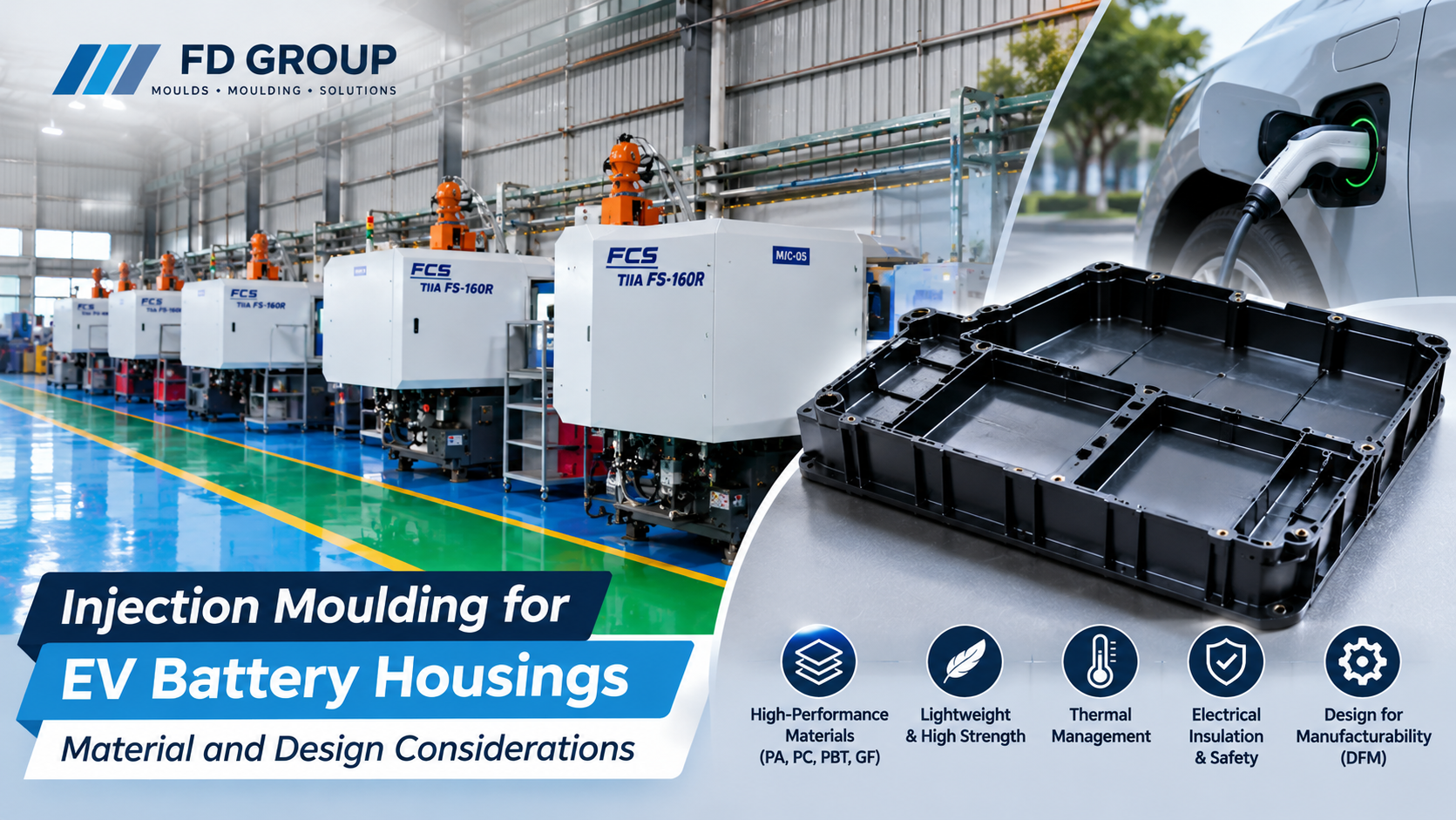
A battery housing is not just a cover. In an electric vehicle it is a structural, thermal, dielectric, and flame-containment part all at once. The specification stack sitting behind one housing is heavier than almost any other plastic component on the vehicle, and the failure mode for getting it wrong is not a warranty return — it is a thermal runaway event.
This article is for product teams, Tier-1 engineers, and sourcing managers specifying injection moulded plastic components for EV battery packs: cell holders, module covers, battery pack upper and lower covers, BMS enclosures, and busbar insulation.
What makes battery housings different
A conventional automotive moulded part is specified against mechanical and cosmetic requirements. A battery housing adds four more layers:
- Flame retardance — must meet or exceed UL 94 V-0 at the thinnest wall section
- Dielectric strength — must prevent current leakage between cells and chassis
- Thermal stability — must survive battery operating temperatures (typically -40 °C to +85 °C, with excursion to 150 °C in some zones)
- Impact and crash resistance — must contain cell contents in a crash scenario, often validated to UNECE R100 for passenger EVs
On top of this, the housing has to seal against moisture ingress to IP67 or higher, carry threaded inserts for assembly without creep failure, and often integrate with liquid cooling plates. For a reference on general automotive moulding requirements, see our broader guide.
Materials that actually work
Four material families cover most EV battery housing applications. Each has a window of use.
PA6 and PA66 with glass fibre and flame retardant
The workhorse for structural housings. Typical grade: PA6-GF30 FR V0, from suppliers such as BASF Ultramid, DSM Akulon, or EMS Grivory. Good mechanical strength (tensile ≥ 150 MPa), halogen-free FR options available, electrical tracking index (CTI) typically 600 V.
Trade-off: moisture absorption. Dimensional stability drops with humidity, which matters for sealed assemblies with tight gaps.
PBT with glass fibre
Used where dimensional stability under humidity matters more than peak strength. Lower moisture uptake than PA, better electrical properties, excellent CTI performance. Typical grade: PBT-GF30 FR, often selected for BMS enclosures and connector housings.
PP with flame retardant and talc or glass
Lower cost, lower density, and increasingly used for larger battery pack covers where structural loads are moderate. Halogen-free FR grades are the standard now. Weight advantage is real — a PP cover can be 15% to 20% lighter than a PA equivalent at the same stiffness, which matters for vehicle range.
PPS and PEI for extreme-temperature zones
For busbar insulators, high-voltage connectors, and anything exposed to sustained temperatures above 150 °C. These are expensive, difficult to mould, and specified only where cheaper options cannot survive. See our planned PEEK article for a deeper look at this class.
Standards that apply
If you are writing a specification for a battery housing, these are the standards your moulder needs to meet or test against:
- UL 94 V-0 — flammability of plastic materials, tested at the thinnest wall section
- UL 746A — short-term property evaluations including CTI, HWI (Hot Wire Ignition), HAI (High-current Arc Ignition)
- IEC 60695 — fire hazard testing for electrotechnical products, including glow-wire test (GWT) at 850 °C or 960 °C
- IEC 62660 — performance and reliability testing for secondary lithium-ion cells
- UNECE R100 — safety requirements for battery electric vehicles, including crash protection of the RESS (Rechargeable Energy Storage System)
- ISO 6469-1 — electrically propelled road vehicles safety specifications, battery system
Design rules for EV battery housings
Wall thickness and UL 94 rating
A UL 94 V-0 rating is only valid at the thickness it was tested at. A material certified V-0 at 1.5 mm may only achieve V-2 at 0.8 mm. Specify the minimum wall thickness in your design against the material's rated V-0 thickness, not against its best-case rating.
Rib design under flame requirements
Standard rib design rules (60% of nominal wall, as covered in our rib and boss design guide) still apply, but ribs that are too thin may fall below the V-0 wall thickness threshold. Validate the thinnest rib section against the material certification.
Weld lines in flame-rated housings
Weld lines reduce mechanical strength by 30% to 70% depending on material and process conditions. In a crash-rated housing, the weld line location becomes a design constraint. Use Moldflow or Moldex3D simulation to confirm weld lines fall outside the primary load path.
Threaded inserts and creep
Battery pack covers are torqued down on hundreds of fasteners. Direct threads into glass-filled plastic will creep over the vehicle's life. Specify brass heat-set or ultrasonic inserts (Böllhoff, Spirol, Tri-Star) and validate the pull-out and torque-to-failure after thermal cycling. For an introduction to overmoulded inserts, see our insert vs overmoulding guide.
Sealing and IP67
Most battery housings require IP67 or higher. The sealing design — groove geometry, gasket material, surface finish at the sealing face — needs to be moulded with tolerances that are tighter than the general part tolerances. See our tolerance guide for the ranges that are realistically achievable.
Flow length to wall thickness ratio
FR-grade glass-filled nylons have shorter flow lengths than their non-FR equivalents. If your housing has a flow length to wall thickness ratio above 150:1, expect to need either multiple gates or a wall thickness increase. Simulate before you commit the tool.
Tooling and process considerations
Battery housings tend to be large (300 mm × 400 mm and up), with multiple load points and complex sealing geometry. Three tooling implications follow:
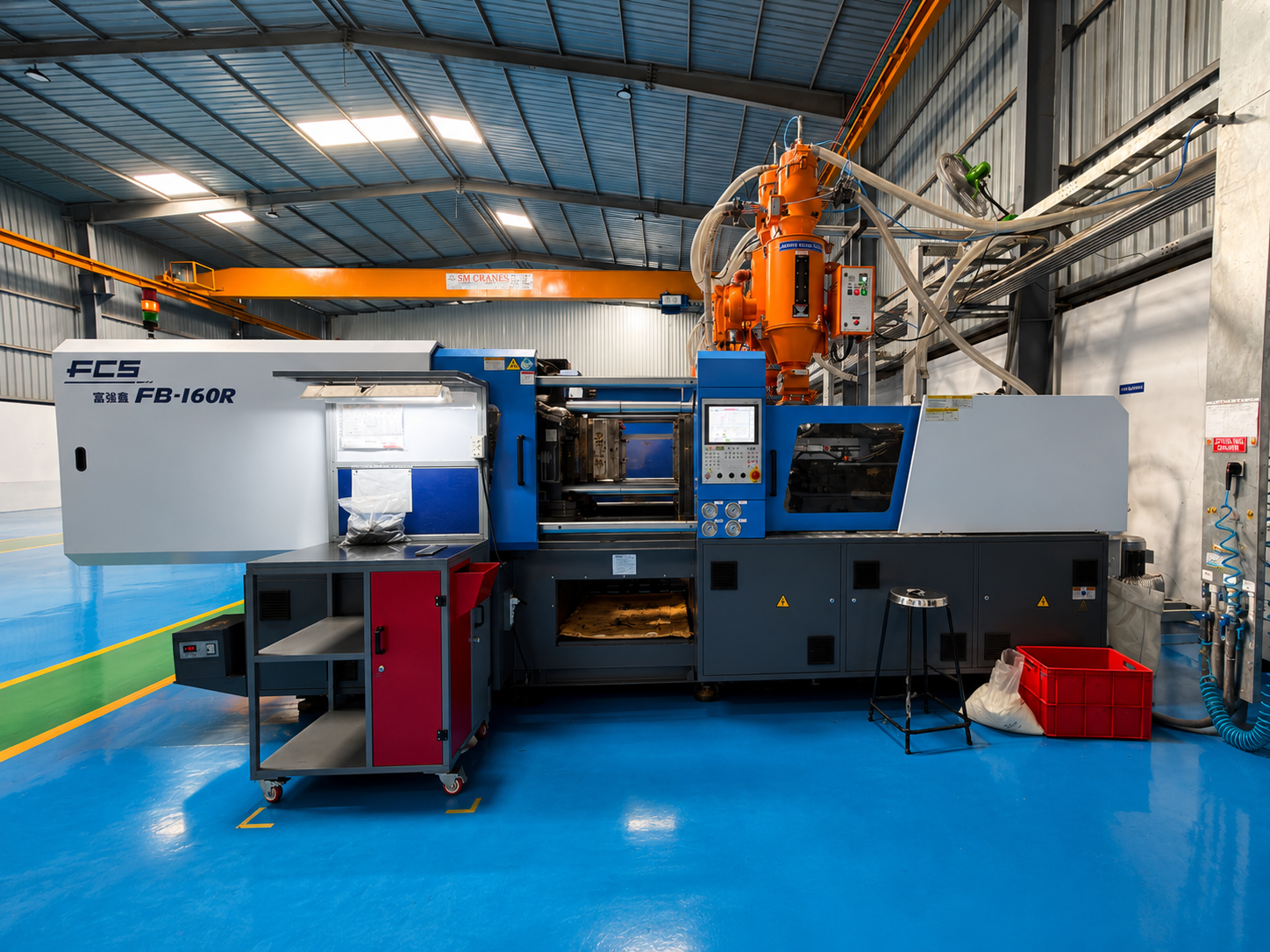
- Press tonnage — a 1 m² projected area housing in PA-GF30 can need 1500 to 2500 ton clamp force. Check your supplier has the press.
- Cooling design — glass-filled materials demand aggressive, uniform cooling to control warpage. Conformal cooling inserts in high-shear zones are often worth the tooling cost.
- Mould steel — glass-filled FR materials are abrasive. Specify a hardened steel for the cavity (H13 or S136 at 48-52 HRC minimum). See our mould steel selection guide for the trade-offs.
Process control is where scientific moulding and in-mould cavity pressure monitoring become essential. The combination of safety-critical function, long cycle times, and expensive materials means scrap and defect costs are high — process stability pays for itself.
Qualification and PPAP for battery housings
Battery housings are almost always classified as safety-related or safety-critical by OEMs. Expect:
- PPAP Level 3 or 5 submission (see our PPAP guide)
- Ppk ≥ 1.67 on all special characteristics
- Full material traceability from resin lot to shipped part
- CoA on every batch, with retained samples for ten years
- Flammability and electrical testing on first-off and periodic requalification
Choosing a moulder for EV battery components
Not every automotive moulder is set up for EV battery work. The specific capabilities to verify:
- Experience with FR-grade engineering plastics (not just general automotive compounds)
- Press tonnage range that covers large pack covers (up to 2500 T for larger platforms)
- Cleanroom or controlled-environment moulding capability for parts with electrical-contact surfaces
- In-house or qualified-partner testing capability for UL 94 and dielectric tests
- Experience executing PPAP at Level 5 for safety-critical automotive parts
FD Group's FIFO Polymers division has been scaling EV component capability as the Indian EV market has grown. If you are specifying an injection moulder for a battery housing programme, our team can walk you through our material capability, press range, and existing EV programme references. Reach out to start a technical review.