Two injection molding shops can run the same tool, the same resin, and the same press and still ship parts that behave differently. The reason usually comes down to how the process was developed. Traditional molding leans heavily on machine settings and operator experience, which makes results hard to repeat when materials, ambient conditions, or shifts change. Scientific molding takes a different route: it develops and controls the process from the plastic's point of view rather than the machine's. The result is tighter part-to-part and lot-to-lot consistency, fewer surprises in production, and a process that holds up when conditions drift. This article explains what scientific molding is, how the method works, and what to look for when you evaluate a molder.
What Scientific Molding Actually Means
Scientific molding, sometimes called scientific injection molding or decoupled molding, is a data-driven way to develop and run an injection molding process. Instead of adjusting settings until parts simply look acceptable, the molder characterizes how the polymer melt behaves inside the mold and builds the process around measurable, repeatable conditions. The methodology is widely associated with the work done at RJG and by processing specialists such as John Bozzelli and Suhas Kulkarni, who helped formalize the studies most molders rely on today.
The guiding principle is easy to state and harder to execute: focus on the four variables the plastic actually cares about, which are melt temperature, flow rate, pressure, and cooling, rather than the machine dials that influence them only indirectly. Machine settings still matter, but they are a means to an end. What matters for the part is what the resin experiences on its way into and inside the cavity.
The Core Idea: Decoupling Fill, Pack, and Hold
In a conventional process, filling the cavity and packing it out can blur into a single motion, so a small change in viscosity or check-ring wear can shift both at once. Decoupled molding separates the process into distinct, independently controlled stages.
- Fill is controlled by injection velocity and typically fills roughly 95 to 98 percent of the cavity. Because filling is speed-controlled, the flow front stays consistent shot to shot.
- Pack and hold are controlled by pressure. Once the cavity is nearly full, the process transfers from velocity control to pressure control at a defined point often called the V/P switchover.
Separating these stages means a molder can adjust how the part is filled without unintentionally changing how it is packed, which is one of the biggest sources of hidden variation in everyday production.
The Six Studies Behind a Robust Process
Most scientific molding process development follows a recognized set of studies. Each one answers a specific question and, together, they define a process window the molder can actually defend.
- Viscosity (rheology) curve: By mapping how the melt's apparent viscosity changes with injection speed, the molder finds the flat region where small speed variations barely affect viscosity. Running there means the process is far less sensitive to normal fluctuations.
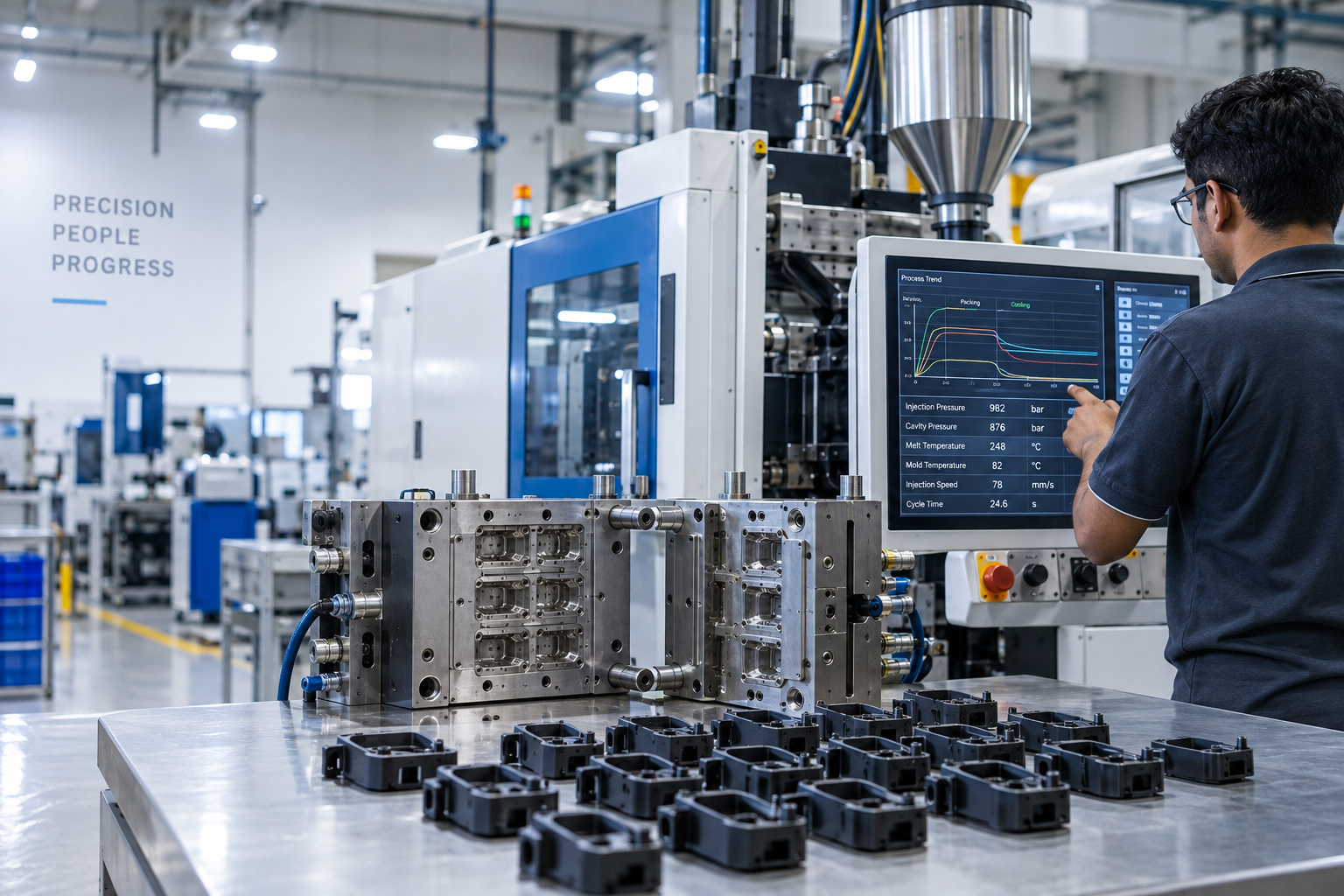
- Cavity balance: Short-shot parts are weighed cavity by cavity to confirm every cavity in a multi-cavity tool fills evenly. Imbalance is a common cause of cavity-to-cavity dimensional differences.
- Pressure drop: This study confirms the machine has enough pressure available across the nozzle, runner, and gate so the process is not starved at any point.
- Process window: The molder maps the range of temperatures and pressures that still produce acceptable parts. A larger window means a more robust, forgiving process.
- Gate seal (gate freeze): Hold time is increased in steps while part weight is tracked. When weight stops climbing, the gate has frozen and additional hold time adds nothing. Setting hold time correctly stabilizes part weight and critical dimensions.
- Cooling study: Cooling time is optimized so the part is stable enough to eject without distortion while keeping cycle time reasonable.
Why It Improves Consistency
Suppose a molded housing has a critical snap-fit dimension that must stay within a tight band. If the process runs on the steep part of the viscosity curve, a minor change in screw recovery or melt temperature can noticeably change fill and packing, nudging that dimension out of range. Developed scientifically, the same job runs in the flat viscosity region with hold time set just past gate seal, so the part fills and packs the same way every cycle. Dimensional variation shrinks because the inputs that drive it are held steady.
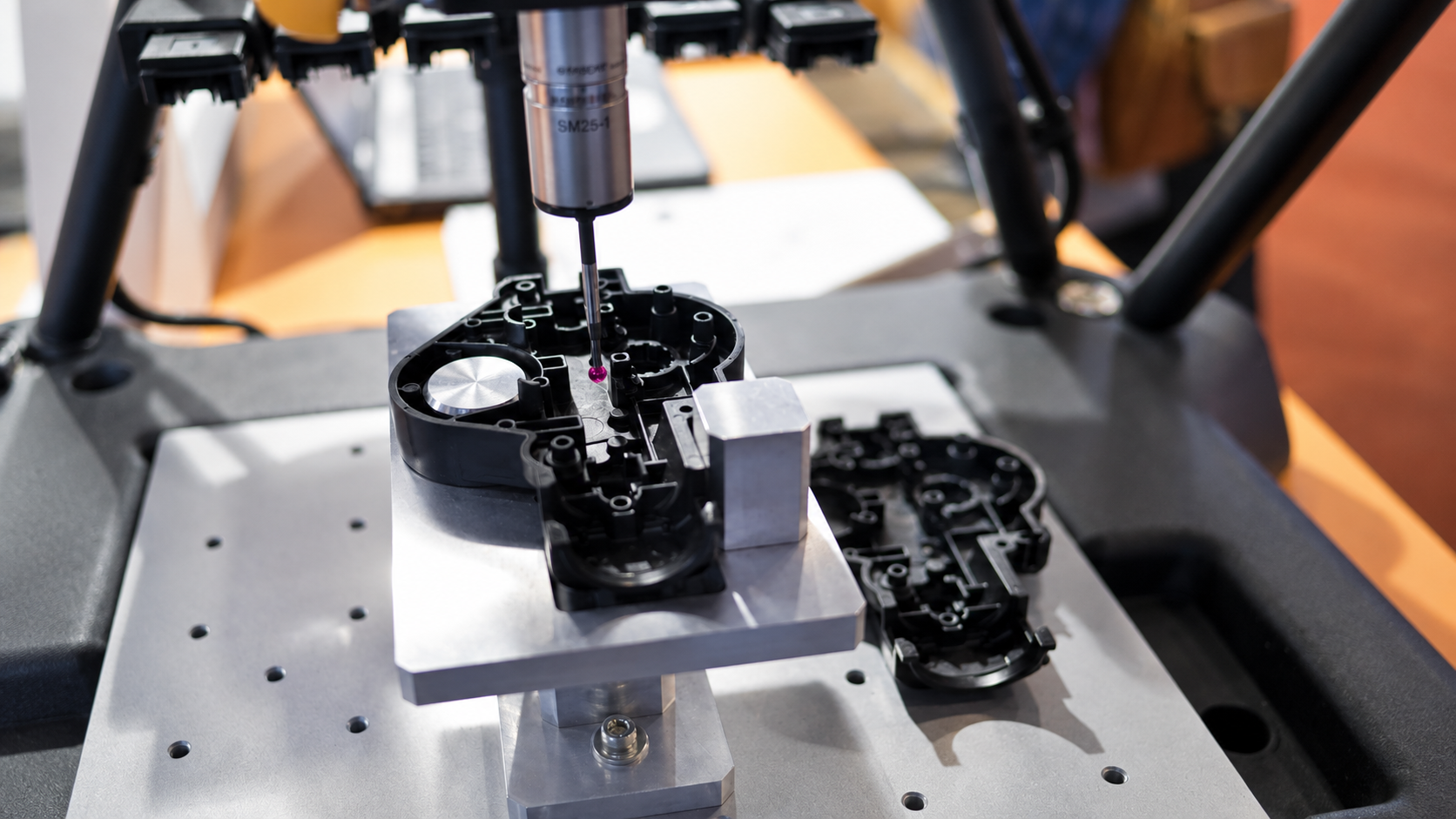
This is also where tools like Design of Experiments (DOE) and statistical process control (SPC) fit in. DOE helps identify which parameters actually move a given dimension, and SPC with capability indices such as Cp and Cpk confirms the process stays centered and predictable during a real production run. For a deeper look at how we verify parts against print, see our [Internal Link: Quality Assurance] overview.
What to Ask Your Molding Supplier
- Do you develop processes using a documented viscosity curve and gate-seal study?
- Is V/P switchover controlled by screw position, cavity pressure, or another signal, and why?
- How do you confirm cavity balance on multi-cavity tooling?
- What data do you record to prove the process was stable across the run?
A molder that can answer these clearly is describing a repeatable, defendable process rather than settings that happened to work on one shift. To discuss a specific application, reach out through our [Internal Link: Contact Our Engineering Team] page, or review our [Internal Link: Injection Molding Services] to see how process development fits into a program.
Frequently Asked Questions
What is scientific molding in simple terms?
It is a data-driven method of building an injection molding process around what the plastic experiences, such as melt temperature, flow rate, pressure, and cooling, rather than around machine settings alone. The goal is a process that repeats reliably.
Is scientific molding the same as decoupled molding?
They are closely related. Decoupled molding refers specifically to separating the fill stage from the pack and hold stages so each can be controlled independently. It is one of the central techniques within scientific molding.
Does scientific molding cost more?
Up-front process development takes engineering time, but it often reduces total cost by lowering scrap, cutting troubleshooting, and making production more predictable, especially on tight-tolerance or high-volume parts.
Does it actually reduce scrap?
A well-developed process that runs in a stable window with correct gate seal and cooling tends to produce more consistent parts, which usually means less scrap and fewer nonconformances over a production run. Results depend on the part, tool, and material.
Related reading: the discussion of scientific molding and Design of Experiments and resources from the Society of Plastics Engineers offer good background for engineers who want to go deeper.