Table of Contents
- Introduction
- What Is 2K Injection Molding?
- 2K Molding vs Overmolding vs Insert Molding
- Why Buyers Choose 2K Molding
- Why 2K Tooling Is Harder Than Standard Molding
- Material Compatibility in 2K Molding
- Design for Manufacturability (DFM) in 2K Parts
- Machine and Process Requirements
- Quality Control for 2K Production
- Industries and Applications
- Cost Considerations in 2K Molding
- Common Buyer Mistakes
- How to Choose a 2K Molding Partner
- Practical Examples
- Frequently Asked Questions
- Why Choose FD Group
- Conclusion
- Talk to Our Engineers
Introduction
Pick up a toothbrush with a soft-touch grip, a power tool handle with a rubberized zone where your palm sits, or a two-color automotive interior panel, and you're holding a 2K molded part. To the person holding it, the part feels effortless — one solid piece, two materials, no visible seam. To the people who built the mold, it's one of the more technically demanding processes in plastic manufacturing.
Buyers evaluating a 2K project often underestimate this gap. A quote for a "2K mold" can look, on paper, like a standard mold with one extra material — the same tonnage, similar lead time, a modest cost premium. In practice, 2K tooling carries its own engineering discipline: material compatibility, core rotation or shuttle mechanics, interface bonding, and hot runner balancing across two shots instead of one. Getting any of these wrong doesn't just cost money — it shows up as a defect a customer can see or feel.
This guide is written for product teams, procurement managers, and OEM buyers evaluating a 2K injection molding project — whether for the first time or the fifth. It covers what 2K molding actually is, how it differs from overmolding and insert molding, what drives tooling difficulty and cost, and what to look for in a manufacturing partner before you commit to steel.
What Is 2K Injection Molding?
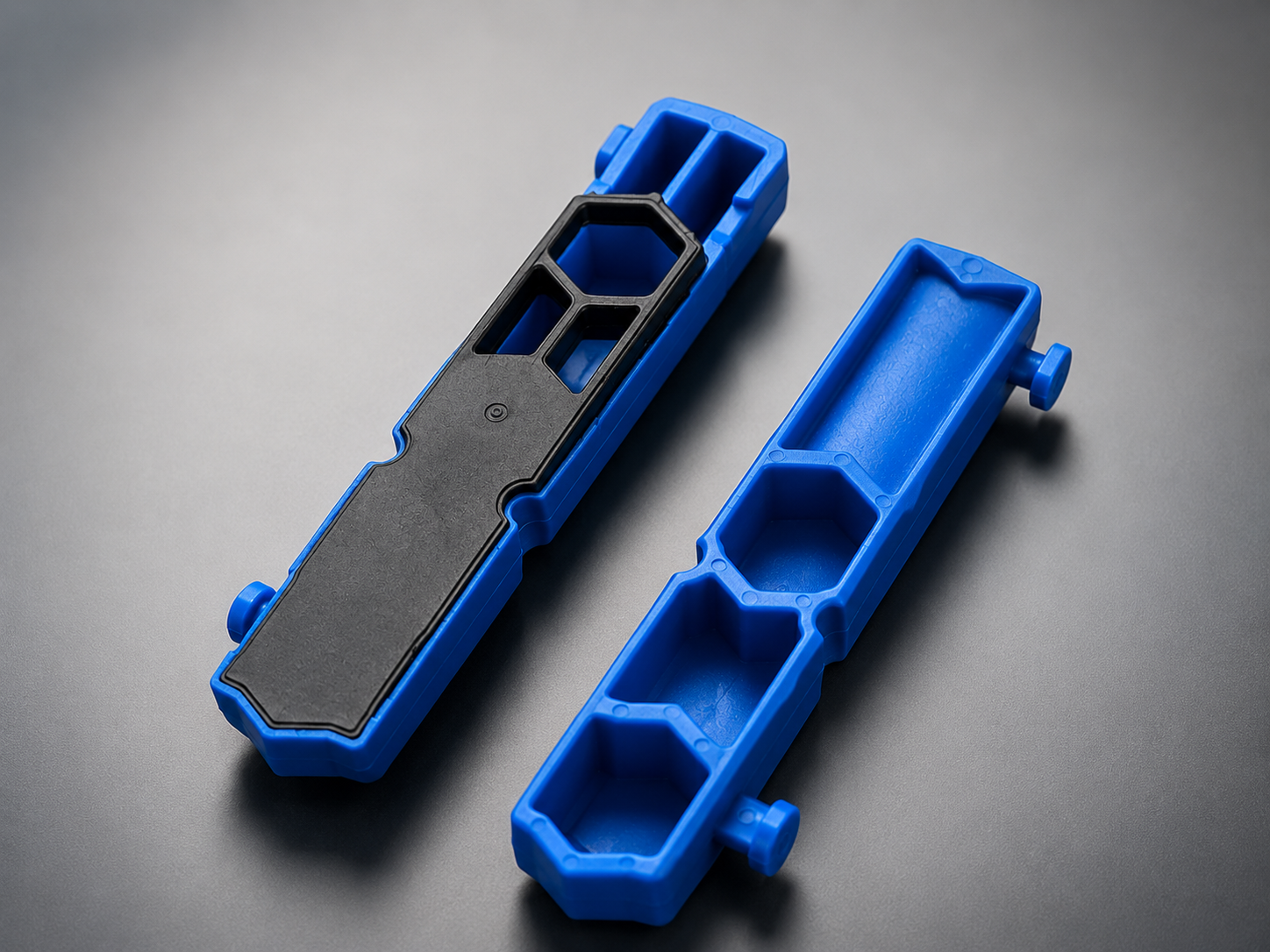
2K — short for "2-component" or "2-shot" — is a process where two different materials, or two colors of the same material, are injected into a single mold in sequence to form one finished part. The first shot is molded, the mold then indexes (via a rotating platen, a core shift, or a transfer between cavities), and the second material is injected directly onto or around the first.
The result is a single part that leaves the machine fully formed — no secondary bonding, no adhesive, no separate assembly step. Common material pairings include a rigid plastic substrate (ABS, PC, PP) combined with a soft elastomer (TPE, TPU) for grip zones, or two colors of the same rigid resin for cosmetic effects without a paint or pad-printing step.
The defining technical challenge is that the mold has to manage two materials with different shrink rates, different cooling behavior, and — depending on the design — a bonding interface that has to hold under flex, torque, or repeated use.
2K Molding vs Overmolding vs Insert Molding
Buyers frequently use these three terms interchangeably. They are related but distinct processes, and the difference matters for tooling design and cost.
| Process | How it works | Typical use case |
|---|---|---|
| 2K / 2-shot molding | Two materials injected in one mold, in one machine cycle, via rotating or shuttle tooling | Soft-touch grips, two-color parts, high-volume production |
| Overmolding | A second material molded over a substrate that was molded separately (often in a different machine or a prior cycle) | Lower-volume runs, or when the substrate is molded elsewhere |
| Insert molding | A pre-formed part — often metal — is placed in the mold and plastic is injected around it | Metal-reinforced components, electrical connectors, threaded inserts |
2K molding produces the part in a single, automated cycle, which is what makes it efficient at volume — but it also demands more from the tool itself, since both shots have to be managed within one piece of tooling and one machine.
Why Buyers Choose 2K Molding
2K is rarely the cheapest way to make a part on a per-tool basis. Buyers choose it for reasons that outweigh tooling cost at scale:
- No secondary assembly. The part is finished when it leaves the machine — no bonding, gluing, or pad-printing step, and no associated labor or defect risk.
- Consistent bonding. Chemical or mechanical bonding between the two materials, done in-mold, is more reliable than adhesive bonding done as a separate operation.
- Lower cycle-to-cycle variation at volume. Once the process is stable, 2K removes a manual step that would otherwise introduce variability.
- Design freedom. Two-color logos, soft-touch zones exactly where needed, and functional seals molded directly into a rigid housing are all easier to achieve in 2K than through post-processing.
The trade-off is tooling complexity and cost upfront — which is why 2K decisions should be made with lifetime volume in mind, not just the first order.
Why 2K Tooling Is Harder Than Standard Molding
A single-shot mold has one set of shrinkage, cooling, and ejection variables to manage. A 2K mold has to manage two of everything, plus the interaction between them:
- Differential shrinkage. The two materials cool and shrink at different rates. If not accounted for in the tool design, this causes warpage, poor fit, or stress at the interface.
- Core/cavity indexing accuracy. Rotating-platen or core-shift mechanisms have to index between shots with zero drift, cycle after cycle. Any misalignment shows up as flash or an uneven interface line.
- Interface bonding or intentional non-bonding. Some 2K designs want the two materials to fuse (a soft-touch grip that won't peel); others need them to move independently (a living hinge or button that flexes). Both require deliberate gate placement and flow design — they don't happen by accident.
- Balanced hot runners across two materials. Each material needs its own controlled fill, often on the same platen, without cross-contamination or uneven pressure between cavities.
Get any of these wrong and the failure modes are visible: flash at the parting line, delamination at the material interface, sink marks, or a soft-touch zone that peels off in the field. This is why DFM review before cutting steel matters more in 2K work than in almost any other molding process — catching a wall-thickness mismatch or gate placement issue on the drawing costs nothing; catching it after tooling starts costs roughly 10x more to fix.
Material Compatibility in 2K Molding
Not every material pair bonds reliably. Compatibility depends on chemical adhesion, melt temperature windows, and surface energy between the two resins.
| First shot (rigid) | Second shot (soft/overmold) | Typical bond |
|---|---|---|
| ABS | TPE (compatible grade) | Strong chemical bond |
| PC | TPU | Strong chemical bond |
| PP | TPE (olefin-based) | Strong chemical bond |
| Nylon (PA) | TPE (specialty grade) | Requires grade-matched TPE; not universal |
Material selection isn't just a spec sheet exercise — it determines whether the two shots actually adhere or delaminate under use. This is one of the first things a competent 2K supplier should flag during quoting, not after the first trial shot.
Design for Manufacturability (DFM) in 2K Parts
DFM review for 2K parts covers everything a standard DFM review covers, plus interface-specific checks:
- Wall thickness consistency across both shots, to avoid differential cooling stress
- Gate location chosen to avoid flow lines exactly where cosmetic surfaces are visible
- Overlap or mechanical lock geometry at the interface, where a chemical bond alone isn't reliable enough
- Draft angles appropriate for both materials' shrink behavior
- Shot sequencing — which material molds first depends on which one needs to define the part's structural geometry
A DFM review that catches these issues before steel is cut is the single highest-leverage step in a 2K project. It's also the clearest signal of whether a manufacturer actually specializes in 2K work or is quoting it as a standard job with an extra shot.
Machine and Process Requirements
2K molding requires machine and tooling infrastructure beyond a standard single-shot setup:
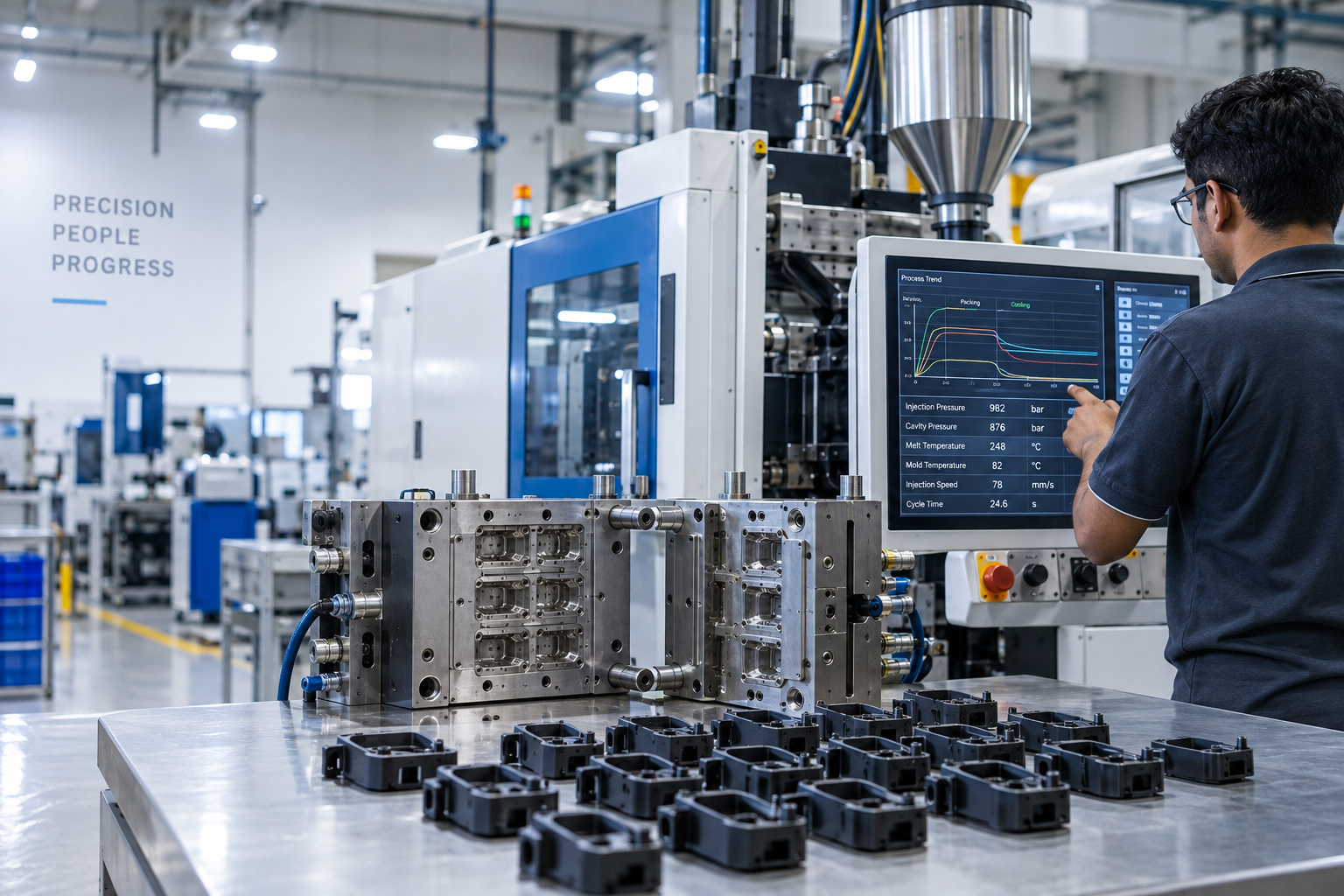
- 2K-capable injection molding machines — either rotary-platen, core-back, or index-plate configuration, with two independent injection units
- Multi-zone hot runner controllers to manage temperature independently across both material feeds
- Precision mold temperature control for both cavities, since the two materials often need different process windows
- Process-controlled molding with SPC monitoring, so shot-to-shot consistency holds across a full production run
The equipment alone doesn't guarantee a good part — but a manufacturer without dedicated 2K machines and multi-zone hot runner control is not equipped to hold tolerance at volume.
Quality Control for 2K Production
Because 2K parts have more failure modes than single-shot parts, quality control has to check more than dimensional accuracy:
- Bond strength testing at the material interface, especially for parts under mechanical stress or flex
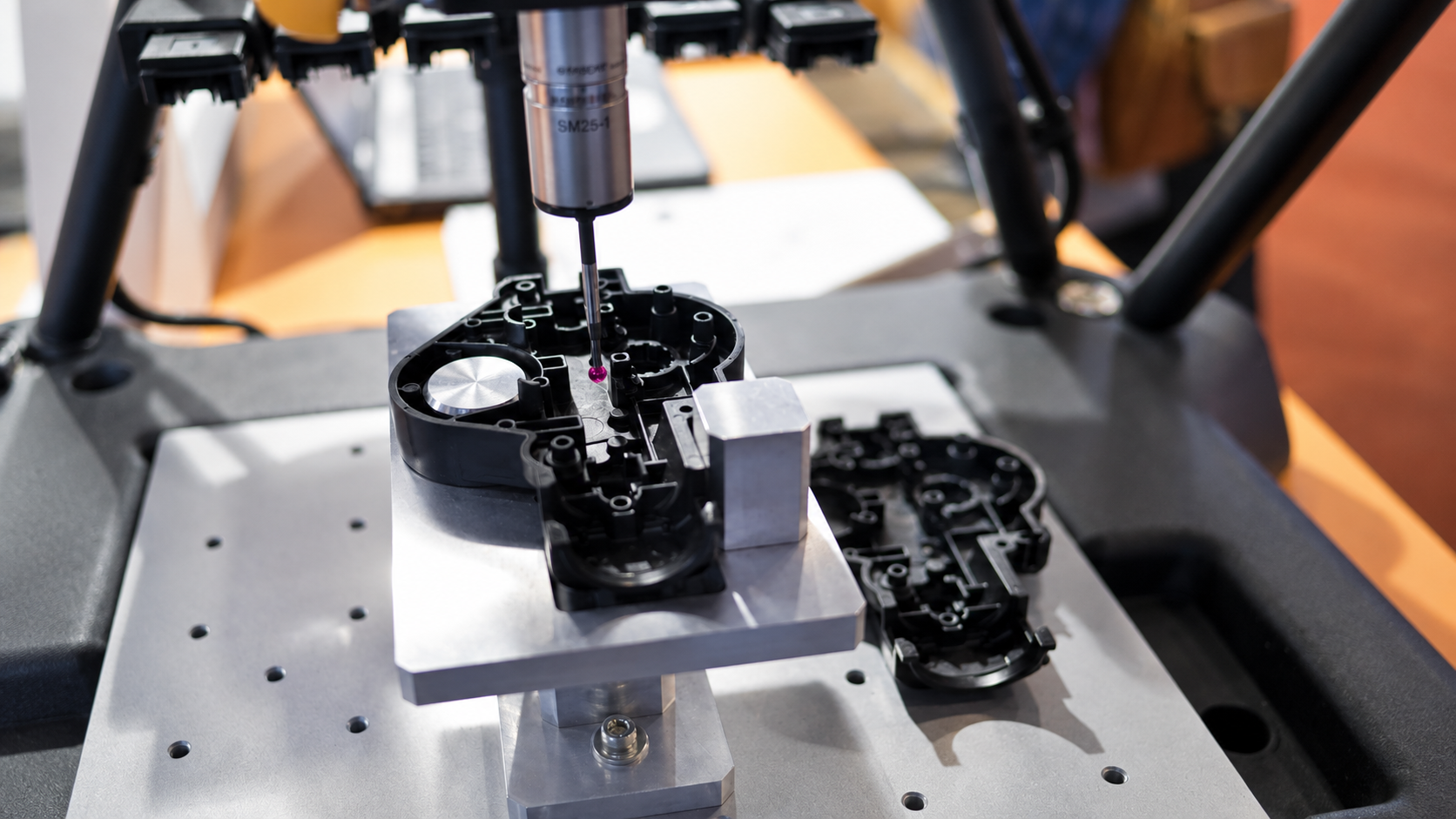
- CMM dimensional inspection on both the substrate and overmold geometry
- Cosmetic surface inspection — sink marks, flow lines, and interface uniformity, particularly on A-class visible surfaces
- Cpk tracking per critical dimension across both shots
- Material traceability for both resins, from certificate to finished part
A supplier that only inspects final part dimensions — without checking bond integrity or interface quality — is missing the failure modes most specific to 2K work.
Industries and Applications
| Industry | Typical 2K application |
|---|---|
| Automotive | Soft-touch interior trim, two-color badging, gasket/seal integration into housings |
| Power tools & hand tools | Ergonomic soft-grip handles bonded to rigid housings |
| Consumer electronics | Rubberized buttons, sealed enclosures with integrated gaskets |
| Two-wheelers | Handlebar grips, control switches with tactile zones |
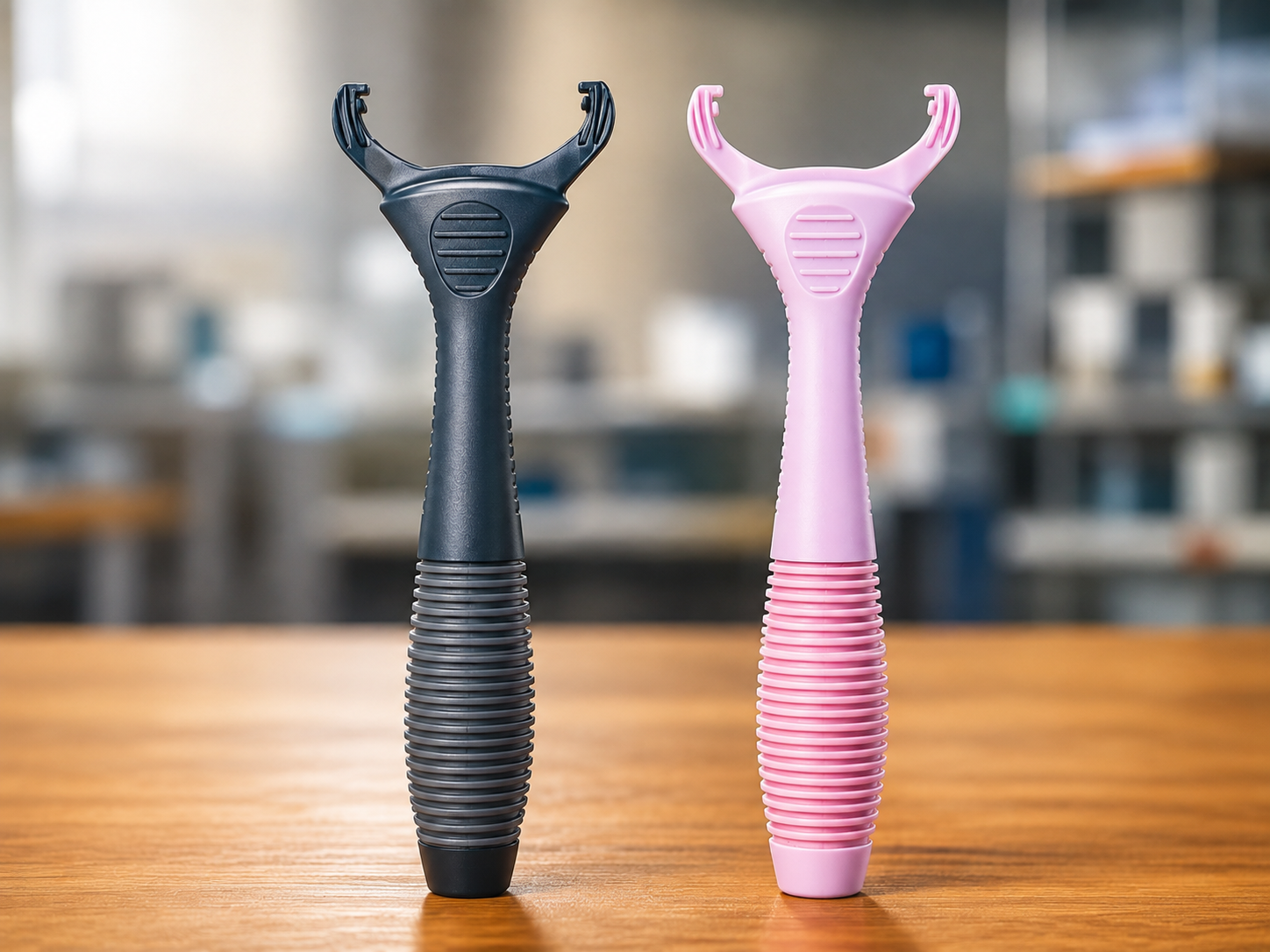
| Personal care | Toothbrush and razor handles with grip zones |
| Defense & industrial | Grips and housings requiring durability and tactile control |
Cost Considerations in 2K Molding
2K tooling costs more than a comparable single-shot mold — typically due to the added core mechanism (rotary platen or shuttle), dual hot runner systems, and the additional engineering time for interface design. As with any injection molding programme, that tooling cost is amortized across production volume: the more parts produced, the lower the effective tooling cost per part.
Buyers should also budget for a longer trial and validation phase than a standard single-shot mold — bond strength and interface quality typically need more iterative process tuning before a 2K tool is signed off for production.
Common Buyer Mistakes
- Treating 2K as "standard molding plus one shot." The interface engineering, not just the extra material, is where the difficulty lives.
- Skipping material compatibility checks. Assuming any rigid-soft pairing will bond leads to delamination discovered only after tooling is cut.
- Choosing a supplier without dedicated 2K machines. A single-shot machine adapted for a 2K trial rarely holds the process control a production run needs.
- Underestimating trial and validation time. 2K parts typically need more iterative tuning than a single-shot equivalent before they're production-ready.
- Not requesting bond-strength data. Dimensional inspection alone doesn't catch an interface that will fail under flex or use.
How to Choose a 2K Molding Partner
A few questions separate a genuine 2K specialist from a shop quoting it opportunistically:
- Do they design and build the mold in-house, or subcontract tooling?
- Do they run a DFM review specific to the interface geometry before cutting steel?
- Do they have dedicated 2K-capable machines with independent injection units, not adapted single-shot equipment?
- Do they test bond strength at the material interface, or only check final dimensions?
- Can they show prior 2K parts in your material pairing and application category?
Practical Examples
Example 1 — Power tool handle. A rigid ABS housing needs a TPE soft-grip zone bonded across the handle. The DFM review flags a wall-thickness transition that would cause sink marks at the grip boundary; the design is adjusted before tooling starts. The resulting mold produces a consistent, flash-free interface across the full production run.
Example 2 — Two-color consumer product. A brand wants a two-color logo molded directly into a housing, without pad printing. Because both shots are the same base resin in different colors, shrinkage is closely matched, simplifying tool design — but gate placement still has to avoid a visible flow line across the color boundary.
Example 3 — Automotive interior trim. A rigid PC/ABS panel needs a TPU soft-touch surface across a large cosmetic area. Bond strength testing during trials catches a process window issue before production sign-off, avoiding a field failure that would have been expensive to trace back to the tool.
Frequently Asked Questions
What does 2K mean in injection molding? 2K stands for "2-component" or "2-shot" — a process where two materials or colors are injected into one mold in sequence to form a single finished part, without secondary assembly.
Is 2K molding the same as overmolding? Related but not identical. 2K molding produces both shots in one machine cycle using specialized tooling; overmolding typically molds the substrate separately before overmolding a second material onto it.
Why does 2K tooling cost more than standard tooling? The mold needs an indexing mechanism (rotary platen or core shift), dual hot runner systems, and additional engineering for the material interface — all of which add cost beyond a single-shot mold.
Which materials can be combined in 2K molding? Common pairings include ABS with TPE, PC with TPU, and PP with olefin-based TPE. Not every combination bonds reliably — material compatibility should be confirmed before tooling.
How long does a 2K mold take to validate? Typically longer than a comparable single-shot mold, since bond strength and interface quality often require iterative process tuning before production sign-off.
What quality checks are specific to 2K parts? Bond strength testing at the material interface, in addition to standard CMM dimensional inspection and cosmetic surface checks.
Why Choose FD Group
2K molding is a specialization at FD Group, not a side capability. Tooling is designed and built in-house at FIFO Industries, using licensed NX 10 and VISI CAD/CAM by a dedicated four-person design team, and molded at FIFO Polymers — so the same group that engineers the interface geometry runs the production shots, with nothing lost between design and molding.
- DFM-first engineering. Every drawing is reviewed for manufacturability — including interface-specific checks — before a single piece of steel is cut.
- Dedicated 2K machines. Our FCS 160-ton 2K machines run alongside multi-zone hot runner controllers and independent mold temperature control built for multi-material work.
- Quality built in, not inspected in. CMM dimensional inspection, Cpk tracking per critical dimension, and full material traceability on every production lot.
- ISO 9001:2015 certified, currently progressing toward IATF certification to extend that rigor into automotive-grade quality systems.
- A decade of track record. Since 2015, FD Group has delivered 1,200+ projects for 35+ clients across 7+ countries, including 2K and multi-shot tooling for automotive, power tools, consumer electronics, and defense-sector applications.
- Scale roadmap aligned to yours. Capacity is planned to scale production from 10,000 to 10 million units, with expansion initiated in advance of demand.
Conclusion
2K injection molding isn't "molding twice." It's a discipline with its own failure modes — differential shrinkage, interface bonding, indexing accuracy — that don't show up in a standard single-shot process. The buyers who get the best results are the ones who ask about DFM process, material compatibility, and bond-strength testing before committing to a supplier, not after the first trial shot reveals a problem.
Choose a partner who treats 2K as a specialization, reviews your design before cutting steel, and can show you production parts — not just quoted capability — in your material pairing and application.
Talk to Our Engineers
Planning a 2K molding project? Share your part geometry, material pairing, and expected volume with the FD Group team. Our engineers will review your design for manufacturability and help you scope the right tooling approach — from first trial to full production.
Request a quote, book a technical consultation, or discuss your requirements at www.fdgroup.co.in.