A sampling run that passes dimensionally does not mean a supplier is ready for production. PPAP exists because the automotive industry learned, the hard way, that proving one part is correct is very different from proving a process can produce the same part a hundred thousand times.
If you are an OEM or Tier-1 placing a programme with an injection moulder for the first time, PPAP is the formal handshake that moves the mould from development into serial production. This article explains what PPAP actually is, what sits inside a submission package, and what a buyer should look for before signing off.
What PPAP is and where it comes from
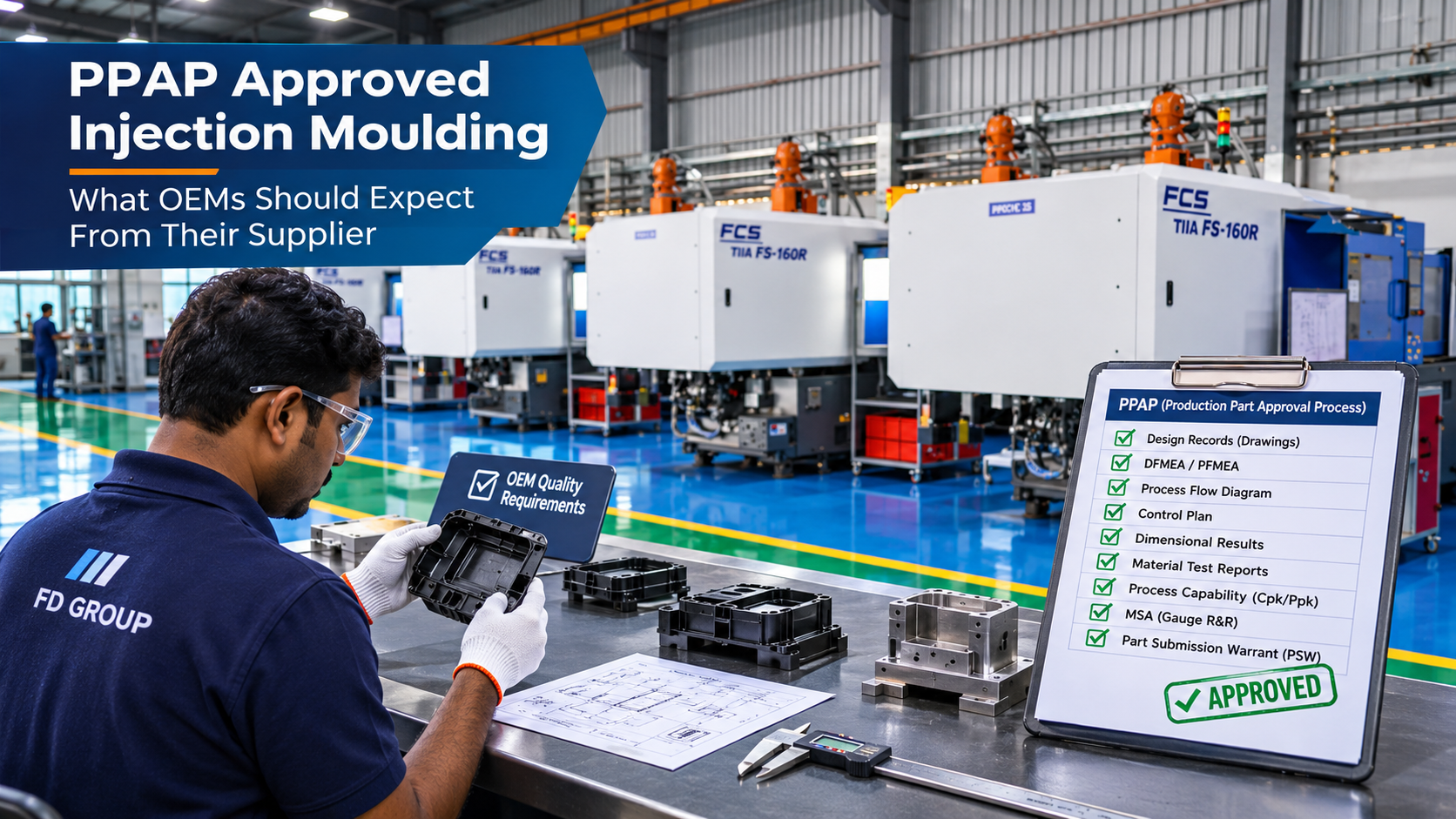
PPAP stands for Production Part Approval Process. It is defined in the AIAG PPAP manual (currently 4th edition) and is one of the five core automotive quality tools, alongside APQP, FMEA, SPC, and MSA. PPAP is a mandatory requirement under IATF 16949 for any production part supplied to an automotive OEM.
The purpose of PPAP is to prove three things, together, in one submission:
- The supplier understands all the customer's engineering requirements
- The supplier's process can produce parts that meet those requirements at the full production rate
- The process is stable and capable enough to continue doing so
PPAP is submitted at the end of APQP Phase 4 (Product and Process Validation) and before Phase 5 (Launch). No part ships to the OEM assembly line without PPAP approval.
How PPAP is different from First Article Inspection
Buyers often use the terms interchangeably. They are not the same. We covered FAI in detail in our First Article Inspection guide, but the short version:
- FAI (per AS9102 in aerospace) proves the first part off the production tool meets print. It is a dimensional and material verification.
- PPAP proves the process can repeatedly produce parts that meet print, at full production rate, with documented capability.
FAI is a snapshot. PPAP is a system qualification. A PPAP submission includes an FAI-equivalent dimensional report (Element 7) but adds seventeen other elements around it.
The five PPAP submission levels
Not every PPAP requires every document in physical form. The AIAG manual defines five submission levels, and the OEM specifies which level applies:
| Level | What is submitted | Typical use |
|---|---|---|
| 1 | Warrant only, with Appearance Approval Report (if applicable) | Low-risk parts, bulk materials, simple components |
| 2 | Warrant with product samples and limited supporting data | Lower-risk parts with some design content |
| 3 | Warrant with product samples and complete supporting data (default for most parts) | Standard production parts — this is what most moulders submit |
| 4 | Warrant and other requirements as defined by the customer | Customer-specific requirements |
| 5 | Warrant with product samples and complete supporting data reviewed at the supplier's manufacturing location | High-risk, safety-critical, or new-supplier programmes |
Level 3 is the industry default. A new supplier on a safety-critical part will often be asked for Level 5.
The 18 elements of a complete PPAP package
A full PPAP submission (Level 3) contains eighteen documents. If you are reviewing a submission as a buyer, use this as your checklist:
- Design Record — current customer-released drawing or 3D model
- Authorised Engineering Change Documents — any ECNs applied since the base design
- Customer Engineering Approval — formal approval if the part has not been fully released
- Design FMEA — only if the supplier owns the design
- Process Flow Diagram — from raw material receipt to finished goods shipping
- Process FMEA — covering every process step with severity, occurrence, detection, and RPN
- Control Plan — one for prototype, pre-launch, and production; must be linked to the PFMEA
- Measurement System Analysis — Gage R&R for every gauge used on characteristics identified in the control plan
- Dimensional Results — a measurement of every dimension on the print, usually on a ballooned drawing
- Material and Performance Test Results — material CoA, functional testing per customer spec
- Initial Process Studies — short-term capability (Ppk typically ≥ 1.67) on special characteristics
- Qualified Laboratory Documentation — ISO/IEC 17025 accreditation for the test lab
- Appearance Approval Report — for parts with cosmetic requirements
- Sample Production Parts — physical parts from the production run
- Master Sample — a signed-off reference part, retained by both parties
- Checking Aids — any gauges or fixtures used for inspection, with their own MSA
- Customer-Specific Requirements — anything the OEM has specified over and above AIAG
- Part Submission Warrant (PSW) — the cover document, signed by the supplier, declaring the submission is complete and accurate
The initial process study — where most PPAPs fail
Element 11 is where PPAP packages typically get bounced. The study requires a short-term capability analysis on special characteristics, usually calculated as Ppk from at least 300 consecutive parts produced under normal production conditions.
AIAG default acceptance is:
- Ppk ≥ 1.67 — process is capable, submission accepted
- 1.33 ≤ Ppk < 1.67 — may be accepted with corrective action and 100% inspection until Ppk is improved
- Ppk < 1.33 — not acceptable; process must be improved before resubmission
Hitting Ppk 1.67 on an injection moulded dimension requires a tight, well-characterised process. This is where scientific moulding and cavity pressure monitoring become decisive — not optional.
Common reasons PPAP submissions get rejected
In our experience the same handful of issues account for most PPAP rejections:
- Dimensional report missing or incomplete — a dimension on the drawing is not addressed
- Control plan characteristics do not match the PFMEA special characteristics
- Gage R&R above 30% on a measurement used in the dimensional report
- Initial process study calculated on fewer than 300 parts, or on parts from a tuning run rather than a production run
- Material certificate from a resin lot that does not match what is in the moulding hopper
- PSW signed before the supporting documents were complete
- No evidence that the measurement system itself has been validated for the specific characteristic
PPAP timing and resubmission triggers
PPAP is not a one-time event. The supplier is required to notify the customer and potentially resubmit when any of the following happen:
- A new or modified tool is used (new cavity, mould transfer)
- Production is restarted after a tooling inactivity of more than twelve months
- A change in material supplier, grade, or source
- A change in manufacturing location
- A change in sub-supplier for a sub-component
- A customer-driven engineering change
- Correction of a non-conformance that affected part characteristics
If your moulder transfers a tool to a different press or a different plant and does not raise a PSW, that is a compliance issue, not just a process one.
What this means for buyers
A PPAP-approved injection moulder is one that has demonstrated, with documentation, that their process is capable of producing conforming parts at full rate. The PPAP package is your evidence trail. Review it, do not just file it.
If your programme is in the APQP phase and PPAP timing is on the critical path, the supplier's ability to execute all eighteen elements on schedule is itself a predictor of how well they will handle the rest of the launch.
FD Group's FIFO Polymers division executes PPAP submissions to Level 3 and Level 5 for automotive customers. If you need a sample PPAP package format or want to discuss how we would approach the submission for your component, reach out and we will walk you through our process.