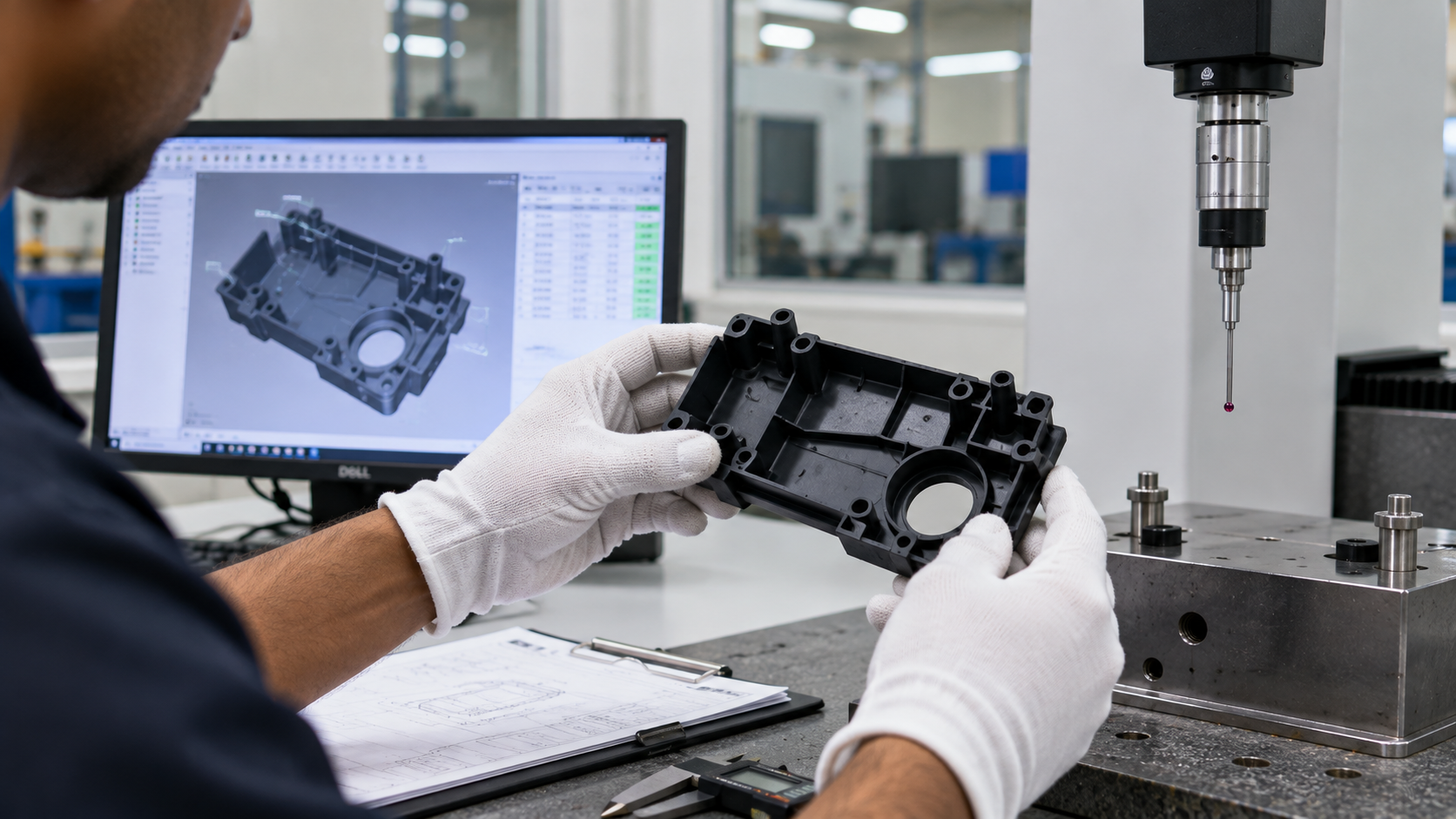
When you place a new molded part into production, how do you know the very first parts off the tool actually match the drawing? That is the job of first article inspection. FAI is a documented check that the tooling, the process, and the paperwork can produce a conforming part before full production begins. For buyers and quality teams, understanding what a proper FAI looks like is one of the clearest ways to judge whether a molder can be trusted with a critical program. This article explains what FAI verifies, when it is required, what a report contains, and how it differs from the automotive equivalent.
What First Article Inspection Verifies
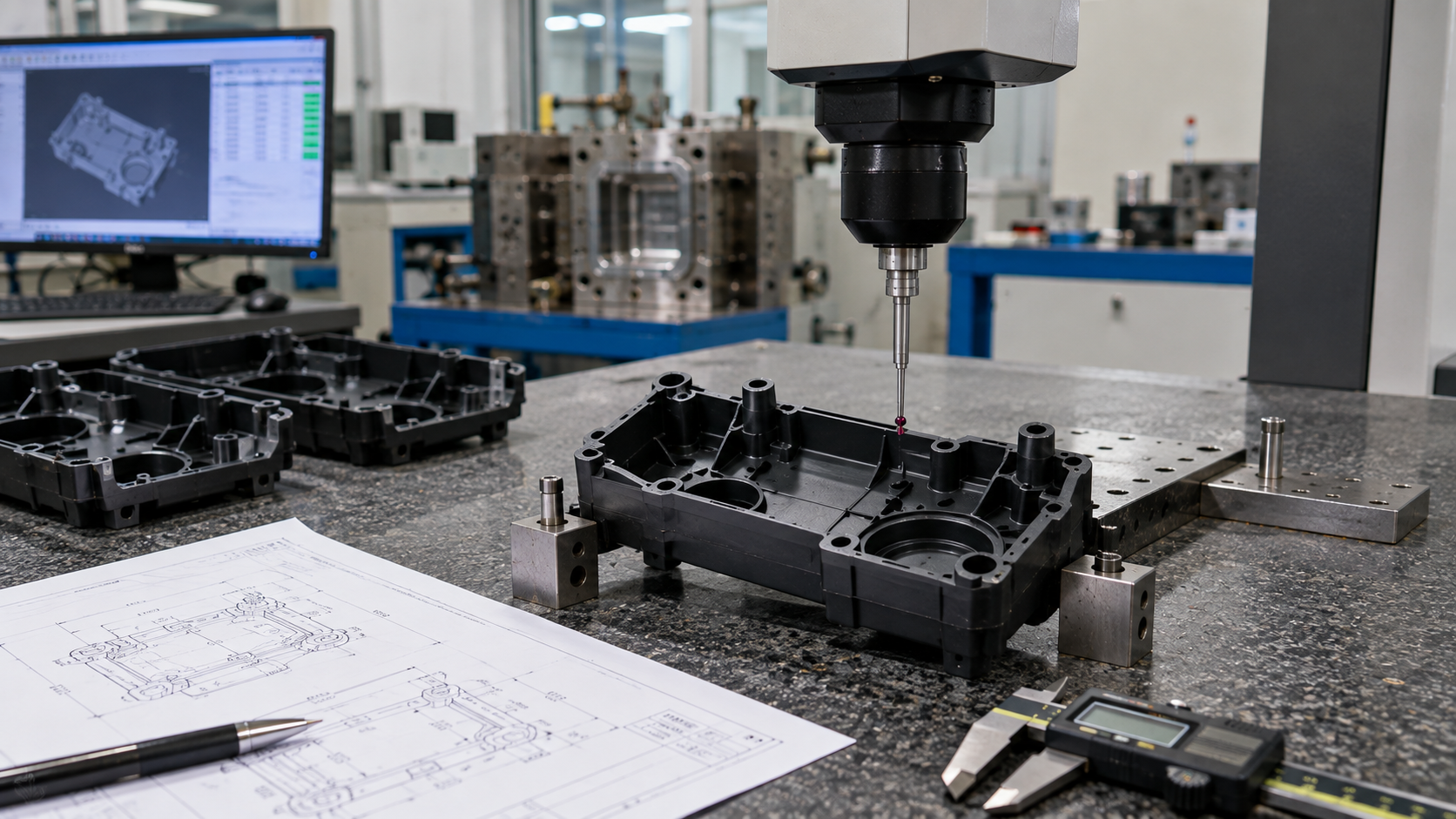
FAI is not just a measurement of one part. It is a verification that the entire production system, meaning the tool, the process, the material, and the documentation, is capable of producing parts that meet every requirement on the drawing. A representative part from the first production run is measured against the print, and every design characteristic is recorded and compared to its specification. The point is to catch problems while they are still cheap to fix, before thousands of parts are made.
When FAI Is Required
FAI is typically triggered by a change that could affect the part. Common triggers include:
- A new part running for the first time.
- A design or engineering change that affects fit, form, or function.
- A change in material or material source.
- A change in the manufacturing process, tooling, or production location.
- A significant lapse in production, after which the process needs to be re-verified.
Requiring FAI after these events protects both sides, because it confirms that a change did not quietly shift the part out of specification.
What Is in an FAI Report
In aerospace, first article inspection is structured by the AS9102 standard, which is governed internationally through the IAQG 9102 requirement. It organizes the report into three forms:
- Form 1, Part Number Accountability: identifies the part, its revision, and the assembly it belongs to.
- Form 2, Product Accountability: records materials, special processes, and any functional testing, along with the certifications behind them.
- Form 3, Characteristic Accountability: lists every design characteristic on the drawing, each matched to a numbered balloon on a ballooned drawing, with the specified value, the measured result, and the tool used.
The ballooned drawing is a small but important detail: every dimension and note is numbered so nothing is skipped and every requirement can be traced to a result. A complete FAI package leaves no characteristic unaccounted for.
FAI Versus PPAP
The automotive world uses a related but distinct system called the Production Part Approval Process, or PPAP, defined by the AIAG. Where aerospace FAI centers on the three forms and characteristic verification, PPAP bundles a broader set of elements, commonly counted as 18, including the design record, process flow, a process failure mode and effects analysis, a control plan, measurement systems analysis, and initial process capability studies. PPAP also defines submission levels, with a mid-level submission often used as the default, and requires the sample parts to come from a significant production run rather than a one-off setup.
Both approaches share the same underlying goal, which is to prove the process can make good parts consistently, but they package the evidence differently and are tailored to their industries.
Full Versus Partial FAI
Not every situation calls for inspecting every characteristic again. A full first article covers all requirements and is the norm for a brand-new part. A partial, sometimes called delta, first article re-verifies only the characteristics affected by a specific change. If a single dimension is revised, for example, a partial FAI documents that dimension and anything the change could influence, rather than repeating the entire report. Knowing when a partial FAI is acceptable, and being able to justify the scope, is part of running the process efficiently without cutting corners. The affected characteristics still need to be clearly identified and tied back to the original baseline so the record stays complete.
A Note on AS9102 and Certification
It is worth being precise here, because it is a common point of confusion. AS9102 is a requirement and a guidance document for how to perform and document first article inspection. It is not a certification a company holds. In aerospace it is invoked through the broader quality management standard as production process verification. A supplier performs FAI in accordance with AS9102; it does not become AS9102 certified. Being clear about this distinction is itself a sign of a molder that understands the requirements.
What to Expect From a Molder
A capable molder should be able to explain how they balloon a drawing, how they record and store results, and how they handle a characteristic that falls out of tolerance during first article. Ask whether they can deliver the report format your industry expects, and how they manage re-verification after a change. You can learn more about how first article fits into our broader inspection flow on our [Internal Link: Quality Assurance] page, or start a conversation through our [Internal Link: Contact Our Engineering Team] page.
Frequently Asked Questions
What is a first article inspection?
It is a documented verification that the tooling, process, material, and documentation can produce a part that meets every requirement on the drawing, performed on a representative part before full production.
When is FAI required?
Usually for a new part, a design change, a material or source change, a process, tooling, or location change, or after a significant lapse in production.
What is in an FAI report?
Under AS9102 it includes three forms covering part identification, product and material accountability, and a characteristic-by-characteristic comparison tied to a ballooned drawing.
How does FAI differ from PPAP?
FAI, common in aerospace, focuses on characteristic verification through three forms. PPAP, used in automotive, bundles a broader set of elements such as control plans and capability studies and defines formal submission levels.
Is AS9102 a certification?
No. AS9102 is a requirement and guidance document for performing first article inspection. A supplier performs FAI to AS9102 rather than holding an AS9102 certification.