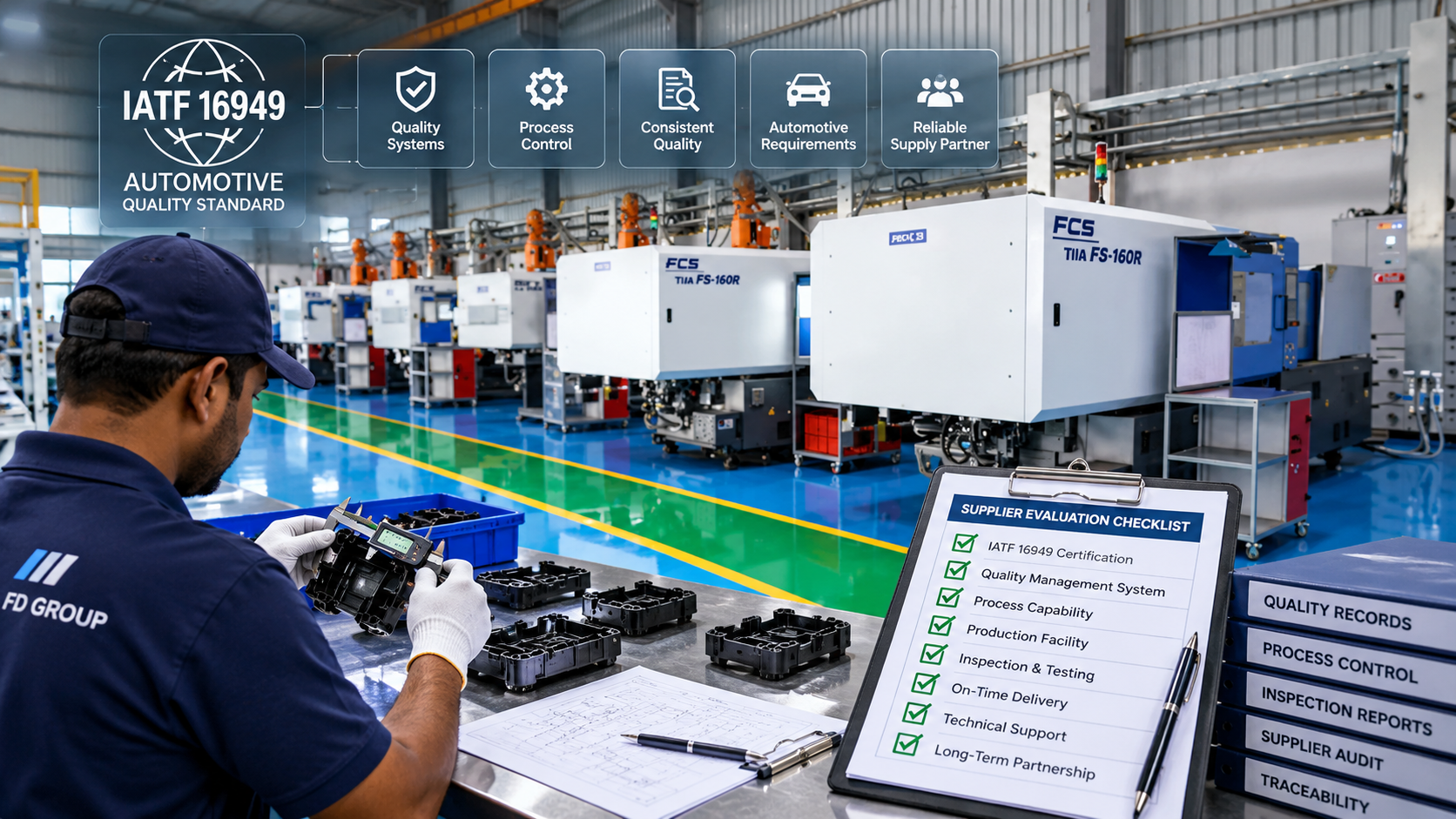
An IATF 16949 certificate on a supplier's website tells you something, but it does not tell you everything. We have seen suppliers wave the logo around while their actual shop floor behaves nothing like a certified operation. We have also seen procurement teams approve suppliers on the certificate alone and discover the quality system behind it was paper-deep.
This guide is written for OEM and Tier-1 buyers who need an injection moulding partner approved to automotive standards. It covers what IATF 16949 is, what it actually requires, how to verify a supplier's certification is live, and what to inspect inside the quality system during your evaluation.
What IATF 16949 actually is
IATF 16949:2016 is the global automotive quality management system standard, published jointly by the International Automotive Task Force (IATF) and recognised by all major automotive OEMs. It replaced the earlier ISO/TS 16949 in 2016 and is now the required QMS baseline to supply any automotive OEM or their approved Tier-1s.
The standard sits on top of ISO 9001. You cannot be IATF 16949 certified without also meeting every ISO 9001 requirement. IATF then adds roughly 100 automotive-specific requirements on top: process controls, product safety, embedded software (if applicable), supplier management, warranty handling, and traceability through the entire supply chain.
For an injection moulder, IATF 16949 is not optional if you want to supply the automotive sector. OEMs will not place even a prototype PPAP request with a non-certified supplier for a safety-related part.
What the certification actually proves
A valid IATF 16949 certificate proves the supplier has been audited by an IATF-recognised certification body against the full standard, that non-conformities raised during the audit have been closed, and that surveillance audits are being conducted at least annually.
It does not prove the supplier is good at making your specific part. It proves they have the system in place to make any part consistently and to react when something goes wrong. The audit tests the system, not every product line.
Three things sit inside the certification that matter most to you as a buyer:
- APQP (Advanced Product Quality Planning) — a 5-phase process for taking a new part from design through to production launch
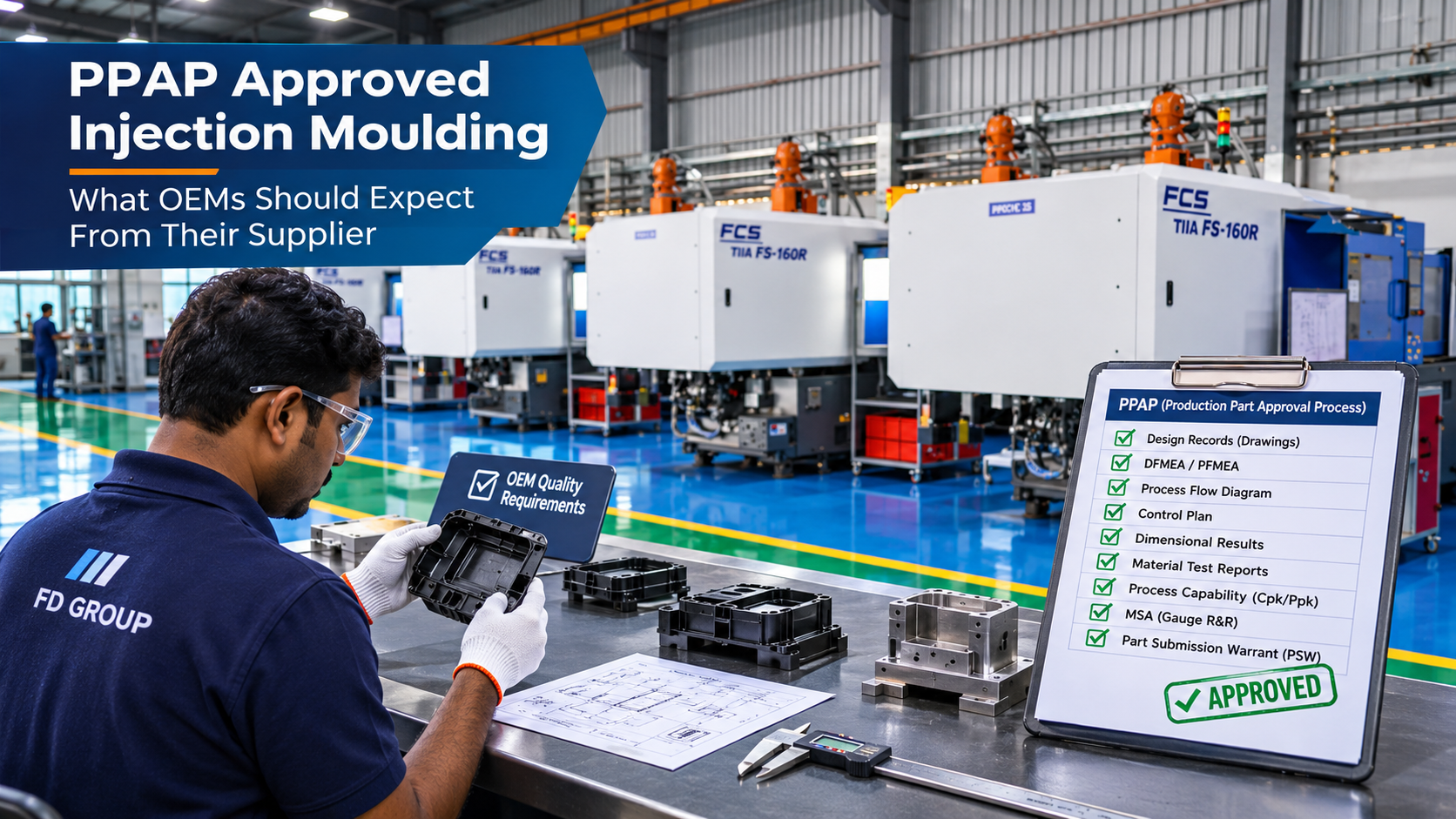
- PPAP (Production Part Approval Process) — the formal submission package that proves the supplier can make conforming parts at full rate (we cover this in detail in our First Article Inspection guide)
- Core tool discipline — FMEA, SPC, MSA, control plans — all mandated and audited
Verifying a supplier's certification is actually live
A certificate PDF on a website is easy to generate. A live certification on the IATF Oversight Database is not. This is the single most important check and most buyers skip it.
Ask the supplier for:
- Certificate number and the exact legal entity name on the certificate
- Name of the certification body (CB) that issued it
- Expiry date and date of the last surveillance audit
- Scope of certification — the certificate must explicitly cover injection moulding of the component type you are sourcing
Then cross-check against the IATF database or ask the certification body directly. If a supplier hesitates on any of these, that is your answer.
What to inspect inside the quality system during your audit
Once you have confirmed the paperwork is real, the shop-floor audit is where you separate strong IATF suppliers from weak ones. We cover the full audit methodology in our Mold Factory Audit guide, but the IATF-specific items to check are these.
Control plans at every workstation
Every production cell should have a current control plan visible to the operator, with characteristics, specification limits, measurement methods, sample sizes, frequencies, and reaction plans. If the control plan is in a folder in the quality office, the system is not being used.
Live SPC data on characteristics marked as significant or critical
IATF 16949 clause 9.1.1.1 requires monitoring of manufacturing process performance. Ask to see live SPC charts for critical dimensions. Look at the Cpk values — anything below 1.33 on an ongoing basis should be flagged. Our cavity pressure monitoring article explains how this ties into process stability.
MSA studies on measurement equipment
Every gauge used for inspection should have a current Measurement System Analysis (Gage R&R) study. Pull a random fixture off the floor and ask for its MSA report. If the R&R is above 30%, the measurement system is noisy and conformance data is unreliable.
PFMEA that has been updated after real failures
Open the Process FMEA for a line that has had a known field issue or an internal rejection in the last twelve months. If the failure mode is not reflected in the FMEA with an updated RPN and action plan, the FMEA is a shelf document, not a live tool.
Traceability from raw material to shipped part
Pick a part from finished goods. Ask the supplier to trace it back to the resin batch, the shot number, the operator on shift, the dimensional inspection record, and the tooling condition at the time. A compliant IATF 16949 supplier can do this in under thirty minutes.
Red flags that override the certificate
Some things we have seen on IATF-certified sites that should still kill the deal:
- Operators cannot explain the control plan at their own workstation
- The last internal audit was more than six months ago
- 8D reports exist but no evidence of long-term containment or horizontal deployment
- Supplier development scores (if applicable) are not being tracked
- Material certificates (CoAs) are not being inspected on incoming batches
- Rework and scrap are mixed with good stock on the floor
- Preventive maintenance records are generic — same checklist, same date, same signature across all machines
How IATF 16949 relates to other certifications your moulder may hold
Some moulders will show you a stack of certificates. Understanding what each one actually covers helps you avoid being impressed by redundancy:
- ISO 9001 — baseline QMS. IATF 16949 includes everything in ISO 9001
- ISO 13485 — medical device QMS. Separate scope; see our medical grade plastics guide
- ISO 14001 — environmental management. Not a quality standard
- ISO 45001 — occupational health and safety. Not a quality standard
- VDA 6.3 — German automotive process audit standard. Many European OEMs require this on top of IATF
What this means for your sourcing decision
IATF 16949 is a necessary condition for supplying automotive, not a sufficient one. Verify the certificate is live and in scope, then audit the actual quality system behind it. The suppliers worth working with will welcome the scrutiny, because their system is built to survive it.
If you are at the earlier stage of evaluating a moulding partner, read our broader guide on how to evaluate an injection moulding partner before signing a contract — IATF is one layer of a larger qualification process.
At FD Group, our FIFO Polymers division serves automotive Tier-1s and OEMs across India and the global market. If you are shortlisting IATF-approved moulders for an upcoming programme, our team can walk you through our quality system, documentation, and representative control plans before you commit to a formal audit. Get in touch to start the conversation.