OEMs do not place programmes with suppliers they have not qualified. The qualification process is designed to answer a simple question — can this supplier deliver conforming parts, at rate, through launch and across the programme life, without exposing the OEM to supply risk — but the process to answer it is long, structured, and unforgiving of shortcuts.
This article covers how automotive OEMs evaluate injection moulding and plastic component suppliers for Tier-1 status, drawing on IATF, VDA, and OEM-specific supplier manuals. If you are an OEM procurement professional, it tells you what to expect to find in a well-run supplier assessment. If you are a supplier looking to move into Tier-1 work, it tells you what you will be measured against.
What "Tier-1" actually means
A Tier-1 supplier ships components, systems, or sub-assemblies directly to the vehicle OEM assembly plant. The term carries three implications beyond logistics:
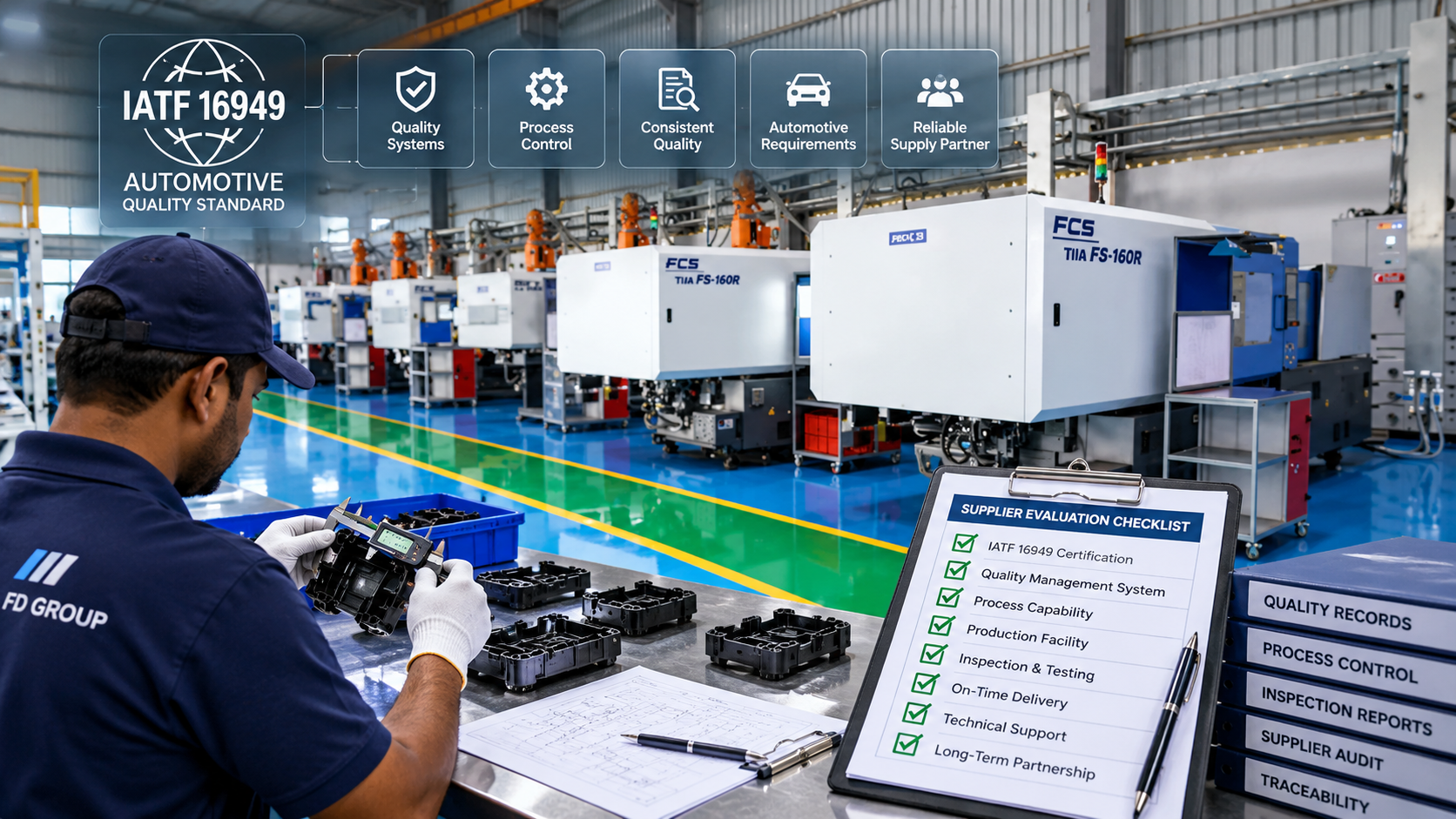
- Full IATF 16949 compliance — see our IATF 16949 supplier guide for what the standard requires
- Direct accountability to the OEM for product and process quality, delivery, and warranty
- Participation in the OEM's supplier development and performance management programmes
Tier-1 is not a certification you can apply for. It is an OEM-granted status, specific to each OEM, for each commodity, for each site.
The qualification pathway
Every OEM runs its own supplier qualification process, but the shape is similar across Volkswagen, Stellantis, Toyota, Ford, GM, Honda, Hyundai, Mahindra, Tata, and others. The sequence typically runs:
- Supplier self-registration on the OEM's supplier portal
- Pre-qualification questionnaire and financial review
- Potential analysis or pre-audit (desk-based review of capability)
- Process audit at the supplier site (usually to VDA 6.3, or OEM-specific equivalent)
- Commodity-specific technical audits
- Nomination for a specific sourcing opportunity (RFQ)
- APQP execution against the awarded programme
- PPAP submission and approval
- Serial production start (SOP) and ongoing performance monitoring
Elapsed time from first registration to first serial production shipment is typically 12 to 24 months, longer for safety-critical parts or new technology (EV, ADAS components).
Stage 1: Supplier portal registration
Each OEM runs its own portal: Volkswagen uses OneSRM, Stellantis uses eSupplierConnect, Ford uses Supplier Portal, GM uses GM SupplyPower, Toyota uses TPS portals. Registration requires:
- Legal entity information, D-U-N-S number, financial standing
- ISO 9001 and IATF 16949 certificate copies with scope statements
- Site locations and manufacturing capabilities
- Code of conduct acknowledgment, usually aligned with Drive Sustainability principles
- Conflict minerals compliance (CMRT) and REACH/RoHS declarations
Registration does not qualify you — it makes you visible to OEM sourcing teams. Nothing happens until an RFQ comes.
Stage 2: Potential Analysis (desk audit)
Before a formal site audit, most OEMs run a potential analysis — a desk-based review of the supplier's stated capability against the specific commodity requirement. Documents typically requested:
- Organisation chart and quality team CVs
- Process flow diagrams for similar parts
- Sample control plans and PFMEAs
- Last two years of customer scorecard performance (PPM, delivery)
- Capacity data by press and process
- Investment plan and tooling capability
Score below the OEM's threshold here and the formal audit does not happen.
Stage 3: VDA 6.3 process audit
VDA 6.3 is the standard German OEM process audit methodology, now widely adopted by non-German OEMs as well. It audits a supplier's manufacturing processes against seven process elements (P1 to P7):
- P1: Potential analysis of new suppliers
- P2: Project management (how the supplier runs new programme launches)
- P3: Product and process development planning
- P4: Realisation of product and process development
- P5: Supplier management (how you manage your own sub-suppliers)
- P6: Process analysis — serial production (the biggest section)
- P7: Customer care, customer satisfaction, service
Each element has multiple questions, scored 0, 4, 6, 8, or 10 points. Final supplier classification based on overall score:
- A supplier (90-100%): qualified without restrictions
- B supplier (80-89%): qualified with conditions and corrective action plan
- C supplier (below 80%): not qualified; usually a 6-12 month development plan before re-audit
Scoring the audit is the audit's result, but the audit itself is where qualification stands or falls. A C-rating on a safety-related commodity means no business for 12+ months. Our mould factory audit article covers what auditors look at on the shop floor.
Stage 4: Commodity-specific technical audits
For injection moulding, the technical review usually adds:
- Press capability (tonnage range, injection units, clamping, control systems)
- Tooling capability (in-house tool room, tool maintenance records, tool life data)
- Material handling (drying, conveying, dosing, regrind management)
- Process documentation (scientific moulding evidence — see our scientific moulding guide)
- In-process monitoring (cavity pressure, OEE, SCADA — see our cavity pressure monitoring article)
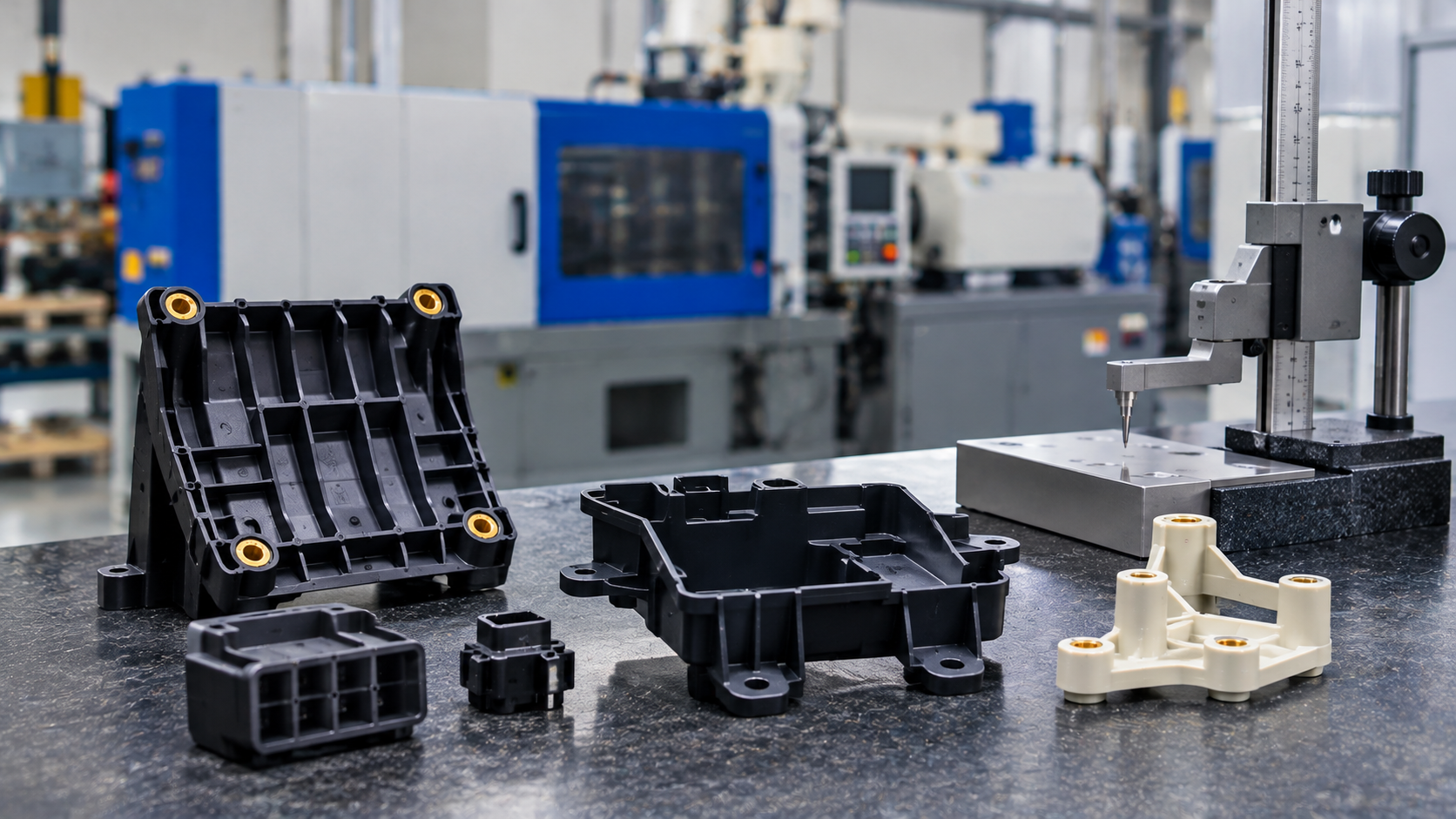
- Inspection capability (CMM, vision systems, dimensional lab)
Stage 5: Financial and capacity due diligence
Separately from the quality audit, OEM sourcing teams run financial checks. Typical requests:
- Audited financial statements for the last 2-3 years
- Working capital ratios, debt-to-equity, cash reserves
- Dependency analysis — what % of your revenue comes from the top 3 customers
- Capacity utilisation vs. installed capacity
- Capacity reservation plan for the awarded programme
OEMs are increasingly rigorous on this because supplier bankruptcy during a programme life is a catastrophic risk. Suppliers heavily concentrated on a single customer are flagged as risky even when quality is strong.
Stage 6: APQP execution
Once an RFQ is awarded, Advanced Product Quality Planning begins. APQP is a 5-phase process defined by the AIAG APQP manual:
- Phase 1: Plan and define programme
- Phase 2: Product design and development
- Phase 3: Process design and development
- Phase 4: Product and process validation
- Phase 5: Launch, feedback, assessment, and corrective action
Each phase has specific deliverables (DFMEA, design verification plan, PFMEA, control plan, MSA studies, PPAP) and gate reviews. OEM programme managers track supplier APQP progress weekly or fortnightly. Falling behind on APQP deliverables puts the sourcing at risk even after award.
Stage 7: PPAP approval
Covered in detail in our PPAP article. PPAP sign-off is the formal gate between APQP Phase 4 and Phase 5. No PPAP, no production shipment.
Stage 8: Ongoing performance management
Qualification does not end at SOP. OEM supplier scorecards track:
- Quality: PPM delivered, incident count, 8D response time, repeat incidents
- Delivery: on-time delivery %, premium freight count, missed shipments
- Cost: achievement of annual productivity (cost-down) commitments
- Technology: new technology proposals, VA/VE participation
- Sustainability: energy use per part, recycled content, carbon reporting
Suppliers below threshold on any dimension for more than 6-12 months typically get placed on new-business hold, meaning no new RFQs until performance recovers.
What differentiates suppliers that qualify quickly
From the OEM side, the suppliers that progress through qualification most smoothly share patterns:
- Their IATF 16949 system is live, not paper — audit evidence is immediate and consistent
- Their APQP tracking is visible to the OEM programme team in real time
- Their PPAP submissions are complete on first submission (no rework cycles)
- They escalate issues early rather than hoping to recover quietly
- Their internal programme team includes someone fluent in the OEM's specific supplier manual (CSR — Customer-Specific Requirements)
- They have supplied the OEM's existing Tier-1 base before — not necessarily the OEM directly, but their quality system has been tested in the same ecosystem
Common disqualifiers
And the patterns that get suppliers rejected:
- IATF 16949 certificate scope does not actually cover the commodity (injection moulding not listed)
- Site location is new or recently relocated without re-audit
- Financial dependency concentration (>40% revenue from one customer) with no diversification plan
- Previous customer non-performance that shows up in a reference check
- Capacity promised exceeds installed capacity, with no capex plan to close the gap
- No evidence of PPAP execution at the OEM's required submission level
- Weak sub-supplier management (your own supplier quality is the OEM's risk)
Where this leaves suppliers aiming for Tier-1 status
Tier-1 qualification is a multi-year investment in quality systems, programme management capability, financial transparency, and relationship development. It cannot be shortcut. The suppliers that make it bring consistent discipline across all seven VDA 6.3 process elements — not just the ones that are easy to show in an audit.
FD Group's FIFO Polymers division has been operating under automotive quality systems for over a decade and has executed PPAP for Tier-1 and OEM customers in India and internationally. If you are an OEM evaluating a potential new source or a supplier aiming to progress toward Tier-1 work, our quality team can walk through our current system, scorecards, and programme management framework. Reach out to start a conversation.