Mould steel is one of those decisions that gets made quickly and then lived with for years. Choose P20 for a half-million-shot programme in a glass-filled nylon, and the cavity will be worn in a year. Choose S136 for a million-shot programme in commodity ABS, and you have spent twice what you needed to.
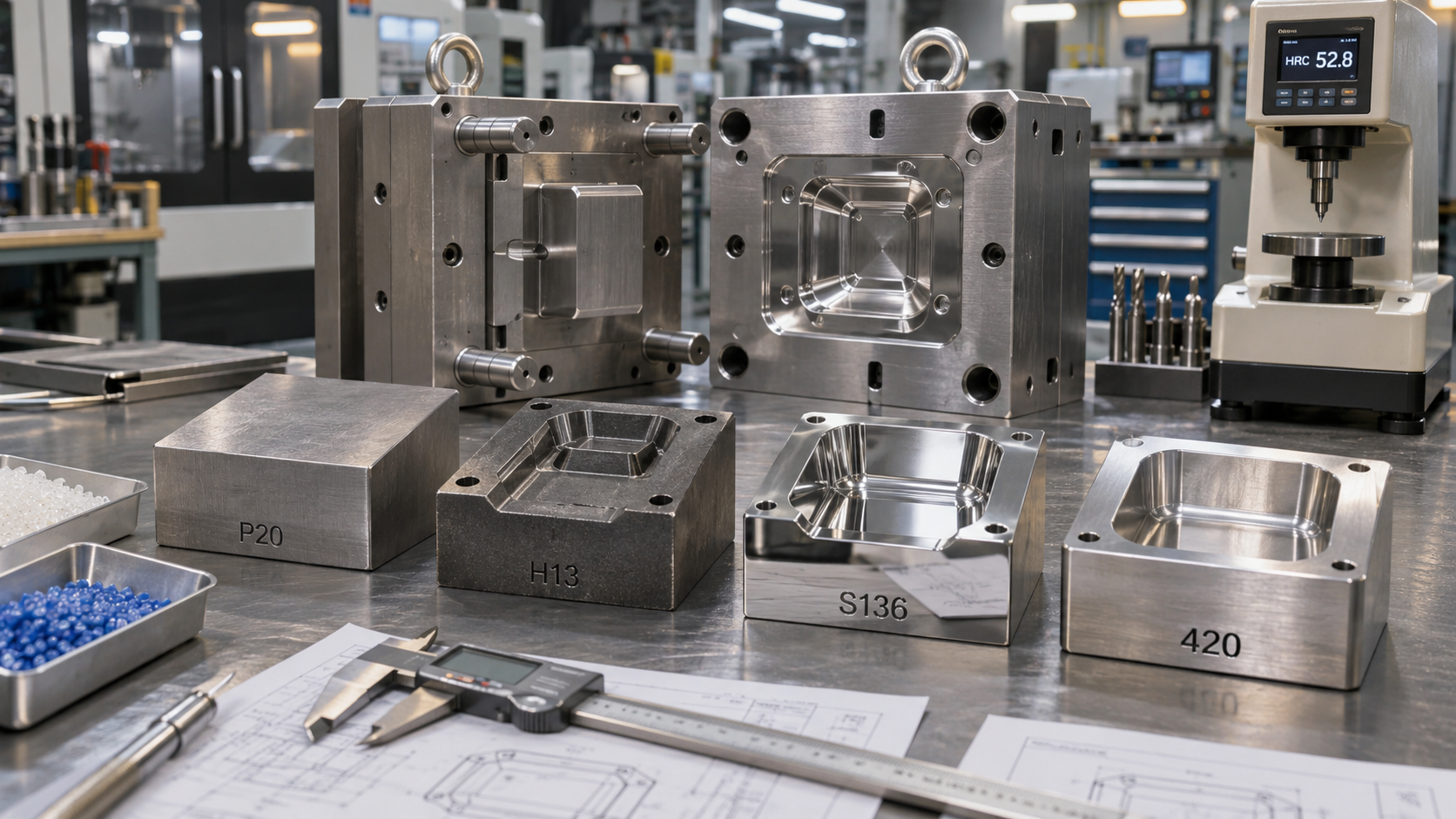
This article covers the four cavity steels we see most often — P20, H13, S136, and 420 — with the properties that matter, the applications each fits, and the cost-per-shot picture over a realistic mould life. If you are evaluating a tooling quote, understanding why the steel line item is what it is will help you ask better questions.
Why mould steel matters
Four properties of the cavity steel decide how a mould performs over its life:
- Hardness — resistance to wear from flow and ejection, usually measured in Rockwell C (HRC)
- Polishability — the surface finish achievable, which determines cosmetic quality of the moulded part
- Corrosion resistance — how the steel reacts to acidic materials (PVC, flame-retardant compounds) and to atmospheric moisture during storage
- Machinability and weldability — how easily the steel is cut and repaired
No single steel is best at all four. The selection is always a trade-off driven by part material, production volume, cosmetic requirement, and budget. For context on how steel choice feeds into total tooling cost, see our injection moulding tooling cost drivers article.
P20 (1.2311 / 1.2312)
The workhorse of general-purpose mould steel. P20 is a pre-hardened chromium-molybdenum steel delivered at 28-32 HRC — ready to machine, no post-machining heat treatment needed. The slightly higher-sulphur version (1.2312) machines faster at the cost of weldability.
Where it fits:
- Prototype and low-to-medium volume moulds (up to roughly 500,000 shots)
- Commodity thermoplastics without flame retardants or glass fill (PE, PP, PS, ABS)
- Non-cosmetic internal parts
- Mould bases, slides, and plates (not usually the cavity for high-volume programmes)
Trade-offs: Lower hardness means faster wear with abrasive materials. Non-stainless, so storage in humid environments needs rust prevention. Polishability is limited to roughly SPI B-2 before pitting appears.
Reference datasheets: Uddeholm Impax Supreme is a widely used P20-equivalent grade.
H13 (1.2344)
A chromium-molybdenum-vanadium hot-work tool steel. Supplied soft (around 200 HB) and heat-treated after machining to 48-54 HRC. Significantly harder than P20 and far more resistant to thermal fatigue.
Where it fits:
- High-volume moulds (500,000 to 2 million+ shots)
- Glass-filled and mineral-filled engineering plastics (PA-GF, PBT-GF)
- Mould components exposed to thermal cycling and shock (hot runner areas, gate inserts)
- Die-casting dies and extrusion tooling (its original application)
Trade-offs: Heat treatment adds cost and lead time, with distortion risk that needs stress relief and allowance for grinding. Non-stainless, so corrosion remains a consideration. Polishability is good but not optical-grade.
Reference datasheets: Uddeholm Orvar Supreme is a premium H13-equivalent.
S136 (1.2083)
A chromium-rich stainless tool steel. The dominant choice for high-cosmetic and medical-grade moulds. Supplied soft, heat-treated to 48-52 HRC. The high chromium content (13%) gives both corrosion resistance and the fine microstructure needed for optical-grade polishing.
Where it fits:
- Optical and lens moulds requiring SPI A-1 or A-2 finish
- Medical device moulds (see our medical grade plastics guide)
- Transparent part moulds (PC, PMMA)
- Moulds for corrosive materials: PVC, POM, flame-retardant compounds releasing acidic gases
- Any mould that will be stored for long periods between campaigns
Trade-offs: Highest material cost of the four — typically 2.5× to 3× P20 per kilogram. Harder to machine, requires experienced toolmakers. For most non-cosmetic, non-corrosive applications, S136 is specification overkill.
Reference datasheets: Uddeholm Stavax ESR is the industry benchmark; Böhler M310 is a direct equivalent.
420 Stainless (1.2316 / 1.2085)
A chromium stainless with slightly lower chromium content than S136, delivering good corrosion resistance at a lower price. Available pre-hardened (1.2085) or heat-treatable (1.2316). Pre-hardened versions sit around 30-35 HRC; hardened versions reach 48-50 HRC.
Where it fits:
- Moderate-volume moulds (up to roughly 1 million shots)
- Moulds for mildly corrosive materials where S136 is overspecified
- Mould bases and plates for corrosive-environment plants (coastal, high humidity)
- Medical moulds where cost pressure rules out S136
Trade-offs: Lower hardness and lower polishability than S136. Weldability is worse than P20. Good middle-ground steel but rarely the best choice for either end of the application range.
Reference datasheets: Uddeholm Mirrax ESR and Böhler M300 are common grades.
Comparison at a glance
| Property | P20 | H13 | S136 | 420 SS |
|---|---|---|---|---|
| Delivered hardness (HRC) | 28-32 (pre-hardened) | 48-54 (after HT) | 48-52 (after HT) | 30-35 or 48-50 |
| Corrosion resistance | Low | Low | Excellent | Good |
| Polishability | Up to SPI B-2 | Up to SPI A-3 | Up to SPI A-1 | Up to SPI A-3 |
| Typical mould life (shots) | Up to 500K | 500K to 2M+ | 1M+ | Up to 1M |
| Relative material cost | 1.0× (baseline) | 1.4-1.6× | 2.5-3.0× | 1.8-2.2× |
| Machinability | Excellent | Fair (after HT) | Fair | Fair |
Prices are approximate and vary by region, bar size, and supplier. Current pricing from distributors such as Hudson Tool Steel or regional stockists will give you accurate figures.
How to match steel to your programme
Three questions decide most selections:
- What is the resin? Non-filled commodity = P20. Glass-filled or mineral-filled = H13 or S136. Flame-retardant or acidic = S136 or 420. PVC = S136 only.
- What is the production volume? Under 100K shots: P20 is almost always enough. 100K to 1M: H13 or 420. Above 1M: H13 or S136.
- Is the moulded surface cosmetic or hidden? SPI A-1/A-2 cosmetic = S136. SPI A-3 or B-grade = H13 or 420. Non-cosmetic = P20 is usually fine.
A good toolmaker will push back if your spec does not match your production reality — specifying S136 for a 50K-shot internal clip is a signal the supplier either misread the brief or is upselling.
Mixing steels within a mould
You rarely need the same steel for every component of the mould. A common hybrid specification for a high-volume cosmetic part:
- Cavity and core: S136 for finish and corrosion resistance
- Mould base: P20
- Slides and lifters: H13 for wear resistance
- Gate inserts: H13 or carbide for abrasion resistance
- Ejector pins: nitride-coated H13
This gets you the right steel in the right place without paying S136 prices for the whole tool. For more on how component choices stack up in total mould cost, our mould cost in India breakdown covers the full picture.
Hardness, surface treatments and coatings
Steel choice is not the end of the specification. Common surface treatments extend the life of the base steel:
- Nitriding — case-hardens the surface to 65+ HRC, improves wear resistance, used on gates and ejector pins
- PVD coatings (TiN, CrN, DLC) — thin ceramic coatings that reduce friction and wear, often applied to cavity surfaces moulding abrasive materials
- Hard chrome plating — older technology, still used for corrosion protection on P20 cavities
Verifying the steel actually delivered
Mould steel is one of the easier line items to substitute without detection. If the specification matters to you, require:
- Mill test certificate (MTC) traceable to the steel supplier for the cavity and core blocks
- Hardness check report after heat treatment, at multiple points on the cavity surface
- Material certificate stamped into the mould base, visible after assembly
An honest toolmaker will provide all three without being asked. If you are shortlisting a tool room, our mould factory audit guide covers broader supplier evaluation.
Working with FD Group on tooling
FD Group's FIFO Industries division handles mould design and build for automotive, electronics, and medical programmes. If you have a part on the way to tooling and want a second opinion on the steel specification, or if you want to understand what we would recommend for your specific resin and volume, reach out and our team will walk you through the trade-offs for your programme.