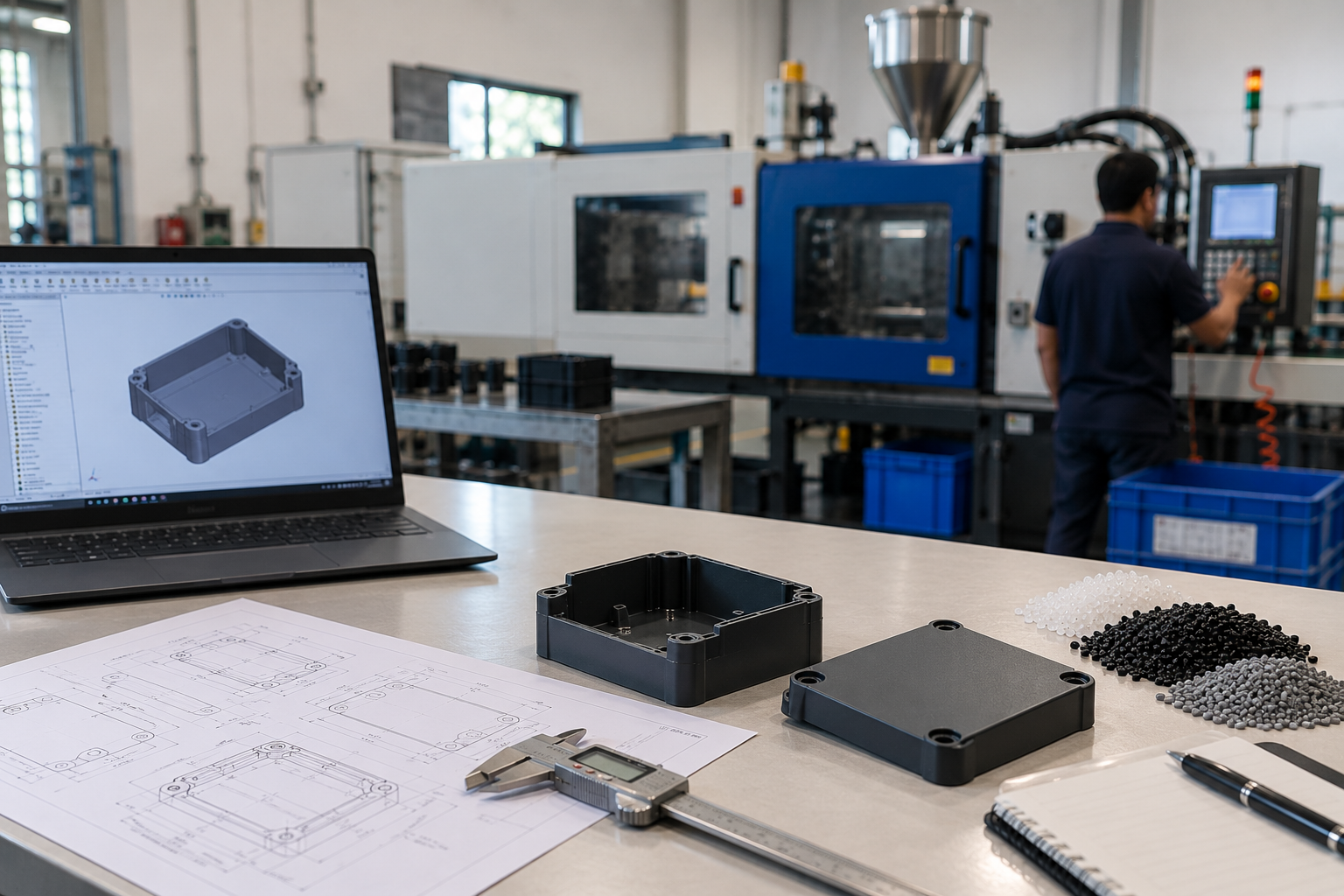
Introduction
For any company that manufactures plastic parts at volume, tooling is the largest single decision in the project — and the one most often misunderstood. The mold is a bespoke, high-precision capital asset. It is engineered once, then quietly governs the cost, quality, and cycle time of every part you produce for years afterward. Get it right and it pays back on every shot. Get it wrong and it becomes a recurring liability that no amount of production efficiency can fully offset.
International procurement teams sourcing tooling from India face an added layer of difficulty: quotations for what looks like the same part can differ by a factor of five or more, and the reasons are rarely spelled out. Is the cheaper quote a genuine saving, or is it a lighter steel grade that will wear out mid-programme? Does the higher quote reflect a better-cooled, longer-life tool, or simply a larger margin?
This guide answers those questions. It explains, in plain engineering terms, exactly what drives injection molding tooling cost up — geometry, cavities, steel, runners, tolerances, side actions, cooling, and more — and then sets out the practical, proven ways to bring that cost down without compromising the quality of the tool or the parts it produces. It is written for the people who actually make the buy: OEM engineers, product designers, sourcing managers, and export procurement teams who need to budget accurately and negotiate on specification rather than on price alone.
What Is Injection Molding Tooling?
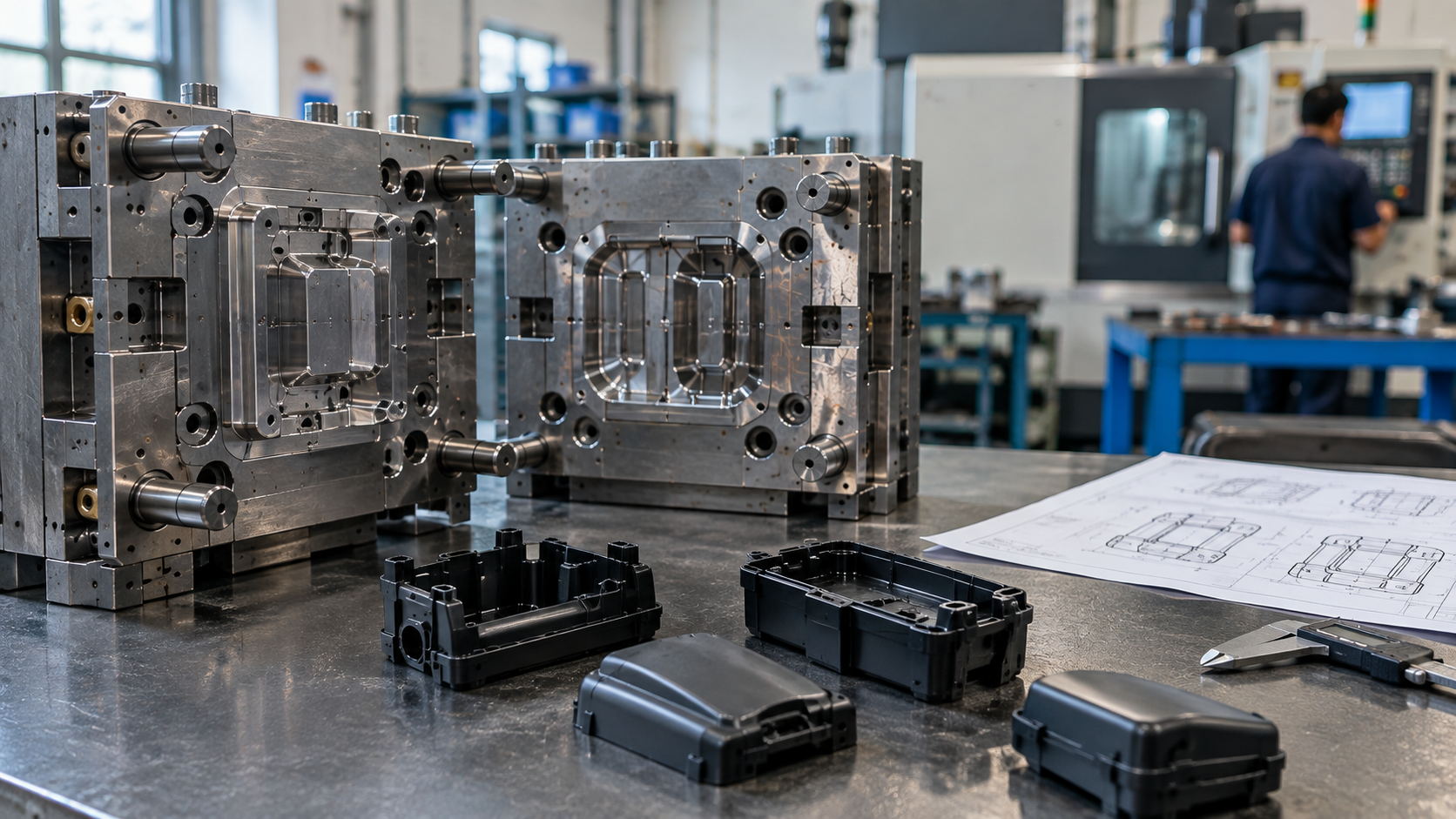
Injection molding tooling — often called the mold, the tool, or the die — is the precision-machined steel assembly that shapes molten thermoplastic into a finished part. Resin is heated until it flows, injected under high pressure into a cavity, held while it cools, and then ejected as a solid component. The tool is what turns a CAD model into millions of identical parts.
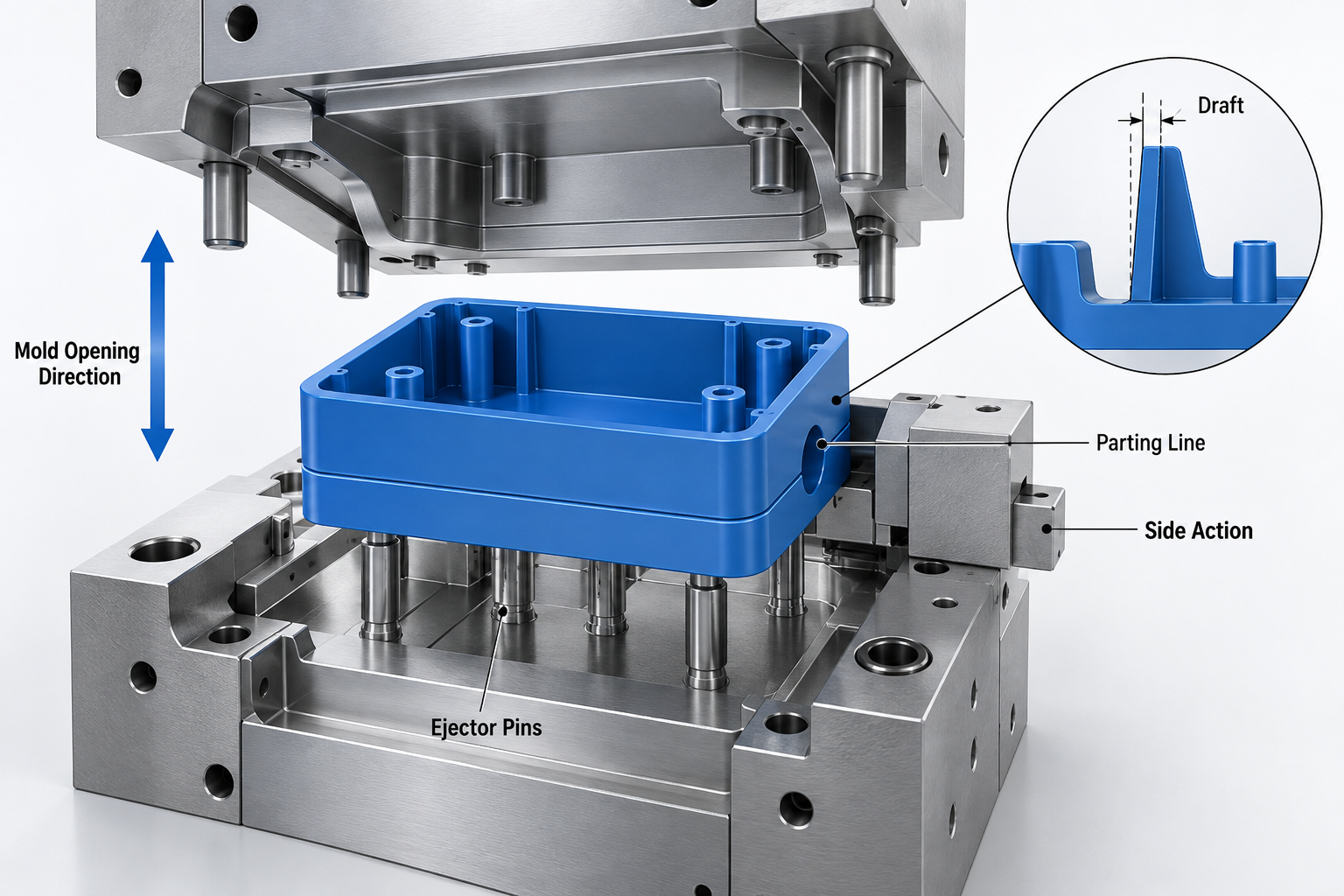
A production mold is a complete mechanical system, not simply two blocks of steel. Its core elements include:
- The cavity (which forms the external surface of the part) and the core (which forms the internal geometry).
- The feed system — sprue, runners, and gates — that delivers plastic to each cavity.
- The cooling circuit, a network of channels that controls part temperature and, critically, cycle time.
- The ejection system — pins, sleeves, or plates that release the part.
- Moving components such as slides, lifters, and unscrewing mechanisms that form undercuts and threads.
- The mold base, which houses and aligns all of the above.
Because the tool dictates dimensions, surface finish, and cycle time for the entire life of the product, it is the most consequential — and most technically demanding — element of any injection molding programme. It is engineered around one part, one production volume, and one quality target. Change any of those inputs and the tool, and its cost, change with it.
Why Tooling Cost Matters
Tooling cost matters for two reasons that pull in opposite directions, and understanding the tension between them is the key to buying well.
First, tooling is a large upfront capital outlay. For international buyers, it is often the biggest single line item in a new product launch, and it is largely non-recoverable once steel is cut. That naturally pushes teams to minimise the number.
Second — and this is where inexperienced buyers lose money — tooling cost is amortised across every part the mold produces. A more expensive, better-engineered tool frequently delivers a lower cost per part over the life of the programme through higher cavitation, faster cycles, less scrap, and longer service life. Spread across a run of several million parts, a difference of a few thousand dollars in tooling can be worth a fraction of a cent per part — while the wrong tool can cost you far more in rejects, downtime, and premature replacement.
The correct question is therefore never "what is the cheapest mold?" It is "what is the lowest total cost per part across the full life of this programme?" That reframing changes almost every decision that follows, and it is the mindset every serious OEM applies to tooling. India's competitiveness only sharpens the point: Indian tool rooms typically deliver production tooling at a meaningful discount to European and North American suppliers, which makes the total-cost calculation even more favourable for overseas buyers — provided the specification is right.
As a broad orientation for 2026, production tooling in India generally ranges from around ₹1.5 lakh to ₹40 lakh or more (roughly USD 1,800 to USD 47,000 at prevailing rates), with most commercial molds landing in the ₹3–15 lakh band. These are indicative market ranges for budgeting, subject to steel and resin price movement; an accurate figure only comes from a reviewed drawing.
Major Factors That Increase Tooling Cost
Below are the engineering variables that account for most of the price difference between two molds. Read a quotation against these and it stops being a mystery — you can see exactly what you are paying for.
Product Geometry
Geometry is the starting point for cost because it dictates how much machining, how many mechanisms, and how much finishing the tool requires. Simple, open shapes with generous draft angles and no undercuts are inexpensive to tool. Complex geometry — deep ribs, thin walls, undercuts, snap features, internal threads — requires more precision machining, more electrical discharge machining (EDM), and often additional moving components. Every feature that cannot be released by simply opening the mold adds cost and ongoing maintenance.
The single most effective cost lever is therefore applied at the design stage, long before any steel is cut.
Number of Cavities
Cavity count is the biggest driver of both tooling cost and per-part cost, and the two move in opposite directions. A single-cavity mold is cheaper to build but produces one part per cycle. A multi-cavity mold — 2, 4, 8, 16 or more cavities — costs more upfront, roughly scaling with cavity count plus the complexity of balancing the feed system across all cavities, but it dramatically lowers the cost per part at volume.
The right cavity count is a function of annual volume. For a programme running millions of parts, higher cavitation almost always wins on total cost. For low volumes, a single or low-cavity tool is the economical choice. This is a calculation to run deliberately, not a default to accept.
Mold Steel Selection
Steel is the foundation of both cost and mold life. The main trade-off:
- Pre-hardened steels (such as P20-grade) are more economical and faster to machine. They suit lower to medium volumes and non-abrasive resins.
- Hardened tool steels (such as H13 and heat-treated equivalents) and stainless grades cost more and take longer to machine, but resist wear and corrosion. They are essential for high volumes, glass-filled or abrasive materials, and corrosive resins.
The principle is to match the steel to the production volume and the resin. Over-specifying steel wastes money; under-specifying it shortens mold life, causes dimensional drift, and forces an early — and expensive — replacement.
Surface Finish
The finish on the part is a direct mirror of the finish on the tool. A standard machined finish is inexpensive. A fine polish for optical or clear parts, an A-class cosmetic finish for visible consumer surfaces, or an applied texture (grain) each add hours of skilled hand-finishing and, often, a better steel grade capable of holding that finish over the tool's life.
Specify the finish you truly need, surface by surface. A mirror polish on a hidden structural rib is pure wasted cost; the same polish on a customer-facing housing is a justified investment.
Tolerance Requirements
Tight tolerances are expensive because they demand precision machining, careful steel selection, controlled heat treatment, and rigorous inspection. A dimension held to ±0.1 mm is far cheaper to tool than one held to ±0.02 mm, particularly across multiple cavities where every cavity must hold that tolerance identically.
Apply tight tolerances only to the dimensions that are genuinely functional — mating faces, sealing surfaces, assembly-critical features. Blanket-tightening every dimension on the drawing inflates tooling cost with no engineering benefit.
Hot Runner vs Cold Runner
This is one of the clearest cost trade-offs in tooling.
A cold runner mold is cheaper to build. Plastic solidifies in the runners each cycle and is ejected with the part, producing regrind or scrap. It suits lower volumes and simpler programmes.
A hot runner mold keeps the feed system molten, delivering resin directly into each cavity with little or no runner waste. It costs significantly more upfront — the manifold, heated nozzles, and temperature controllers are precision components, often imported — but it eliminates runner scrap, shortens cycle time, and improves fill balance on multi-cavity tools.
For high-volume production, the material and cycle savings from a hot runner frequently repay the higher tooling cost many times over. For short runs, a cold runner is usually the more economical choice.
Side Actions and Lifters
Undercuts — features that would otherwise lock the part in the tool — are released using side actions (slides) and lifters. A lifter moves at an angle during ejection to clear an internal undercut; a slide retracts sideways to clear an external one. Each mechanism adds machining, moving parts, and maintenance to the tool.
They are sometimes unavoidable, but they are also frequently designed in unnecessarily. A minor change to part geometry can often eliminate an undercut entirely, removing the mechanism and its cost. This is one of the highest-value findings of a good design review.
Slides and Inserts
Beyond undercuts, larger side actions and interchangeable inserts add both capability and cost. Inserts allow a single mold base to produce variant parts, or allow a wear-prone area to be replaced without rebuilding the whole tool — a smart long-term economy, but an upfront cost. Complex slide arrangements for parts with multiple undercuts on different faces raise machining and assembly effort substantially. Each is justified in the right context and wasteful in the wrong one.
Cooling System Design
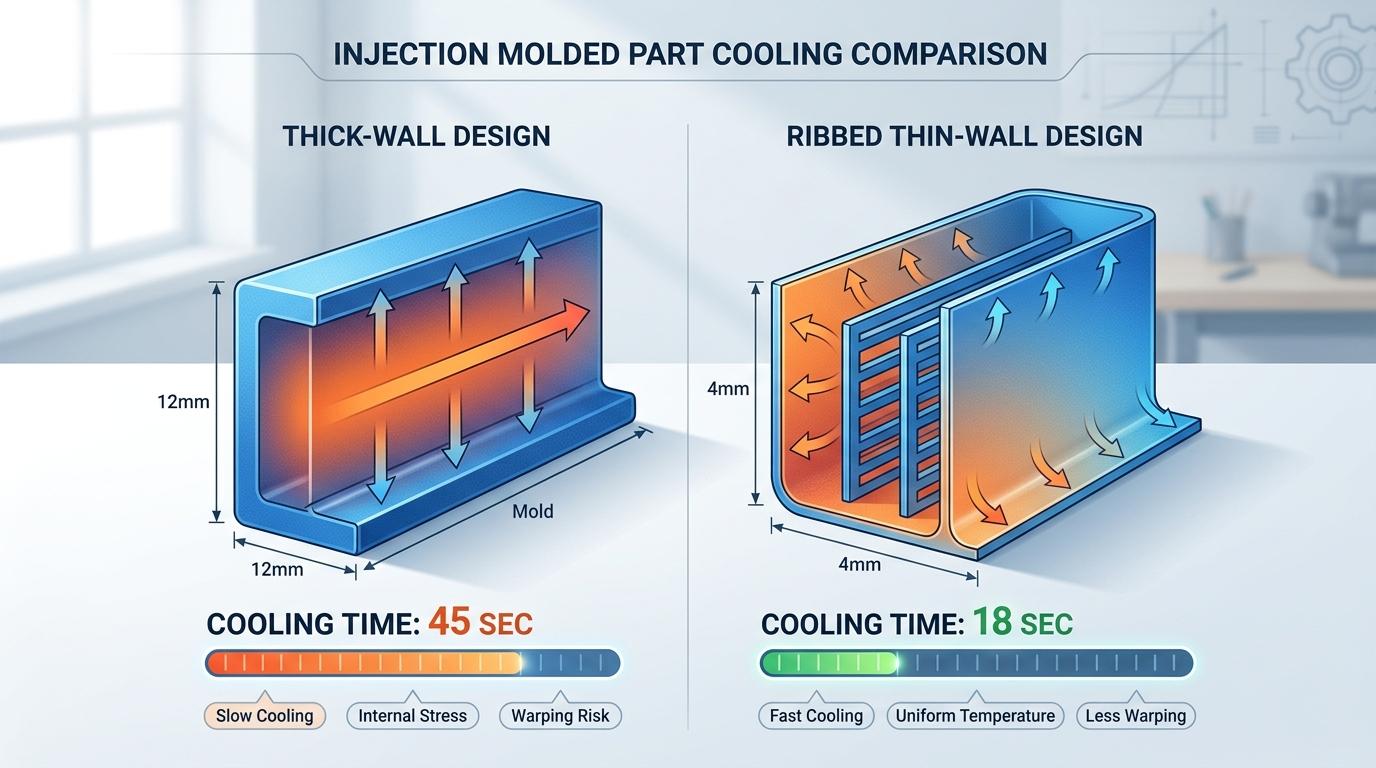
Cooling is the quiet driver of both tool cost and production economics. The cooling circuit controls how evenly and quickly the part solidifies, which determines cycle time and part quality. A well-designed circuit — including, where warranted, conformal cooling channels that follow the part geometry — costs more to engineer and machine, but shortens every cycle for the life of the tool.
Because cycle time directly sets your machine-hour cost per part, investing in cooling design often pays back faster than any other tooling upgrade. Poor cooling, by contrast, causes warpage, sink marks, and long cycles that quietly erode margin on every part.
Mold Complexity
Complexity is the sum of the factors above — cavities, mechanisms, tolerances, finish, and cooling — expressed as total design, machining, assembly, and validation effort. A simple single-cavity tool with no moving parts sits at one end; a high-cavitation, hot-runner, multi-slide, two-shot (2K) or unscrewing tool sits at the other. Complexity is where "medium" tools become "complex" tools, and it is the clearest single indicator of where a quotation will land.
Part Size
Larger parts require larger mold bases, more steel, bigger machines to run them, and longer cooling times. Cost scales with the volume of steel to be machined and hardened, and with the tonnage of the molding machine required. A large automotive panel tool sits in a different cost universe from a small connector tool, even at the same complexity level. Part size also interacts with cavitation: bigger parts mean fewer cavities per tool for a given machine size.
Automation Requirements
Tools built to run in automated cells — with features for robotic part removal, in-mold labelling, sensor integration, or automated insert loading — carry additional design and build cost. That cost is repaid through lower labour cost, higher consistency, and faster cycles at volume. For high-volume export programmes where labour and consistency drive total cost, automation-ready tooling is frequently the right investment; for low volumes it may not be.
Hidden Costs Buyers Often Miss
The quoted mold price is rarely the total cost of ownership. Experienced buyers budget for the items below; first-time buyers are often caught out by them.
- Design and DFM revisions. Changes discovered after steel is cut are far more expensive than changes caught on the drawing — reworking hardened steel can cost many times a paper-stage fix.
- Mold trials and sampling (T0, T1, T2). Initial trials, first-article approval, and iteration take machine time and material before the tool is production-ready.
- Mold flow analysis. Simulating fill, weld lines, air traps, and warpage costs a little upfront and prevents costly surprises later.
- Inspection and validation. CMM dimensional reports, first-article inspection, and process capability (Cpk) studies are essential on critical parts.
- Texturing and secondary finishing applied after the base tool is complete.
- Freight, duties, and installation. For international buyers, shipping the tool (or the parts) and fitting the tool on the press add real cost.
- Maintenance and spare components. Ejector pins, springs, seals, and hot-runner tips wear and need replacement over the tool's life.
- Storage and refurbishment between production campaigns for repeat programmes.
A quote that looks cheap often becomes expensive once these items surface. A slightly higher quote from a partner who includes DFM, mold flow, trials, and inspection frequently proves cheaper in total — and far less risky.
Common Design Mistakes That Increase Tool Cost
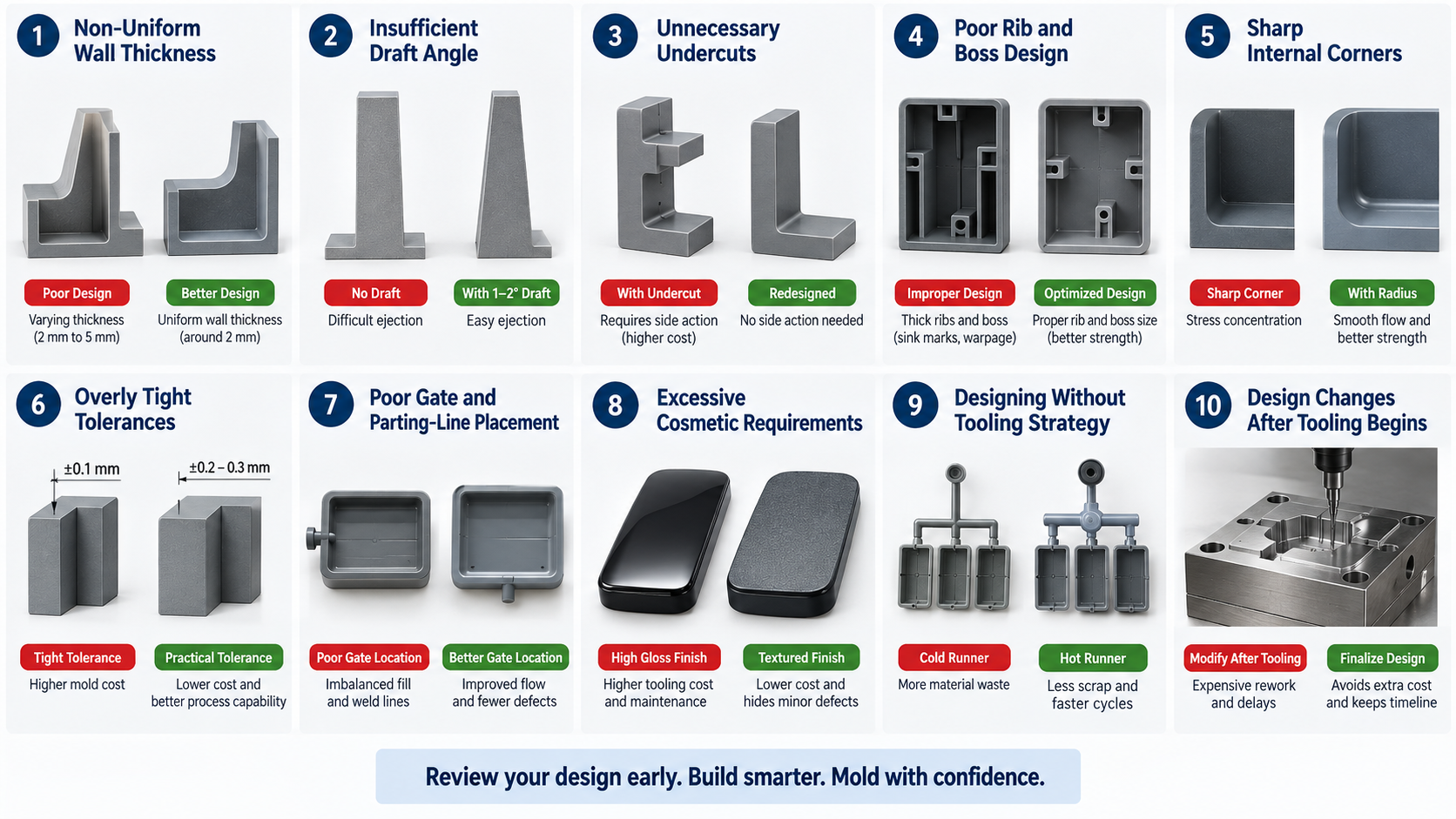
Most avoidable tooling cost is designed in, not machined in. The recurring culprits:
- Non-uniform wall thickness, which causes sink marks and warpage and forces compensating tool features.
- Insufficient or missing draft angles, which make ejection difficult and can require additional mechanisms or finishing.
- Unnecessary undercuts that force slides and lifters where a small geometry change would remove them.
- Over-tight tolerances applied globally rather than only to functional dimensions.
- Sharp internal corners that concentrate stress and complicate machining; generous radii are cheaper and stronger.
- Over-specified surface finish on non-cosmetic surfaces.
- Over-specified material grade that demands harder steel and raises both tooling and part cost.
- Ignoring the parting line and gate location early, leading to cosmetic defects that are expensive to fix after tooling.
Every one of these is cheaper to fix on the screen than in steel — which is exactly why the next two sections matter so much.
Practical Ways to Reduce Tooling Cost Without Compromising Quality
Real savings come from engineering decisions, not from cutting corners on the tool. The most effective levers:
- Invest in a DFM review before cutting steel. This is the single highest-leverage cost decision in the entire project — a paper-stage fix costs a fraction of a hardened-steel fix.
- Right-size steel and mold life to real volume. Don't buy a multi-million-shot tool for a modest programme, or a light tool for a high-volume part.
- Optimise cavity count against amortised part cost, not against the sticker price of the tool.
- Maintain uniform wall thickness. It cuts material use, shortens cycle time, and reduces scrap over the entire run.
- Apply tight tolerances and premium finishes selectively, surface by surface and dimension by dimension.
- Design out undercuts where possible, eliminating slides and lifters and their ongoing maintenance.
- Match the resin to actual requirements. Over-specifying to a higher engineering grade raises tooling and part cost together.
- Consider a family or multi-part tool where variant parts can share a mold base, spreading cost across components.
- Consolidate parts. Combining two molded components into one well-designed part can remove a whole tool and an assembly step.
Applied together, these routinely reduce tooling cost by a meaningful margin while improving part quality — the two are not in conflict.
Design for Manufacturing (DFM) Best Practices
DFM is the disciplined review of a part design for manufacturability before tooling begins, and it is where the best tooling partners earn their value. A rigorous DFM review looks at:
- Wall thickness — uniform sections to avoid sink, warpage, and long cycles.
- Draft angles — sufficient draft on all vertical faces for clean ejection.
- Radii and fillets — generous internal corners for strength and easier machining.
- Undercuts — identifying which can be designed out and which genuinely require mechanisms.
- Gate location and type — placed for balanced fill and acceptable cosmetics.
- Parting line — chosen to minimise flash and cosmetic impact.
- Rib and boss design — proportioned to avoid sink on the opposite face.
- Tolerance allocation — tight only where function demands it.
- Material and shrinkage — factored into the tool from the outset.
Pairing DFM with mold flow analysis — simulating how resin fills the cavity — lets issues such as weld lines, air traps, and warpage be resolved on screen. Finding a problem at the paper stage typically costs a fraction of finding it in hardened steel. For international buyers, a partner who runs DFM and mold flow before cutting steel is not offering a nicety; they are removing the largest source of cost and schedule risk from your programme.
When Paying More Actually Saves Money
Cheapest-upfront is frequently the most expensive choice across a product's life. A higher-cost tool is the better investment when:
- Volumes are high. A hot-runner, multi-cavity, hardened-steel tool costs more to build but collapses the per-part cost and pays for itself across the run.
- The part is dimensionally critical. Precision tooling that holds tolerance for the full production life prevents rejects, warranty issues, and line stoppages downstream.
- The resin is abrasive or corrosive. Premium steel avoids premature wear and the cost of re-tooling mid-programme.
- The finish is cosmetic and customer-facing. A tool built to hold an A-class finish protects your brand on every part.
- Uptime and cycle time matter. Well-engineered cooling and ejection run faster and more reliably, improving overall equipment effectiveness.
Framed as total cost per part, the higher-quality tool is very often the cheaper decision. The skill in tooling procurement is knowing which upgrades pay back for your specific volume and part — which is exactly the conversation a good engineering partner should have with you before quoting.
Case Study Example
The following illustrates how specification drives cost and total value. Figures are indicative.
The situation. An international consumer-appliance OEM needed a housing produced at roughly 2 million parts per year, with a visible A-class surface and several assembly-critical dimensions. Their initial enquiry, based on a single-cavity cold-runner concept, looked inexpensive on paper.
The engineering review. A DFM review flagged three issues: non-uniform wall sections that would cause sink on the cosmetic face, two undercuts that would each require a slide, and a globally tight tolerance that only two dimensions actually needed. Mold flow analysis confirmed a weld-line risk near a visible edge.
The revised approach. Wall sections were equalised and one undercut was designed out, removing a slide. Tolerances were relaxed on the non-critical dimensions. The tool was re-scoped as a 4-cavity hardened-steel mold with a hot runner and an optimised cooling circuit.
The outcome. The revised tool cost more upfront than the naive single-cavity concept, but the four cavities and hot runner cut the per-part cost sharply, the cooling design shortened the cycle, and the cosmetic defects were eliminated before steel was cut. Across the annual volume, the higher-cost tool delivered a materially lower total cost per part — and a part that met the brand's surface standard on every shot. The upfront saving of the cheaper concept would have been erased within the first production quarter by scrap and slower cycles.
The lesson. The lowest quotation and the lowest cost are rarely the same thing. Engineering the tool around volume, criticality, and finish — before cutting steel — is where the real money is made or lost.
Frequently Asked Questions
There is no single factor, but cavity count and mold complexity (steel grade, side actions, hot runner, tolerances, and cooling combined) usually move the price most. Two molds for similar parts can differ several-fold based on these choices, not on part size.
Because tooling price is driven by specification, and quotes often assume different steel grades, cavity counts, runner types, or inspection scopes. Always compare what is included — steel, cavities, DFM, mold flow, trials, and inspection — not just the headline number.
For high-volume production, usually yes: a hot runner eliminates runner scrap and shortens cycle time, and those savings typically repay the higher tooling cost several times over. For short runs, a cold runner is normally more economical.
Invest in a DFM review before cutting steel, right-size steel and mold life to your real volume, keep wall thickness uniform, apply tight tolerances and premium finishes only where needed, and design out unnecessary undercuts.
Tooling cost is the one-time capital investment in the mold. Part cost is the recurring cost of each molded piece — material, machine time, and labour. A higher-cavity tool costs more upfront but usually lowers part cost at volume, which is why the two must be evaluated together.
Mold life is designed in and measured in shots (cycles), from around a lakh shots to well over a crore, depending on steel grade, hardness, cooling, and the resin being molded. Matching mold life to production volume is essential to avoid premature replacement.
For a serious OEM programme, you should expect to own the tool you pay for, with the design and part data treated confidentially under a non-disclosure agreement. Confirm tool ownership and IP protection terms in writing before you commit — a professional partner will welcome the clarity.
India typically delivers production tooling at a meaningful discount to European and North American suppliers, with strong design and communication support. The key is choosing a partner with in-house machining, DFM capability, and documented quality systems rather than the lowest-cost job shop.
Standard tooling lead times run from several weeks to a few months depending on complexity. Compressing the schedule usually means additional shifts, prioritisation, and sometimes expedited component freight — all at a premium. Planning tooling early is one of the simplest ways to avoid paying for speed.
A 3D model and 2D drawing with critical dimensions and tolerances marked, your target annual volume and expected mold life, the molding material, and any surface finish or texture requirements. The more complete the brief, the more accurate — and comparable — the quote.
Yes. Removing an undercut can eliminate a slide; equalising wall thickness can remove cosmetic defects and shorten cycles; relaxing non-critical tolerances reduces machining and inspection. Small, well-chosen design changes frequently reduce tooling cost by a significant margin.
Why Choose FD Group
FD Group brings precision mold manufacturing and injection molding together under one group, giving international buyers a single, accountable partner from design through to production parts. Tooling is engineered and built at FIFO Industries, the group's mold manufacturing plant, while FIFO Polymers handles high-precision injection molding — so a programme moves from steel to shipped parts without the delays, hand-offs, and finger-pointing that come with outsourcing.
What that means for your project:
- More than a decade of precision mold-making experience, with over 1,200 projects delivered across India and international markets.
- In-house tooling capability — VMC machining, EDM, CNC wire cutting, grinding, and automated inspection under one roof, keeping quality and schedule under direct control.
- Comprehensive mold expertise across 2-plate, 3-plate, hot-runner, two-colour (2K), unscrewing, collapsible-core, insert, and rubber injection molds.
- DFM-first engineering. Drawings are reviewed for manufacturability before steel is cut, so issues are found at the paper stage — where they cost a fraction to fix.
- A dedicated design team working on licensed NX and VISI CAD/CAM, with mold flow analysis to validate designs before tooling.
- ISO 9001:2015 certified quality systems, with CMM dimensional inspection, process capability (Cpk) tracking, and material traceability from raw material to finished component.
- Scalable production from prototype through high-volume runs, with capacity planning aligned to your roadmap.
- A partner built for international buyers — clear engineering communication, competitive Indian tooling economics, and a track record with automotive, consumer goods, healthcare, and defence customers.
The result is tooling scoped honestly around your volume, your part, and your total cost per part — not the cheapest number on the page.
Conclusion
Injection molding tooling cost is not a mystery once you can see what drives it. Geometry, cavity count, steel selection, surface finish, tolerances, runner type, side actions, cooling design, part size, and automation together decide whether a tool costs a few thousand dollars or ten times that. The quoted price is only part of the story; DFM, mold flow, trials, inspection, freight, and maintenance make up the true cost of ownership.
The buyers who get the best outcomes are the ones who scope tooling around total cost per part, validate the design before cutting steel, and match the tool to the job. Do that, and the mold becomes exactly what it should be — an investment that pays back on every part you produce, for years.
For international OEMs and sourcing teams, the added advantage is clear: partnering with an experienced Indian tooling house combines strong engineering with competitive economics, provided you choose a partner with genuine in-house capability and documented quality systems.
Talk to Our Engineers
Get in Touch with Our Engineering Team
Planning an injection molding programme? Share your part drawing with the FD Group team for a Design for Manufacturing review and a clear, honest tooling estimate scoped to your volume and quality targets. From precision mold manufacturing at FIFO Industries to high-precision molding at FIFO Polymers, we take your project from design to production parts under one roof.
Request a Quote / DFM ReviewGet in Touch with Our Engineering Team
Talk to our engineers or request a quote at www.fdgroup.co.in to discuss your tooling requirement, prototypes, or a long-term OEM partnership.
Request a Quote / DFM Review