The runner decision is one of the few tooling choices that affects both the capital cost of the mould and the recurring cost of every part you ever produce from it. Get it right and you lower your part cost for the life of the programme. Get it wrong and you either overpay for a system you did not need or underspec a cold runner on a job that should have had a hot one.
This article covers how each system works, where each one wins, and the numbers that drive the decision. If you need a broader primer on how injection moulding works before reading on, start there.
How each system works
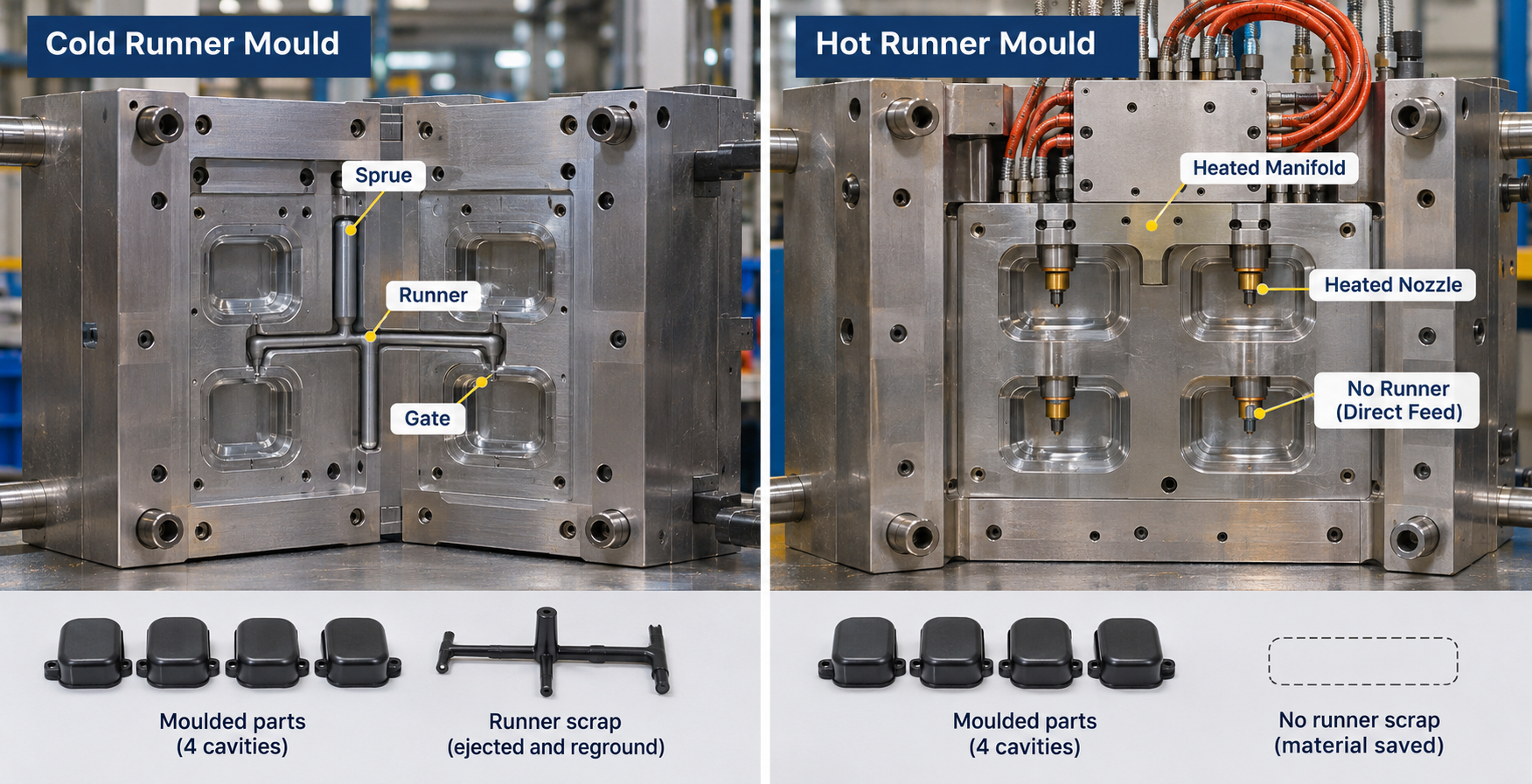
In a cold runner mould, molten plastic travels from the machine nozzle through a sprue, into a runner system cut into the parting line, and from there into each cavity through a gate. The runner cools with each cycle alongside the part, and is ejected as scrap (or reground and recycled).
In a hot runner mould, the sprue and runner channels are kept at melt temperature by a heated manifold with cartridge heaters, and plastic flows directly from the manifold through heated nozzles into each cavity. Nothing solidifies in the runner, so there is no runner to eject.
Hot runner systems from vendors such as Mold-Masters, Husky, INCOE, and Synventive dominate the market, each with their own nozzle designs, control systems, and valve-gate technologies.
The cost picture
Tooling cost
Hot runner systems add real money to the tooling bill. A typical 4-cavity hot runner adds 15% to 25% over a cold runner equivalent; an 8-cavity valve-gated system can add 30% to 40%. For a reference on how tooling costs break down overall, see our tooling cost drivers article.
The hot runner cost is made up of the manifold, the heater cartridges, thermocouples, the temperature controller, nozzles, and the control cables — plus toolmaker labour for integration, pocket machining, and testing.
Per-part material cost
This is where hot runners earn back their premium. Material savings per cycle depend on the ratio of runner mass to part mass. Typical examples:
- Small cosmetic part (5 g) with a 15 g runner system: hot runner saves 15 g per cycle, or 75% of the shot
- Mid-size automotive part (50 g) with a 20 g runner: hot runner saves 20 g per cycle, or 29% of the shot
- Large structural part (300 g) with a 40 g runner: hot runner saves 40 g per cycle, or 12% of the shot
At 1 million shots per year, saving 15 g per cycle on a material costing ₹200/kg is ₹3,000,000 per year in avoided material cost — before accounting for the energy to regrind, the quality penalty of using regrind, and the cycle time cost of handling runner scrap. That is why hot runners dominate high-volume commodity moulding.
Energy and operating cost
Hot runners draw continuous power to keep the manifold at melt temperature. Depending on manifold size, that is 3 to 15 kW continuous. Over a 24/7 operation that is non-trivial. Partly offset by the reduced regrind grinding and the shorter cycle times.
Cycle time
Hot runners reduce cycle time in three ways:
- No runner to cool — the limiting cooling time is set by the part, not the thicker runner
- Shorter nozzle contact and faster shot recovery for the next cycle
- Valve gates can control pack and hold timing per cavity, reducing the overall cycle
Typical cycle time saving: 10% to 25% versus the equivalent cold runner, with the biggest gains on thin-walled parts where the runner was dominating the cooling time.
Material and part quality considerations
Materials that like hot runners
- Thermally stable commodity resins (PP, PE, PS, ABS)
- Engineering plastics with wide processing windows (PA, PC, PBT)
- Any material where regrind is undesirable
Materials that fight hot runners
- Highly heat-sensitive polymers (PVC, POM) — risk of degradation in the heated manifold
- Materials with narrow processing windows and long residence time sensitivity
- Highly filled compounds with abrasive fillers (glass, mineral) that can erode nozzle tips
For acidic or heat-sensitive materials, specialist hot runner designs with reduced residence volume and controlled gate heating exist, but add further cost. For a reference on moulding heat-sensitive materials, see our scientific moulding guide.
Gate quality
Hot runner gates leave different cosmetic signatures than cold runners:
- Thermal gates (open hot tips) — leave a small vestige mark; adequate for most non-cosmetic surfaces
- Valve gates — leave a clean round mark, almost flush with the part surface; the standard for cosmetic parts
- Cold runners — leave a sprue or runner stub that is removed in secondary trimming, usually leaving a cleaner primary surface but adding handling
When hot runners win
- High-volume production (annual volumes above 100,000 parts in most cases)
- High cavity counts (4+ cavities) — the per-cavity hot runner cost drops with cavitation
- Cosmetic parts where valve gate marks are the only acceptable gate signature
- Thin-wall parts where runner cooling was setting the cycle time (see our thin-wall moulding guide)
- Materials where regrind use is prohibited (medical, food contact, optical)
- Parts with low tolerance for cosmetic defects and sink marks from runner-adjacent cooling
When cold runners win
- Low to moderate volume (under 100,000 parts/year typically)
- Prototype and bridge tooling
- Family moulds producing a mix of parts where valve-gate control adds complexity
- Heat-sensitive materials (PVC, POM in some grades)
- Highly abrasive compounds where hot runner nozzle wear is prohibitive
- Low-cavitation moulds (1 or 2 cavities) where runner mass is low relative to tool cost
Insulated and hybrid systems
Between the two extremes sit two intermediate approaches:
Insulated runner moulds — large-diameter cold runners where only the outer surface solidifies, leaving a molten core that acts as a flow channel. Cheaper than hot runners but with limited control and difficult start-up.
Hot sprue bushings — a heated sprue feeding a cold runner. Partial material saving at a fraction of a full hot runner cost. Common in small moulds moving from cold to warm.
Decision framework
A rough rule we use when advising on new programmes:
| Annual volume | Part type | Likely best choice |
|---|---|---|
| Under 50K | Any | Cold runner |
| 50K-200K | Non-cosmetic, standard material | Cold runner, or hot sprue bushing |
| 50K-200K | Cosmetic or thin-wall | Hot runner (thermal gate) |
| 200K-1M | Non-cosmetic | Hot runner (thermal gate) |
| 200K-1M | Cosmetic | Hot runner (valve gate) |
| Above 1M | Any | Hot runner (valve gate), high cavitation |
Volumes are indicative — material cost, cycle time, and cosmetic requirement can all shift the breakeven point.
Maintenance and lifetime considerations
Hot runner systems require specialist maintenance: heater cartridge replacement, thermocouple calibration, nozzle tip inspection, and periodic manifold cleaning. Typical maintenance intervals:
- Thermocouple check: every 6 months
- Heater resistance check: every 6 months
- Nozzle tip inspection: every 500K shots or at colour change
- Manifold clean-out: every 1-2 million shots or at material change
A moulder set up for hot runner work has the controllers, spare heaters, and maintenance protocols in place. A moulder who runs mostly cold runners may struggle to support a hot runner tool well.
Working with FD Group on runner system selection
If you are at the quotation stage for a new tool and the runner specification is still open, the decision deserves more than a default checkbox. FD Group's FIFO Industries team sizes hot runner systems from Mold-Masters, INCOE, and other major vendors, and we can run the per-part economics on both options for your specific programme. Get in touch to walk through the trade-offs for your part.