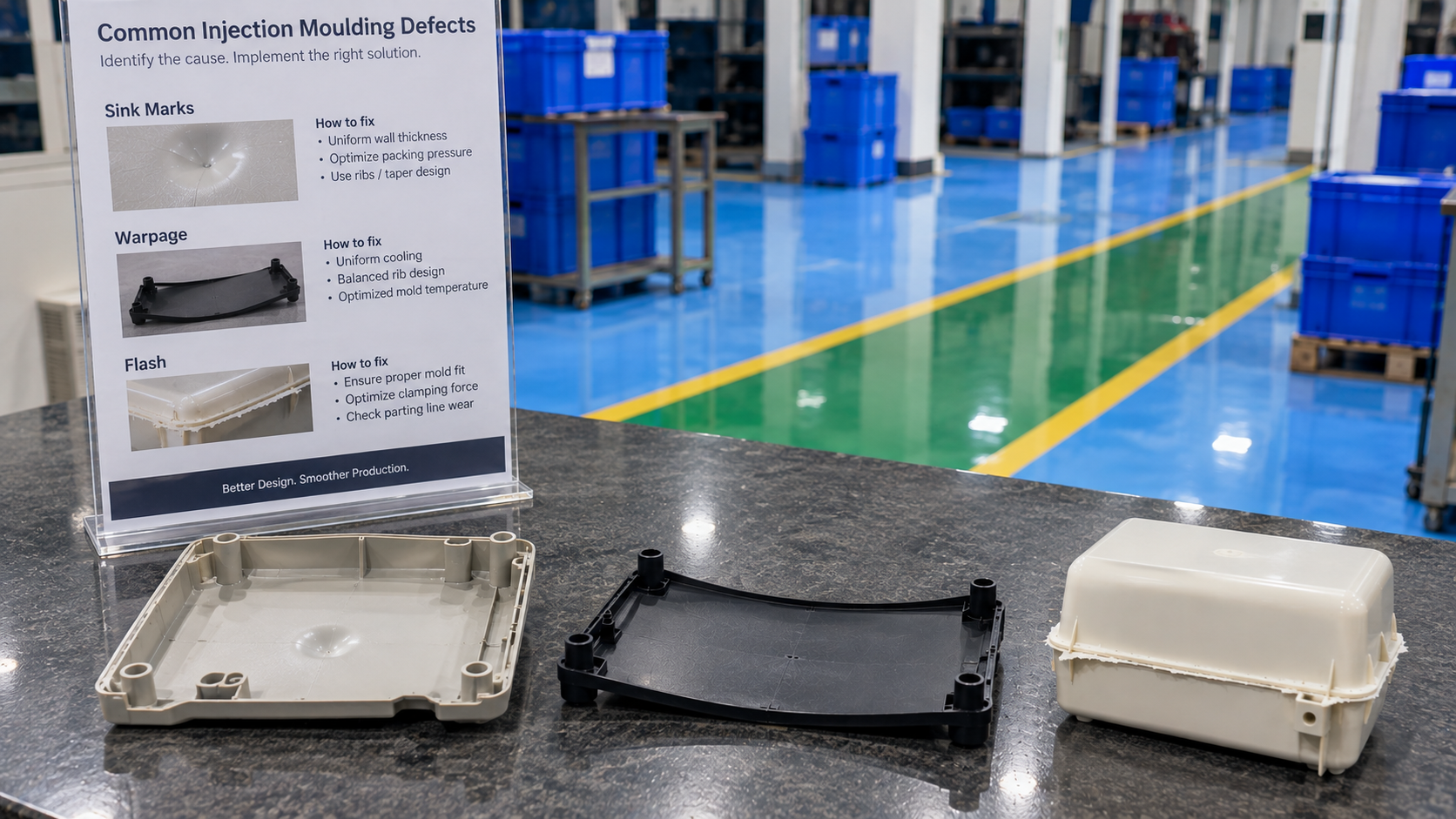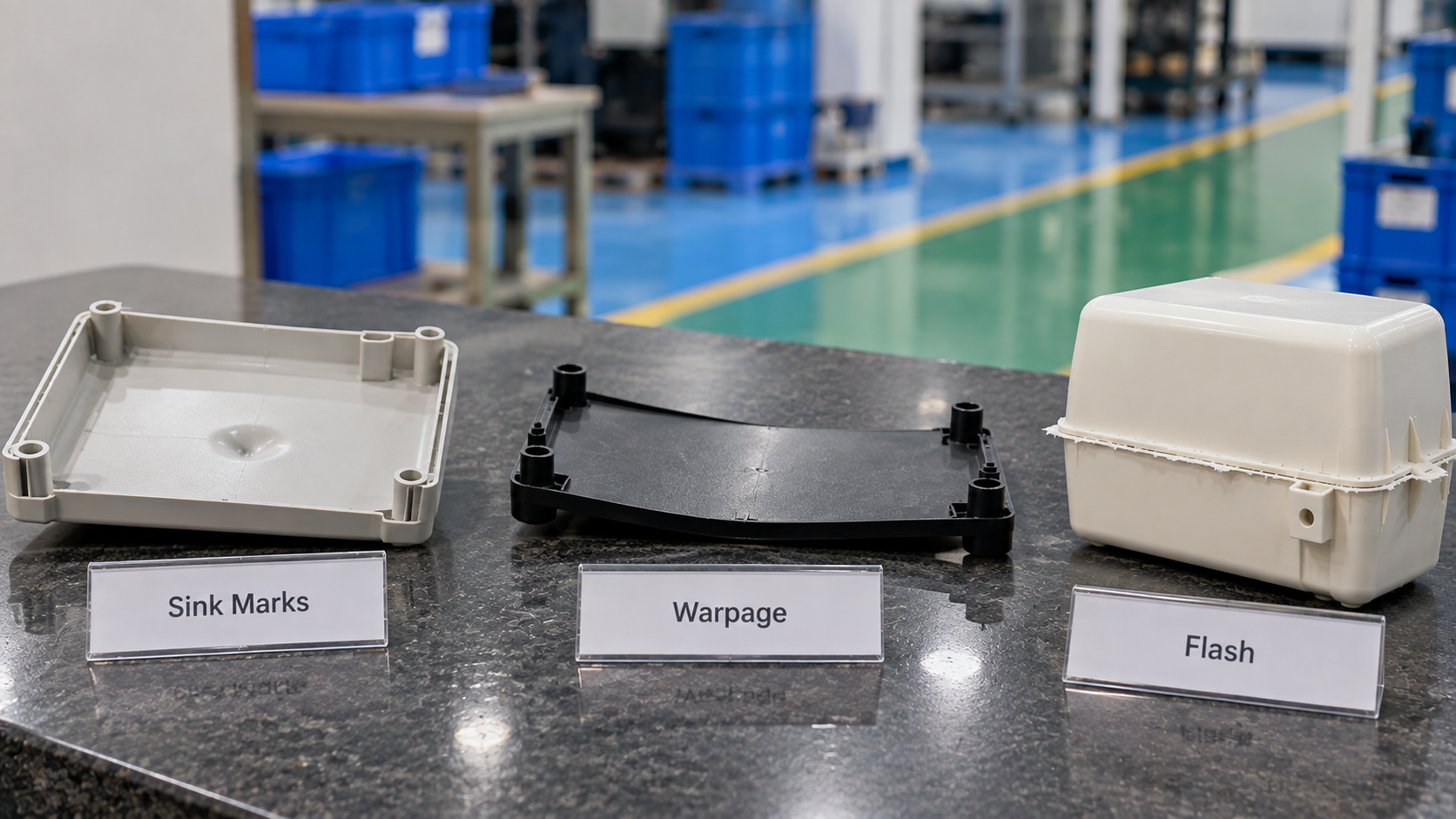
Three defects account for most injection molding rejects: sink marks, warpage, and flash. Understanding their root causes—and which fixes work—separates efficient production from endless firefighting at the press.
The critical insight: these defects usually originate in design or tooling, not just machine settings. Adjusting pressure or cooling time might reduce a defect, but if the underlying design or mold problem remains, you're masking the symptom, not solving it.
Sink Marks: The Thick-Section Problem
What they look like: Shallow depressions or dimples on the surface, usually over ribs, bosses, or thick sections. More visible on cosmetic (Class A) surfaces.
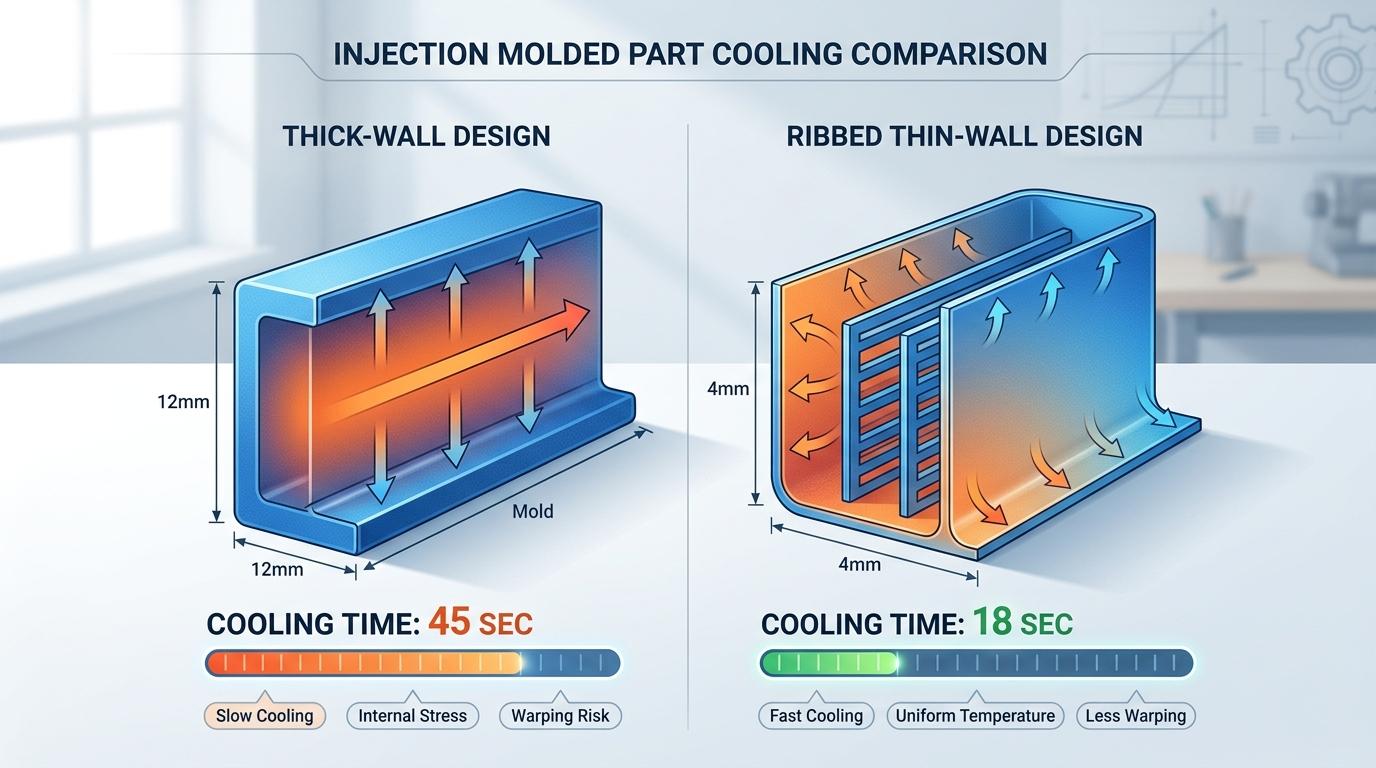
Why they occur: Thick sections cool slowly. After the gate freezes, material inside still shrinks but can't be resupplied. The surface pulls inward, creating a depression.
Design causes:
- Ribs or bosses that are too thick (>60% of wall)
- Uneven wall thickness (thick sections adjacent to thin)
- Bosses without proper taper or fillet
- Insufficient packing pressure during cooling
How to prevent (design-side):
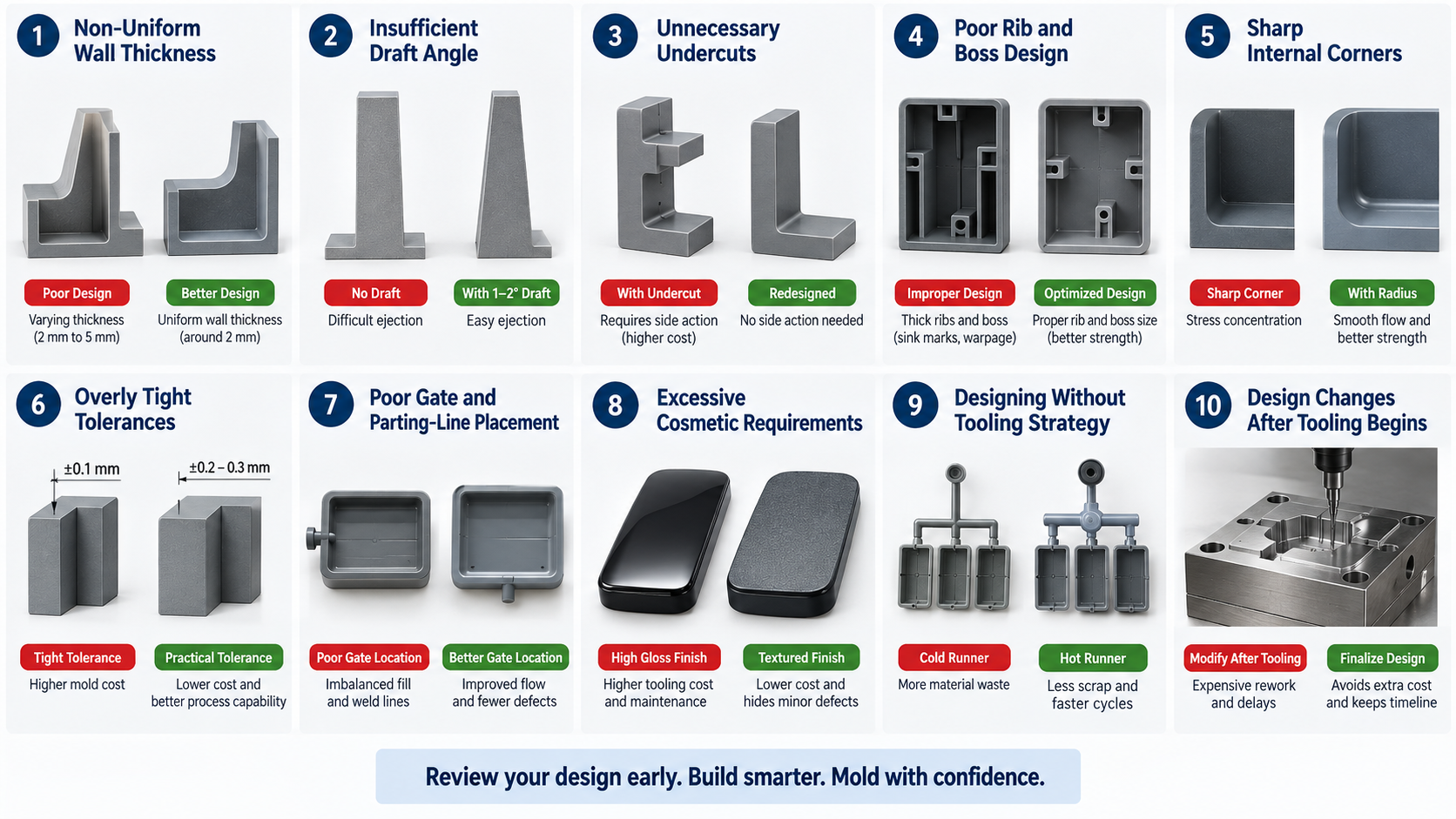
- Maintain uniform wall thickness (1.2–3.0 mm nominal)
- Use ribs instead of thick walls
- Taper bosses and use generous fillets
- Smooth transitions with blending, not sharp steps
How to manage (process-side):
- Increase packing pressure to push more material into the cavity after gate freeze
- Extend cooling time (cycle time increases, but sink reduces)
- Increase gate size to delay gate freeze-off
- Optimize mold temperature for faster, more uniform cooling
Reality check: A design with 4 mm bosses on a 2 mm wall will always have sink-mark risk. No amount of pressure adjustment eliminates it. Better to redesign.
Warpage: Differential Shrinkage Problem
What it looks like: The part bows, twists, or becomes non-square. A flat base becomes wavy. A rectangular part becomes parallelogram-shaped.
Why it occurs: Different regions of the part cool at different rates. Thin sections freeze first and shrink quickly. Thick sections cool slowly and shrink later, pulling the thin sections out of shape.
Semi-crystalline resins (PP, nylon, POM) warp more than amorphous resins (ABS, PC) because crystallization amplifies shrinkage differences.
Design causes:
- Uneven wall thickness
- Thick ribs or bosses creating local cooling differences
- Poor rib spacing or orientation
- Undercut-related stress
How to prevent (design-side):
- Maintain uniform walls and smooth transitions
- Orient ribs to distribute cooling evenly
- Avoid extreme rib-to-wall thickness ratios
- Use cross-rib patterns instead of parallel ribs where possible
How to manage (process-side):
- Slow, controlled cooling allows internal stresses to relax
- Proper mold temperature (too hot = slower cooling, risking warpage; too cold = fast cooling, risking internal stress)
- Adjust cavity pressure and hold time
- Material drying: moisture can accelerate warpage
Note: Warpage from uneven cooling is a design problem. You can reduce it at the press, but you can't eliminate it without fixing the design.
Flash: Mold-Fit and Pressure Problem
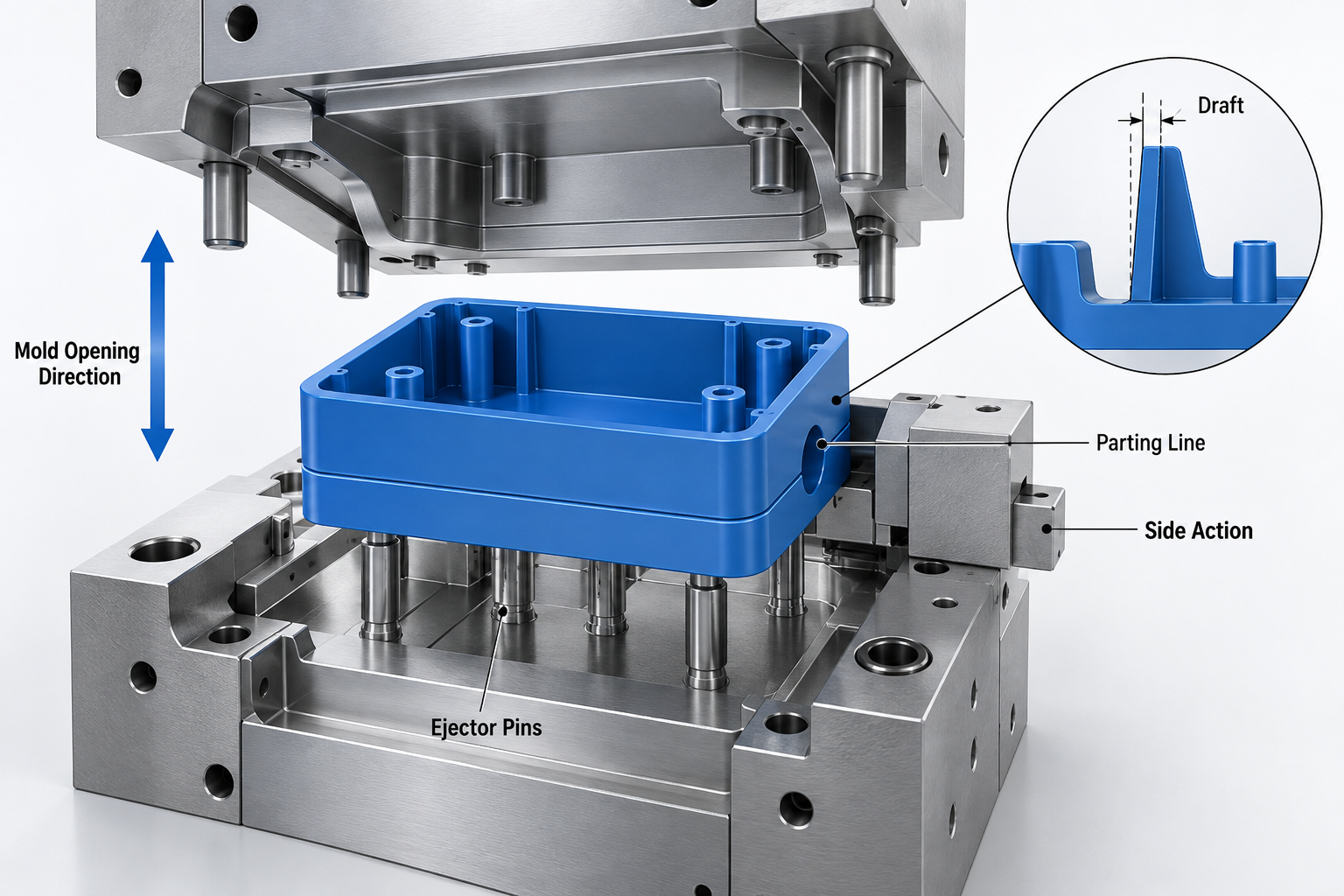
What it looks like: Thin plastic fins protruding from parting lines, ejector pin locations, or movable core positions. Usually thin and brittle.
Why it occurs: Plastic escapes between mold halves or past pins under high injection pressure. Causes include:
- Loose parting-line fit (wear, corrosion, or poor manufacturing)
- Clamping force too low for the injection pressure
- Mold halves misaligned (cavity and core not perfectly flush)
- Ejector pins backed out slightly from repeated use
- Gate positioned where pressure is highest
Design contribution:
- Thick cross-sections that require very high pressure to pack
- Complex flow paths that demand aggressive injection
- Poor gate positioning
How to prevent (design-side):
- Design for lower injection pressure (uniform walls, clear flow paths)
- Position gates to minimize pressure spikes
- Avoid features that trap air and require high pressure to vent
How to manage (mold/process-side):
- Verify mold clamp force is adequate (machine tonnage, system pressure)
- Reduce injection pressure (may require gate adjustment or mold-flow simulation)
- Verify parting-line fit and flatness (re-EDM or grind if worn)
- Check ejector pins for proper protrusion
- Increase cooling time slightly to reduce pressure-hold duration
Reality check: Flash is usually a mold-fit or process issue, not a design issue—unless your design demands extreme injection pressure. If flash persists despite proper clamping and reasonable pressure, the mold parting-line fit needs inspection.
DEFECT TROUBLESHOOTING TABLE
| Defect | Most Likely Root Cause | Design-Side Fix | Tooling Fix | Process Adjustment |
|---|---|---|---|---|
| Sink marks | Thick sections shrinking after gate freeze | Reduce boss/rib thickness; use tapers | Optimize cooling channels | Increase packing pressure; extend cooling |
| Warpage | Uneven cooling / differential shrinkage | Uniform walls; even rib spacing | Balanced cooling channels | Slow, controlled cooling; optimize mold temp |
| Flash | Low clamp force or parting-line wear | Lower injection pressure; better gates | Verify parting-line flatness; re-EDM | Reduce injection pressure; verify clamp force |
CRITICAL PRINCIPLE: Don't Mask Design Problems with Machine Settings
Here's the trap many production teams fall into: a defect appears at the press, so they adjust parameters. Pressure up, temperature up, cooling time extended—the defect improves. But cycle time increases, scrap is still above target, and the process is now brittle and sensitive.
The real issue was often in design or tooling, not the machine.
Before changing process parameters, ask:
- Does the design have uniform walls? If not, sink marks are predictable.
- Is the mold cooled evenly? If not, warpage is expected.
- Is the parting line tight? If not, flash will return.
Fixing the root cause takes longer upfront, but stabilizes production and lowers cost long-term.
FREQUENTLY ASKED QUESTIONS
A: In class-A cosmetic parts, not entirely—but they can be minimized to acceptable levels through good design and process control. Parts with uneven walls will always have some sink risk.
A: More pressure pushes extra material into the cavity, compensating for shrinkage. But it's a bandage. The underlying thickness problem remains.
A: Semi-crystalline resins (PP, nylon) have higher shrinkage variability and warp more. Amorphous resins (ABS, PC) shrink more uniformly and are easier to hold to tight dimensional tolerance.
A: Small flash at parting lines is often trimmed post-mold. Excessive flash that requires hand-removal is costly. Design and tooling should minimize it.
A: Partially. Balanced cooling channels help achieve uniform cooling. But if the part geometry forces uneven cooling (e.g., thick sections), channels can only reduce, not eliminate, warpage.
A: Faster injection can create higher pressure peaks that force plastic past parting-line seals. Slower, more controlled injection reduces flash but extends cycle time.
A: Only if it's insufficient for the injection pressure. Excessive clamp force doesn't reduce flash if parting-line wear is the root cause.
A: Moisture in nylon increases dimensions and affects cooling. Parts may warp differently depending on humidity. Material drying before molding is critical.