Featured Snippet Answer
Micro injection molding is a specialised form of plastic injection molding that produces medical components with part weights typically below one gram, feature sizes measured in microns, and tolerances often tighter than ±10 µm. In 2026 it is the enabling manufacturing technology behind microfluidic diagnostic cartridges, drug-delivery micro-components, minimally invasive surgical instruments, and implantable device sub-assemblies — with the global medical micro-injection molding market valued at approximately USD 1.70 billion in 2025 and projected to reach USD 3.30 billion by 2033.
Introduction
Ask any medical device engineer where the industry's precision limits are being redrawn today, and the conversation will land quickly on micro injection molding. A decade ago, features below 100 microns were the domain of laboratory prototypes and specialist research programs. Today, they are being produced at millions of parts per year, in ISO Class 7 and Class 8 cleanrooms, for products that ship to hospitals worldwide.
The shift reflects a broader movement in medicine: minimally invasive procedures, wearable diagnostics, cell-level analysis, and drug-delivery devices that place engineered polymer components deep inside the human body. Every one of these depends on manufacturing capabilities that did not exist in production form fifteen years ago.
This article examines what micro injection molding actually delivers in medical device manufacturing today, where its adoption is accelerating, and what OEMs need from a molding partner to compete in this space.
Industry Context
Micro injection molding sits at the intersection of three long-running medical device trends: miniaturization, disposability, and microfluidic diagnostics.
Minimally invasive surgical devices continue to displace open procedures in cardiovascular, neurovascular, and orthopaedic care. Drug-delivery platforms are moving from bulk vials to individual, self-contained dose devices. Point-of-care diagnostics are moving out of central laboratories and into pharmacies, clinics, and homes — each depending on injection-molded microfluidic cartridges that can process patient samples with laboratory-grade accuracy.
According to Data Bridge Market Research, the medical micro-injection molding market was valued at USD 1.70 billion in 2025 and is projected to reach USD 3.30 billion by 2033, growing at a CAGR of 8.66%. A separate market analysis published in early 2026 projects the broader microfluidics cartridge injection molding segment growing from USD 40 billion in 2025 to over USD 75 billion by 2030, driven by point-of-care diagnostics, single-cell analysis, organ-on-chip platforms, and next-generation sequencing automation.
Current Market Trends
Four trends are shaping micro molding adoption entering 2026.
Feature tolerances continue to tighten. Current-generation applications routinely demand tolerances below ±10 µm on structural features and better than ±100 nm on optical surfaces, particularly for intraocular lenses and diagnostic optics.
Cleanroom integration is now baseline, not a differentiator. ISO 14644-1 Class 7 environments are common for micro-molded medical components, with Class 6 laminar-flow cells becoming standard for the most sensitive applications. Machine designs from Engel, Arburg, Wittmann, and others now offer enclosed drive systems, sealed housings, and smooth external surfaces specifically engineered to reduce particulate contamination.
One-step assembly cells are replacing multi-station lines. At NPE 2024, Engel demonstrated one-step drip-chamber production combining moulding, filter insertion, and overmoulding inside a single cleanroom cell — the kind of consolidation that eliminates handling risk and reduces the validation burden.
Material selection has become highly application-specific. Cyclic olefin copolymers (COC and COP) dominate optical and microfluidic applications for their transparency and low autofluorescence. PEEK and LCP take structural roles. Medical-grade LSR handles micro-seals and soft components. Each brings its own moulding constraints — from shot volumes of 0.05 to 4 cm³ to material costs that can reach €2,000 to €5,000 per kilogram for specialty grades.
Technical Analysis: What Makes Micro Different
Micro injection molding is not merely small-scale conventional molding. The physics change.
Shot volumes are small enough to challenge standard screw geometry. Dedicated micro-molding machines use two-step screw-and-plunger designs to accurately meter shots as low as 0.05 cm³, avoiding the residence-time and thermal-degradation problems that would result from partial-shot cycles on a standard press.
Cavity venting must be micron-scale. Micro-vents below 5 µm are common, since anything larger will flash on parts where the entire feature may be only 100 µm across. This turns tooling into an exercise in surface finish and mould-alignment precision that has more in common with optical fabrication than conventional mould making.
Flow dynamics behave differently at micro scale. Melt viscosity, wall-slip behavior, and cooling rates all shift when channel dimensions drop into the tens of microns. Simulation packages such as Moldex3D and Autodesk Moldflow have added dedicated micro-molding modules over the last several years, but real-world tuning still relies heavily on process engineers with direct micro-molding experience.
Metrology is a capital-equipment discussion. A burr of a few microns can jam a microfluidic channel or defeat a downstream assembly step. In-line vision inspection, laser scanning, and confocal microscopy replace traditional gauge-based QC. These systems, integrated into the molding cell, become part of the release documentation rather than a downstream check.
Real Manufacturing Applications
Where micro injection molding is delivering commercial impact today:
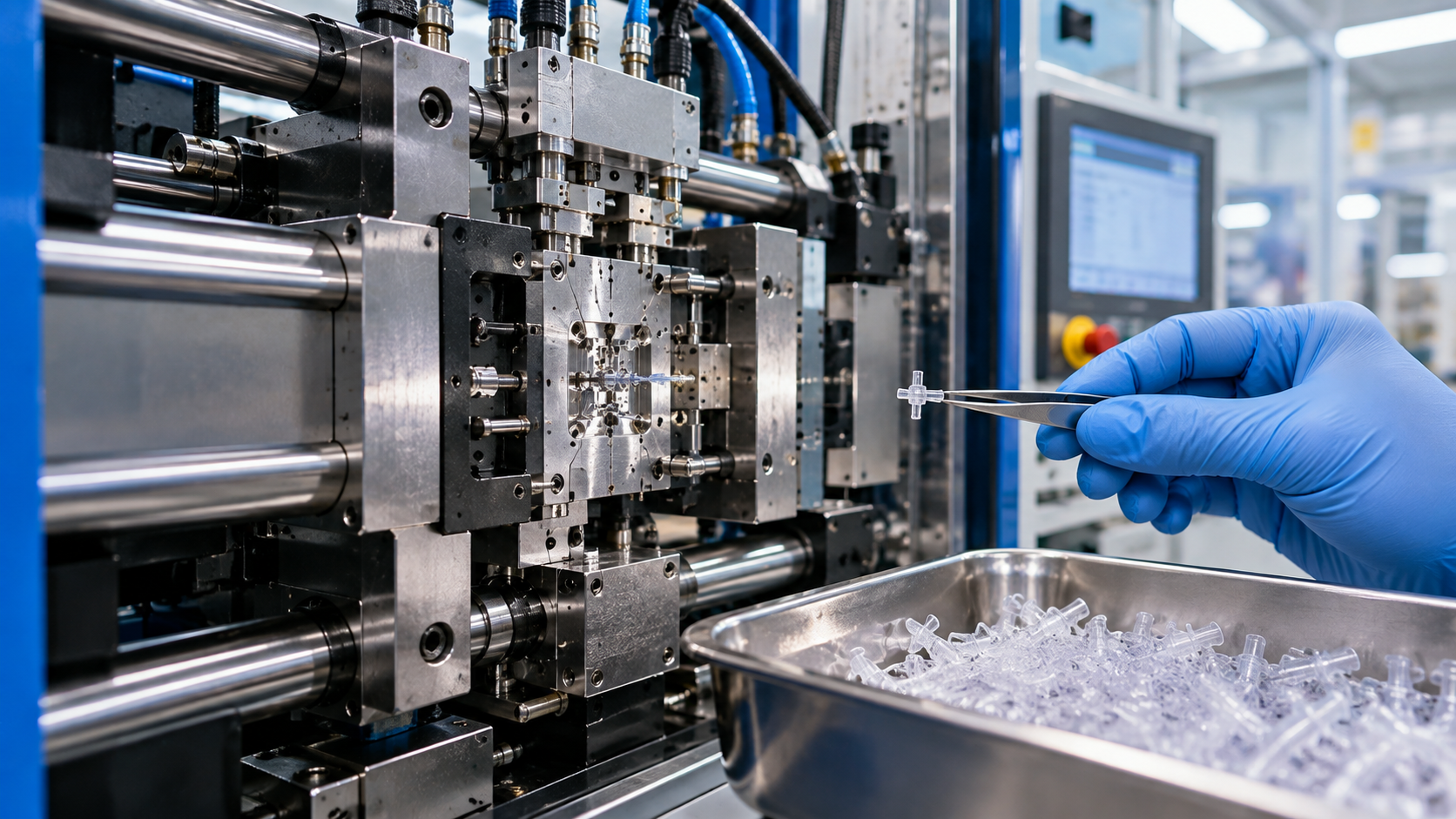
Microfluidic diagnostic cartridges for lateral-flow, molecular, and PCR-based tests, produced at millions of units per year for both centralised laboratory and point-of-care markets. A study published in September 2025 demonstrated mass fabrication of PDMS microfluidic devices through injection molding at throughput exceeding 10,000 parts per week per machine.
Intraocular lenses (IOLs) and ophthalmic delivery cartridges, where optical clarity, geometric precision, and biocompatibility must combine in parts measured in millimetres.
Neurovascular devices and minimally invasive surgical instruments, including catheter tips, stent delivery components, and biopsy device internals.
Drug delivery components such as micro-gears, valves, and lattice features for auto-injectors, insulin pumps, and inhaler dose-counters.
Implantable device sub-assemblies, including hearing aid components, neurostimulation lead connectors, and implantable sensor housings.
Wearable device internals, including micro-optics for pulse oximetry, biochemical sensor components, and micro-fluidic sample-transport paths in continuous glucose monitors.
Advantages
The commercial and clinical case for micro injection molding rests on several concrete advantages:
- Repeatability at scale: shot-to-shot dimensional stability that supports high-volume production of parts that would otherwise require secondary machining or hand assembly
- Material versatility: access to biocompatible, optically clear, and structurally engineered polymers suitable for a wide range of medical applications
- Reduced post-processing: net-shape or near-net-shape parts reduce or eliminate downstream machining, deburring, and finishing
- Regulatory documentation advantage: a well-controlled micro-molding cell generates the process data required for FDA QSR, EU MDR, and ISO 13485 compliance
- Cost efficiency at volume: despite tooling and material costs, per-part costs at production volume are significantly lower than alternative micro-manufacturing routes such as micromachining or two-photon lithography
- Waste and energy reduction: shorter cycle times and lower material use compared to standard molding can reduce operating costs by 30–50% for micro-appropriate applications, particularly important when running material at €2,000–5,000 per kilogram
Challenges
The barriers to entry remain substantial:
- Tooling cost and lead time: micro-molds require exotic tool steels, micron-precision EDM, and inspection equipment that few conventional mold shops possess
- Process validation complexity: qualifying a micro-molding process for FDA or EU MDR submission is significantly more demanding than for conventional parts
- Cleanroom capital investment: ISO Class 6 and Class 7 environments carry both upfront and ongoing cost that many general-purpose molders cannot justify
- Talent scarcity: process engineers with direct micro-molding experience are limited in supply and command premium compensation
- Metrology gap: many CROs and OEMs discover that measuring micro-features accurately is harder than moulding them, requiring investment in confocal microscopy, X-ray CT, or laser-based systems
- Regulatory scrutiny: ISO 13485 systematic review activity through 2025 and continuing EU MDR documentation demands place a rising compliance burden on medical molders
Future Outlook
Three developments will define micro injection molding through 2028.
Automation-integrated cells will become the standard. The move toward fully integrated cleanroom cells combining moulding, insertion, overmoulding, inspection, and packaging in a single validated flow is well underway. This changes the buyer conversation from "who can mould this part?" to "who can deliver a validated cell that produces this device?"
AI-assisted process control will move from research to production floor. Recent published research from German engineering institutes has demonstrated simulation-based AI models capable of optimising injection molding processes in real time, including for challenging feedstock like recycled or variable-viscosity materials. Adaptations of this approach for micro molding are already in pilot deployment.
Microfluidic complexity will increase substantially. The next generation of diagnostic cartridges, organ-on-chip devices, and single-cell analysis platforms will place multi-layer, multi-material moulding demands on suppliers. Multi-shot micro-moulding, laser-welded assemblies, and integrated optical features will move from R&D to production volume.
Expert Perspective
For medical device OEMs and product engineers evaluating micro molding partners in 2026, the practical selection criteria are increasingly convergent:
- Cleanroom certification level and scope — Class 7 minimum for most medical applications; Class 6 for critical diagnostics and optical parts.
- Micro-molding equipment fleet, not general-purpose presses down-tooled for small parts.
- In-house metrology capable of micron-scale dimensional verification, not outsourced measurement that introduces cycle-time delay.
- Regulatory documentation capability, including validated processes, DHF/DMR support, and experience with FDA and EU MDR submissions.
- Design-for-manufacturing engineering engaged at concept stage, not called in after tool design is fixed.
- Toolmaking capability — whether in-house or through a tightly integrated partner — that can produce and maintain micron-precision inserts through the life of the program.
A molder that meets three of six may deliver acceptable parts. A molder that meets all six is what a next-generation medical device platform actually requires.
Key Takeaways
- Micro injection molding is now a mainstream medical device manufacturing technology, not a specialist niche
- The medical micro-molding market is on a steady growth trajectory driven by minimally invasive procedures, point-of-care diagnostics, and drug-delivery innovation
- Tolerances below ±10 µm and cleanroom production are baseline expectations, not premium features
- Integrated moulding-inspection-assembly cells are becoming the standard fulfilment model for medical device OEMs
- AI-assisted process optimisation and automation will drive the next efficiency step through 2028
- Selecting a micro-molding partner requires evaluation across cleanroom, equipment, metrology, regulatory, DFM, and tooling capability — not price alone
Conclusion
The rise of micro injection molding in medical devices is not a technology story. It is a healthcare story: it is the reason drug-delivery pens can dose insulin to micro-liter precision, the reason diagnostic cartridges can identify pathogens in twenty minutes at a pharmacy counter, and the reason surgical devices can navigate arterial anatomy that would have required open surgery a generation ago. The manufacturing capability makes the clinical capability possible. For OEMs, the question is no longer whether micro molding belongs in the product roadmap — it is which partner is capable of delivering it at production quality, at production volume, with the regulatory documentation to support submission.
Work With FD Group
FD Group brings integrated micro injection molding, precision tooling, and cleanroom production capability to medical device OEMs developing the next generation of diagnostic, drug-delivery, and minimally invasive products. Our engineering team supports programs from DFM through validation and full-scale production.
Frequently Asked Questions
1. What defines a "micro" injection molding application?
Micro injection molding generally refers to processes producing parts weighing less than one gram, containing feature sizes in the micron range, and holding tolerances often tighter than ±10 µm. Some industry definitions also include full-size parts with micron-scale critical features.
2. Which polymers are most commonly used in medical micro injection molding?
Cyclic olefin copolymers (COC, COP) dominate optical and microfluidic applications for clarity and low autofluorescence. PEEK and LCP serve structural roles. Medical-grade LSR is used for micro-seals. Selection depends on biocompatibility, sterilization compatibility, and mechanical requirements.
3. What cleanroom class is required for medical micro injection molding?
ISO 14644-1 Class 7 is the common minimum for medical micro components, with Class 6 laminar-flow environments used for the most contamination-sensitive diagnostic and optical parts.
4. How does micro injection molding differ from conventional injection molding?
Micro injection molding uses dedicated machines with two-step screw-and-plunger dosing for very small shot volumes, requires micron-scale mould venting and tooling precision, and depends on advanced metrology such as confocal microscopy and vision systems for quality verification.
5. Can micro injection molding produce microfluidic diagnostic cartridges at scale?
Yes. Recent published research and commercial experience demonstrate throughput exceeding 10,000 parts per machine per week for microfluidic devices, with millions of units produced annually for point-of-care diagnostic products.
6. What regulatory frameworks apply to medical micro-molded components?
Products serving the US market must comply with FDA QSR (transitioning to QMSR alignment with ISO 13485). EU market participation requires MDR compliance. ISO 13485 is the underlying quality management standard for medical device manufacturing globally.
7. How much do micro-molded medical parts cost compared to alternatives?
Micro-molding tooling and cleanroom investment are substantial, but per-part cost at production volume is significantly lower than alternative micro-manufacturing methods such as micromachining, two-photon lithography, or manual assembly of laboratory-scale prototypes.