Featured Snippet Answer
Industry 4.0 in the mold shop refers to the practical integration of IoT sensors, in-mold monitoring, MES and ERP connectivity, predictive maintenance, and AI-driven process optimisation into injection molding operations. In 2026, the real applications delivering measurable ROI are in-mold pressure and temperature sensing, real-time OEE dashboards, connected auxiliaries, predictive tool maintenance, and adaptive process control for variable materials such as PCR — not the buzzword-heavy "smart factory" claims that dominated early conference cycles.
Introduction
Every mold shop has heard the pitch. Sensors on every machine, real-time dashboards on every wall, AI that predicts failures before they happen, and a "smart factory" transformation that pays for itself in eighteen months. Some of it is real. Some of it is expensive theatre. Distinguishing the two has become one of the most consequential capital decisions plant managers make.
Industry 4.0 is not a single technology. It is a family of capabilities — some mature, some emerging, some overhyped — that together move a mold shop from paper-and-instinct operation to data-driven production. Deloitte research cited across the industry indicates that 83% of manufacturers believe smart factories will transform the way products are made within five years. Belief is not implementation, but it does explain why every machine supplier now ships a digital suite alongside the press.
This article separates what is genuinely delivering value in mold shops today from what remains a slide-deck aspiration.
Industry Context
The injection molding industry sits at an unusual point in the Industry 4.0 curve. On one hand, the process itself is deeply mature — a modern injection molding press does the same fundamental job as one from the 1990s. On the other hand, the data produced by that process has quietly become one of the richest sources of manufacturing telemetry available: cavity pressure curves, temperature profiles, cycle-to-cycle variation, material usage, and defect correlation, all generated at high frequency, on every shot.
The result is that Industry 4.0 in the mold shop is less about installing new capital and more about capturing, transmitting, and acting on data the machines were already producing. As Scott Lundy of Sonoco Industrial and Specialty Plastics has framed it, the fundamentals of molding — fast cycles, fast cooling, minimum labour — have not changed. What has changed is the ability to see whether those fundamentals are being achieved in real time.
Current Market Trends
Four Industry 4.0 developments are actively reshaping mold shop operations in 2026.
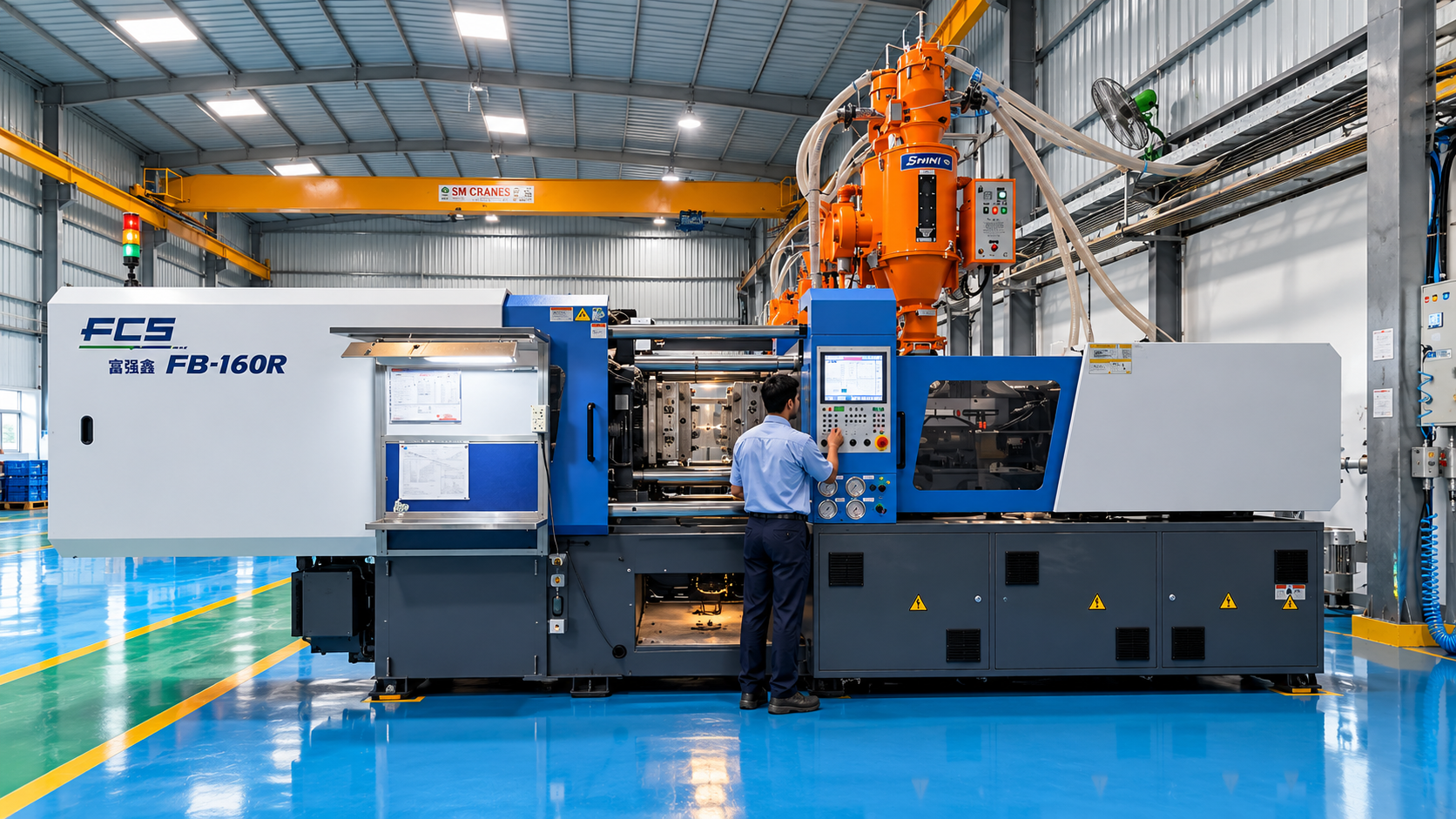
Machine-level digital suites have matured. Long-established injection machine builders including Arburg, Engel, LS Mtron, and Wittmann now ship fully integrated digital manufacturing platforms alongside their presses. Arburg's ALS (Arburg host computer system) is a purpose-built MES for plastics production. Wittmann 4.0 extends data collection beyond the press to connected auxiliaries — dryers, blenders, temperature control units — with the aim of maximising cell-level uptime rather than machine-level uptime alone.
In-mold sensing has moved from research to production. Direct cavity pressure and temperature measurement was a specialist tool five years ago. In 2026 it is a common QC and process-control mechanism, particularly for medical, automotive, and packaging applications where zero-defect production is a contractual requirement.
Predictive maintenance is delivering measurable ROI. Machine learning models trained on machine sensor data are moving from academic case studies to production deployment. Peer-reviewed research has demonstrated cognitive analytics frameworks specifically for injection molding machines, with early fault detection reducing unplanned downtime substantially.
Connectivity is finally the norm. The old challenge — OPC UA, EUROMAP 77/83 mapping between machines and MES systems — is now handled by most current-generation controllers out of the box. For older machines, retrofit gateways bridge the gap without requiring press replacement.
Technical Analysis: The Three Layers That Actually Deliver Value
According to published research summarising the practical taxonomy of Industry 4.0 in injection molding, full process control operates on three levels: machine parameters, in-mold parameters, and part quality. Effective Industry 4.0 investment addresses all three.
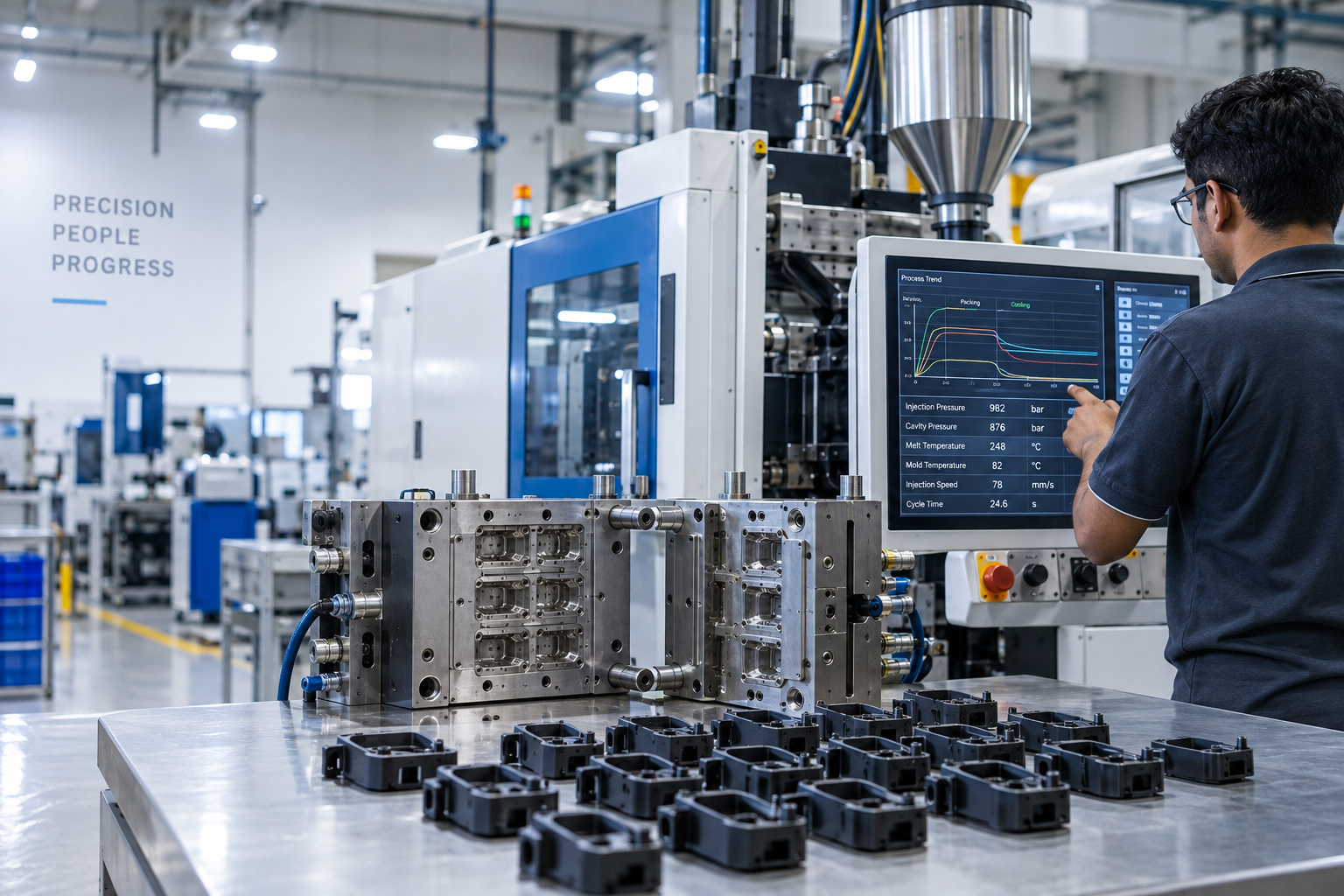
Layer 1: Machine parameter monitoring. Injection pressure, screw position, cycle time, energy consumption per cycle, and downtime causes are captured from the machine controller. This is the easiest layer to instrument and the most commonly implemented. It supports OEE calculation, shift-level performance analysis, and basic process alarms.
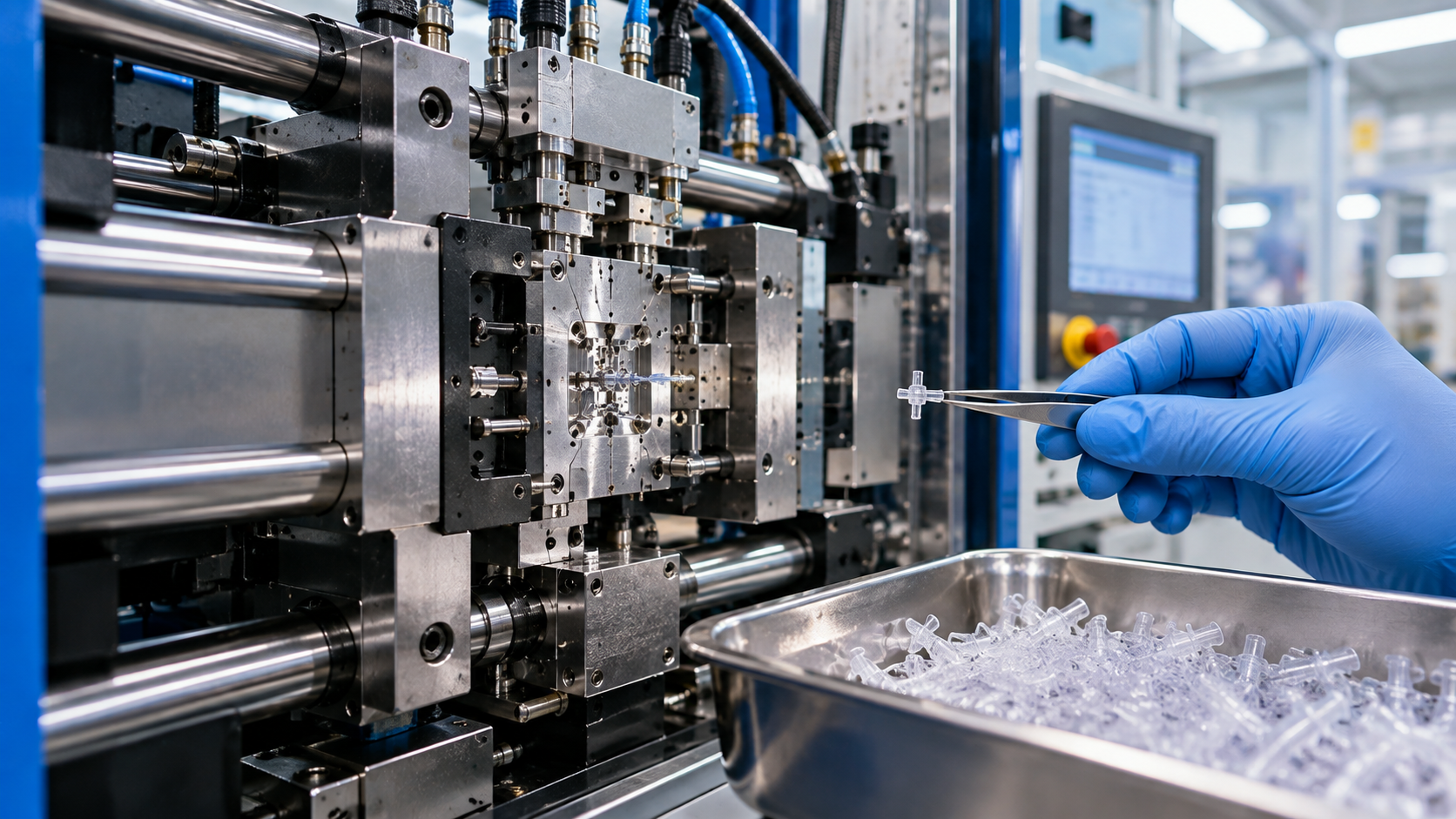
Layer 2: In-mold sensing. Cavity pressure and temperature sensors embedded in the mould itself produce the most reliable predictors of part quality. Because they measure what the polymer actually experiences — not what the machine intended — in-mold sensors detect drift, gate wear, and cooling anomalies that machine-level data alone will miss. In-mold sensing is the single highest-value investment for mold shops producing critical parts.
Layer 3: Part quality integration. Vision systems, dimensional gauging, and automated inspection stations close the loop by linking measured part characteristics back to the specific shot that produced them. Full traceability from raw material lot through processing parameters to finished-part inspection is now achievable, and is increasingly demanded by medical device and automotive OEMs.
Together, these three layers make the injection molding cell what published academic literature calls a cyber-physical system — a mold shop capable of real-time quality prediction and adaptive process control rather than post-hoc scrap sorting.
Real Manufacturing Applications
Beyond the theory, five applications are delivering measurable value in production mold shops today.
OEE dashboards that operators actually use. Real-time visibility of availability, performance, and quality across a fleet of presses — displayed on shop-floor screens accessible to the operators running the machines, not just the plant manager in the office. Simple, but decisive when embedded in daily shift routines.
Predictive tool maintenance. Monitoring cycle count, cavity pressure signature drift, and cooling performance to schedule tool cleaning, resharpening, or replacement before defects appear. This shifts maintenance from calendar-based to condition-based, cutting both unplanned downtime and unnecessary intervention.
Adaptive process control for variable materials. Recycled and biobased resins bring viscosity variability that fixed-setpoint molding cannot handle. Adaptive control systems — of which iMFLUX (used by StackTeck in Procter & Gamble PCR programmes) is one example — hold melt behaviour constant instead of holding pressure and time constant, compensating in real time for material drift.
Energy monitoring per shot. Energy accounts for a significant portion of injection molding operating cost. Per-cycle energy monitoring identifies inefficient presses, poorly optimised process settings, and heater or drive faults that would otherwise be invisible until utility bills arrived.
Digital twin process development. Simulation packages such as Moldex3D and Autodesk Moldflow, now enhanced with AI-driven optimisation tools, allow process engineers to develop and validate process windows before first-article production. Moldex3D 2025 introduced an AI Optimization Wizard that recommends parameter sets based on part geometry and material behaviour, and the 2026 release extends this with additional automation and optimisation modules.
Advantages
Where Industry 4.0 is deployed selectively rather than exhaustively, the benefits are tangible:
- Reduced scrap and rework, particularly for parts with critical dimensional or cosmetic requirements
- Higher OEE, driven by faster diagnosis of downtime causes and reduced unplanned maintenance
- Documented process traceability, essential for regulated industries and increasingly expected in automotive and industrial OEM supply chains
- Better cost visibility, tying utility, material, and labour cost to specific parts and production runs
- Faster new-program qualification, when digital twin simulation and validated process libraries reduce tryout iterations
- Ability to run challenging materials profitably, particularly PCR and biobased grades that fixed-parameter processing cannot handle economically
Challenges
The barriers are real, and the biggest ones are not technical:
- Legacy machine integration. Older machines without OPC UA or EUROMAP-compliant controllers require gateway hardware, custom mapping, or replacement — none of which is cheap
- Data overload without a strategy. Collecting data is easy; deciding what to do with it is where most Industry 4.0 investments stall
- Skills gap. Process engineers who can interpret cavity pressure curves and machine learning outputs are in short supply
- Vendor lock-in risk. Each machine builder's digital suite works best with its own equipment; multi-vendor shops face harder integration decisions
- Change management. Operators and supervisors need training, buy-in, and updated shift routines — the technology alone changes nothing
- Cybersecurity. Networked mold shops become attack surfaces. IT and OT integration must be planned with security-by-design principles
Future Outlook
Three developments will shape mold-shop Industry 4.0 through 2028.
Large language models will enter process engineering workflows. Academic and industrial research is already exploring LLM-based multi-agent frameworks for knowledge transfer, process troubleshooting, and machine monitoring. Expect production tools within eighteen months that let a process engineer ask conversational questions about a running cell and receive grounded, sensor-derived answers.
Auxiliary equipment data will close the last data gap. Dryer, chiller, and conveyor telemetry — historically stranded outside MES systems — will be integrated into cell-level dashboards, supporting true holistic OEE analysis rather than press-only calculations.
Sustainability reporting will drive data investment. Scope 1 and Scope 2 emissions reporting requirements, combined with customer requests for product-level carbon data, will make per-part energy monitoring a standard requirement, not a differentiator. Mold shops that instrument now will avoid a scramble in 2027–2028.
Expert Perspective
For plant managers and manufacturing directors planning Industry 4.0 investment in 2026, the practical guidance emerging from both industry publications and academic research is consistent:
- Start with the problem, not the technology. Every successful Industry 4.0 deployment begins with a specific pain point — scrap rate, unplanned downtime, changeover time — and works backward to the sensors and analytics needed to address it.
- Invest in in-mold sensing first. The single highest-ROI Industry 4.0 investment for most mold shops is instrumentation inside the mould itself. Machine-level data alone will miss the anomalies that drive scrap.
- Don't collect data you won't use. Every additional data stream requires storage, bandwidth, and analytical attention. Start narrow and expand.
- Plan for interoperability. Prefer machines and auxiliaries that support open standards (OPC UA, EUROMAP) over proprietary-only systems, particularly in multi-vendor shops.
- Budget for people, not just equipment. A machine learning model with no engineer to interpret its outputs is a screensaver. Talent is often the constraint, not capital.
- Roll out in one cell first. Prove the value in a single production cell before scaling across the plant. Learn from what does and does not work at small scale.
Key Takeaways
- Industry 4.0 in the mold shop is a family of capabilities, not a single technology or platform
- The highest-value applications are in-mold sensing, adaptive process control, predictive maintenance, and per-shot data traceability
- Real ROI comes from solving specific operational problems, not from generic "digital transformation" programs
- Machine builders now ship mature digital suites, but multi-vendor integration and legacy machine retrofits remain challenges
- Skills, change management, and cybersecurity are frequently the binding constraints, not technology cost
- Sustainability reporting will make per-part data capture a business requirement through 2028
Conclusion
Industry 4.0 has moved past the point where "connected factory" is a phrase that impresses anyone on its own. In 2026, the mold shops that are winning contracts, reducing scrap, and profitably running challenging materials are the ones that have quietly deployed specific, targeted digital capabilities — often in a single cell first, always tied to a real operational problem, and never at the expense of the engineering fundamentals that make good parts. The buzzwords are optional. The results are not.
Work With FD Group
FD Group operates injection molding and mold manufacturing facilities that combine engineering-led process control with practical Industry 4.0 capabilities — from in-mold sensing and adaptive control to full production traceability for regulated OEM programs.
Frequently Asked Questions
1. What is Industry 4.0 in injection molding?
Industry 4.0 in injection molding is the integration of IoT sensors, in-mold monitoring, MES/ERP connectivity, predictive maintenance, and AI-driven process optimisation into molding operations to deliver real-time visibility, quality prediction, and adaptive process control.
2. Which Industry 4.0 investment gives the highest ROI for a mold shop?
In-mold pressure and temperature sensing is generally the highest-ROI Industry 4.0 investment because it measures what the polymer actually experiences inside the mould, catching anomalies that machine-level data alone will miss.
3. Do I need to replace legacy injection molding machines to adopt Industry 4.0?
No. Retrofit gateway hardware and protocol converters can bring most legacy presses into an OPC UA or EUROMAP-compatible data environment without replacing the machine itself, though older controllers may limit the granularity of available data.
4. What is the difference between machine-level and in-mold data?
Machine-level data reflects what the press is doing (screw position, injection pressure, cycle time). In-mold data reflects what the polymer is actually experiencing inside the cavity (cavity pressure, cavity temperature). In-mold data is more predictive of part quality.
5. Can Industry 4.0 help with recycled and biobased resin processing?
Yes. Adaptive process control systems compensate in real time for the viscosity and material variability common in PCR and biobased grades, holding melt behaviour constant instead of holding fixed setpoints. This makes challenging materials economically viable.
6. How is AI being used in injection molding process control?
AI applications in injection molding include process parameter optimisation, predictive maintenance based on machine sensor data, quality prediction from in-mold telemetry, and increasingly, LLM-based tools for process troubleshooting and knowledge transfer.
7. What are OPC UA and EUROMAP in the context of Industry 4.0 molding?
OPC UA is an open, cross-vendor communication standard used to move data between industrial equipment and higher-level software. EUROMAP 77/83 are companion specifications defining how injection molding machines and MES systems exchange data. Together they enable multi-vendor mold-shop integration.