Featured Snippet Answer
Sustainable plastics that are commercially viable for injection molding in 2026 fall into three practical categories: mechanically recycled post-consumer resin (PCR) for non-critical parts, bio-based drop-in polymers like bio-PE and bio-PET that use existing tooling without process changes, and compostable resins like PLA, PHA, and PBAT for short-life packaging. High-performance engineering parts still rely largely on virgin resin because recycled and biopolymer alternatives have not yet matched the mechanical consistency, heat resistance, and regulatory acceptance required for medical, automotive, and long-life industrial applications.
Introduction
The conversation around sustainable plastics has shifted. For most of the last decade, "green materials" in injection molding meant marketing claims and pilot batches. In 2026, it means procurement mandates, PPWR compliance deadlines, and OEM contracts that specify recycled content by weight. What has not changed is the engineering reality: not every sustainable resin is ready for every application, and mistaking a marketing datasheet for a validated process specification remains one of the most expensive errors a molder can make.
This article separates what is now genuinely viable from what remains experimental, based on current market data, published research, and the practical constraints that shape mold shops and processing floors.
Industry Context
Injection molding sits at the center of the plastics circular economy debate for a simple reason: it accounts for the largest share of bioplastics processing globally. According to a December 2025 market analysis, injection molding captured 35.9% of bioplastics processing by volume in 2024, driven by its ability to produce complex geometries at scale. Meanwhile, the broader bioplastics market — valued between USD 14.2 billion and USD 18.4 billion in 2025 depending on the source — is projected to grow at a CAGR of roughly 17% to 22% through the early 2030s.
At the same time, regulation is doing what voluntary sustainability commitments could not. The EU Packaging and Packaging Waste Regulation (PPWR) entered into force on February 11, 2025, with general application from August 12, 2026, and mandates that by 2030 all packaging must be designed for recycling and contain minimum post-consumer recycled (PCR) content — 30% for PET beverage bottles, 35% for other plastic packaging, and 10% for food-contact-sensitive plastics, rising to 65%, 65%, and 25% respectively by 2040.
For molders serving European brands, these are no longer aspirational targets. They are procurement specifications with legal teeth.
Current Market Trends
Three trends define the sustainable materials landscape entering 2026.
First, PCR has become procurement-driven rather than R&D-driven. A 2024 industry survey referenced by The Madison Group found that 87% of respondents had already integrated or planned to integrate mechanically recycled resins into their production lines. This is a step change from a decade ago, when PCR was a laboratory curiosity for most industrial molders.
Second, bio-based drop-in polymers are gaining share faster than compostable ones. Bio-PE, bio-PET, and bio-PA are chemically identical to their fossil-based equivalents and process on existing equipment with no cycle-time penalty. This makes them the path of least resistance for OEMs chasing Scope 3 emissions targets without retooling.
Third, certification is replacing self-declaration. ISCC PLUS mass-balance certification, Cradle-to-Cradle, and UL environmental certifications are now common contractual requirements. In early 2025, LCY Chemical announced ISCC PLUS certification for several polymer lines including bio-based TPE and PP, enabling brand owners to source traceable sustainable feedstock through documented supply chains.
Technical Analysis: What Actually Works on the Press
The core engineering challenge with sustainable plastics is variability. Virgin resin arrives with a tightly controlled melt flow index (MFI), predictable viscosity, and consistent additive loadings. Recycled and biobased materials frequently do not.
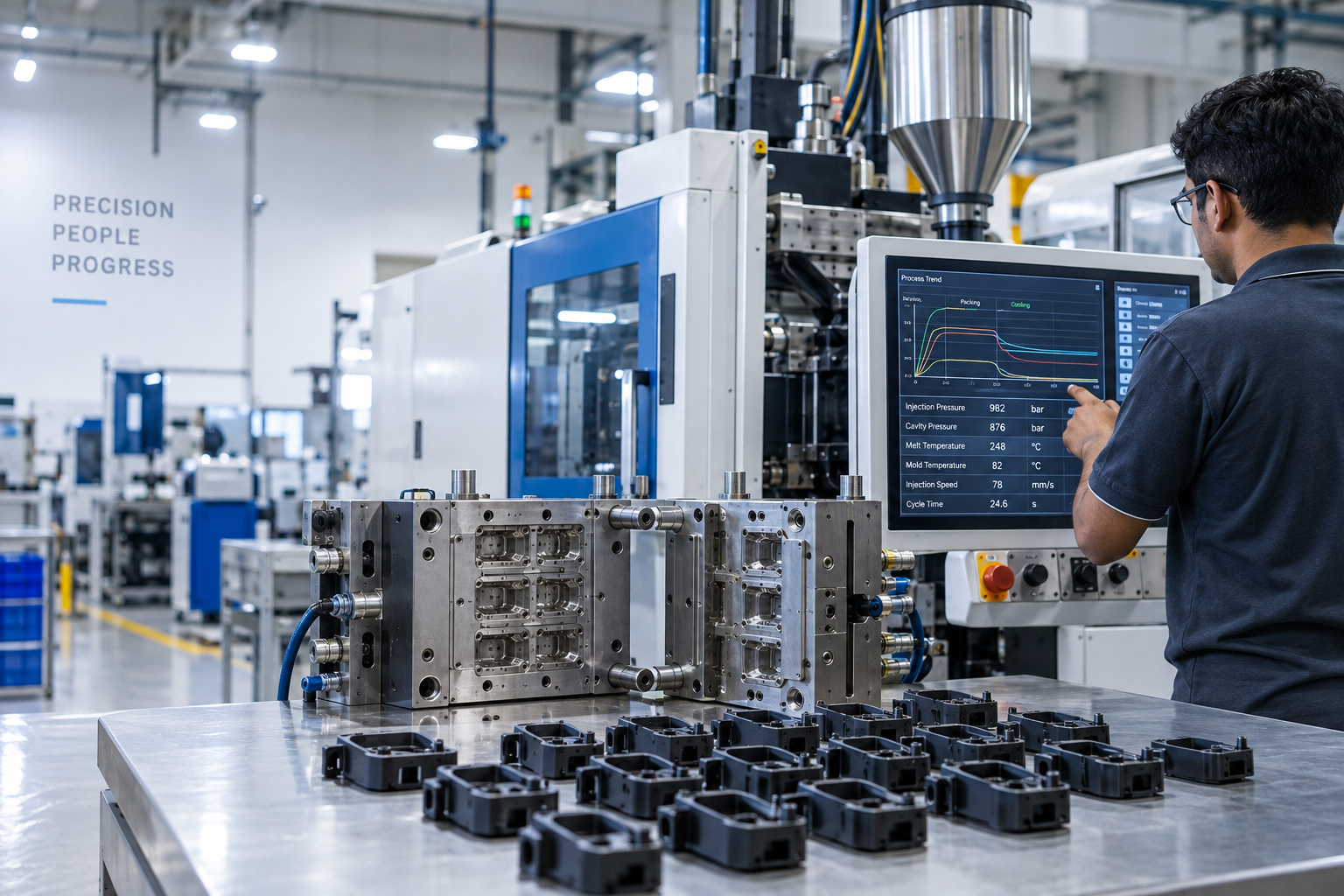
PCR variability is the dominant processing challenge. According to StackTeck, MFI in a single batch of PCR can range from 30 to 70 — a spread that makes traditional pressure-and-time process control unreliable. Adaptive process technologies such as iMFLUX have emerged specifically to address this: rather than holding pressure and time constant, they hold melt behavior constant and let the machine compensate for viscosity swings in real time.
Thermal degradation compounds the problem. PCR has already gone through at least one heat history, and further melt cycles trigger chain scission that reduces molecular weight and mechanical performance. Stress-crack resistance in PCR-HDPE, in particular, is significantly lower than in virgin HDPE, which limits its use in pressurized or load-bearing parts.
Contamination is invisible until it isn't. Polypropylene contamination in recycled HDPE streams — often at low single-digit percentages — can render the material brittle. Legacy fillers such as calcium carbonate from the original packaging can further compromise properties.
For biopolymers, the constraints are different but no less real. PLA has excellent stiffness and clarity but softens above 60°C, ruling it out for anything that sees a car dashboard, a dishwasher, or a sterilization cycle. PHA offers better heat performance and marine biodegradability but remains expensive and supply-constrained. PBAT is often blended with PLA to add flexibility. Bio-PA (partially bio-based nylon) has proven viable for automotive under-hood applications where a fossil equivalent would otherwise be specified.
Real Manufacturing Applications
Where are these materials actually being used in production today?
Consumer packaging is the dominant application, and the one being reshaped fastest by regulation. Rigid HDPE and PP bottles are increasingly molded with 25% to 50% PCR content. Essentra Components reports LDPE component ranges — caps, plugs, protectors — running at 98% recycled content with 2% colorant.
Automotive interiors have adopted bio-filled polyolefins for non-structural trim. Avient's Maxxam BIO polyolefin range, launched for interior components with up to 40% natural cellulose filler, reduces part weight and embedded carbon without changing the moulding process.
Consumer electronics housings increasingly use bio-based PA and high-heat PLA blends where cosmetic and structural requirements allow, though mold cooling times can extend by roughly 25% for some biopolymer grades.
Medical device housings — as distinct from patient-contact components — are beginning to accept certified bio-content resins, but implants, fluid-path components, and sterilizable single-use devices remain almost exclusively virgin, medical-grade material, driven by ISO 10993 biocompatibility requirements and regulatory traceability.
Advantages
The engineering and commercial case for sustainable plastics, where they genuinely fit, is now substantive:
- Regulatory compliance ahead of enforcement, particularly for products bound for the EU market post-2030
- Scope 3 emissions reduction measurable through ISCC PLUS or comparable mass-balance frameworks
- Brand-owner procurement preference, with major FMCG buyers publishing binding recycled-content targets in supplier RFPs
- Feedstock diversification that reduces exposure to crude-oil price volatility, particularly for bio-PE and bio-PA
- Design-for-recycling benefits that reduce end-of-life disposal cost and support extended producer responsibility (EPR) fee eco-modulation
Challenges
The barriers are equally real:
- Cost parity remains elusive. High-quality food-contact PCR frequently costs the same as or more than virgin material once collection, sorting, decontamination, and traceability are factored in.
- Batch-to-batch variability forces qualification of representative lots rather than one-off trials, and often demands adaptive process control.
- Cycle-time penalties of up to 25% for some biopolymer grades cut into press throughput and unit economics.
- Limited high-heat and high-strength options rule out most current biopolymers from engineering applications above 100°C.
- Regulatory fragmentation — EU, US state-level, and Asian frameworks differ significantly, complicating global product platforms.
- Colour and cosmetics are constrained for uncoloured PCR, which arrives grey and requires higher pigment loading to achieve dark or bright finishes.
Future Outlook
Three developments will shape sustainable materials in injection molding through 2028.
Chemical (advanced) recycling is scaling. Unlike mechanical recycling, chemical recycling depolymerizes waste streams back to monomer, allowing "virgin-quality" recycled resin suitable for food-contact and medical applications. Capacity is being commissioned across Europe and Asia, and mass-balance accounting is likely to become the dominant certification model.
PHA is transitioning from novelty to commodity in narrow applications. Announced capacity expansions in Asia targeting agricultural mulch film and marine-degradable packaging suggest PHA will move from a boutique material to a viable option for specific segments — though not, in the near term, for engineered structural parts.
Design-for-recycling will drive tooling decisions. As the PPWR recyclability grading system takes effect from 2030, mold designers will be increasingly asked to eliminate multi-material assemblies, in-mould labels that impede sorting, and dark pigments that defeat NIR sorting equipment. This is a mold-shop conversation, not just a materials one.
Expert Perspective
For manufacturing directors and product engineers evaluating sustainable materials today, the practical guidance from the current body of processing research is consistent:
- Qualify by lot, not by grade. Request property data from at least six to nine representative lots before locking in a PCR or biopolymer for production.
- Design your process window around variability. Characterise viscosity-shear behaviour across multiple lots and set your safety factor accordingly.
- Match material to service environment. PLA in a car interior fails; bio-PE in a shampoo bottle succeeds. Chemistry, not marketing, decides.
- Treat certification as a supply-chain audit, not a checkbox. ISCC PLUS traceability protects you when a customer, regulator, or NGO asks how you know the recycled content is real.
- Involve tooling and processing engineers early. Sustainable material decisions made in procurement without mold-shop input frequently unwind at first-article inspection.
Key Takeaways
- Sustainable plastics are commercially viable in injection molding today, but only when material, application, and process are matched with engineering discipline.
- The EU PPWR turns recycled-content targets into legal requirements from 2030, reshaping procurement globally.
- PCR is the highest-volume opportunity, but variability requires adaptive process control and rigorous lot qualification.
- Drop-in bio-based polymers offer the lowest-friction path to lower-carbon parts.
- Compostable biopolymers remain limited to short-life, low-heat, non-load-bearing applications.
- High-performance engineered parts continue to require virgin resin until chemical recycling and next-generation biopolymers close the performance gap.
Conclusion
Sustainable plastics have moved past the pilot-project stage in injection molding, but "viable" is now a function of application, service environment, regulatory context, and processing capability — not a blanket claim. The molders and OEMs that will thrive through the 2030 regulatory horizon are those investing now in material qualification protocols, adaptive process technology, and design-for-recycling capability. The rest will discover, expensively, that a compliance deadline is a poor time to start engineering.
Work With FD Group
FD Group brings decades of injection molding, precision tooling, and mold manufacturing expertise to the sustainable materials transition. Whether you are qualifying PCR grades for a packaging platform, designing a mould for a bio-based automotive component, or building a compliance roadmap for EU market access, our engineering team helps you move from marketing claims to production-ready parts.
Frequently Asked Questions
1. What is the most widely used sustainable plastic in injection molding today?
Post-consumer recycled (PCR) polyolefins — HDPE and PP — are the most widely used sustainable plastics in injection molding, driven by packaging applications and mandatory recycled-content targets in the EU and several US states.
2. Can bioplastics be run on standard injection molding equipment?
Drop-in bio-based polymers such as bio-PE and bio-PET can be processed on standard equipment with minimal changes. Compostable biopolymers such as PLA and PHA typically require adjusted temperature profiles, longer cooling times, and careful moisture control, but do not require dedicated machines.
3. How does PCR affect part performance compared to virgin resin?
PCR typically shows lower stress-crack resistance, reduced impact strength, greater viscosity variability, and inconsistent colour compared to virgin resin. Performance can be maintained for many applications through blending with virgin material, additive packages, and adaptive process control.
4. What does the EU PPWR require for recycled content in plastic packaging?
Under the EU PPWR, by 2030 plastic packaging must contain minimum PCR content of 30% for PET beverage bottles, 35% for other plastic packaging, and 10% for food-contact-sensitive plastics. These thresholds rise to 65%, 65%, and 25% respectively by 2040.
5. Are sustainable plastics suitable for medical device injection molding?
Sustainable plastics are used in medical device housings, secondary packaging, and non-patient-contact components, but implants, fluid-path parts, and sterilizable single-use devices remain almost exclusively virgin medical-grade resin due to ISO 10993 biocompatibility and regulatory traceability requirements.
6. What is the difference between bio-based and biodegradable plastics?
Bio-based plastics are made wholly or partly from renewable feedstock but may not degrade in the environment. Biodegradable plastics break down through microbial action under defined conditions. A plastic can be one, both, or neither — bio-PE is bio-based but not biodegradable, while PBAT is biodegradable but not bio-based.
7. Is chemical recycling better than mechanical recycling for injection molding feedstock?
Chemical recycling produces higher-purity feedstock suitable for food-contact and medical applications and does not suffer the property degradation of mechanically recycled resin. It currently has smaller commercial capacity and higher cost than mechanical recycling, but capacity is expanding rapidly through 2027.