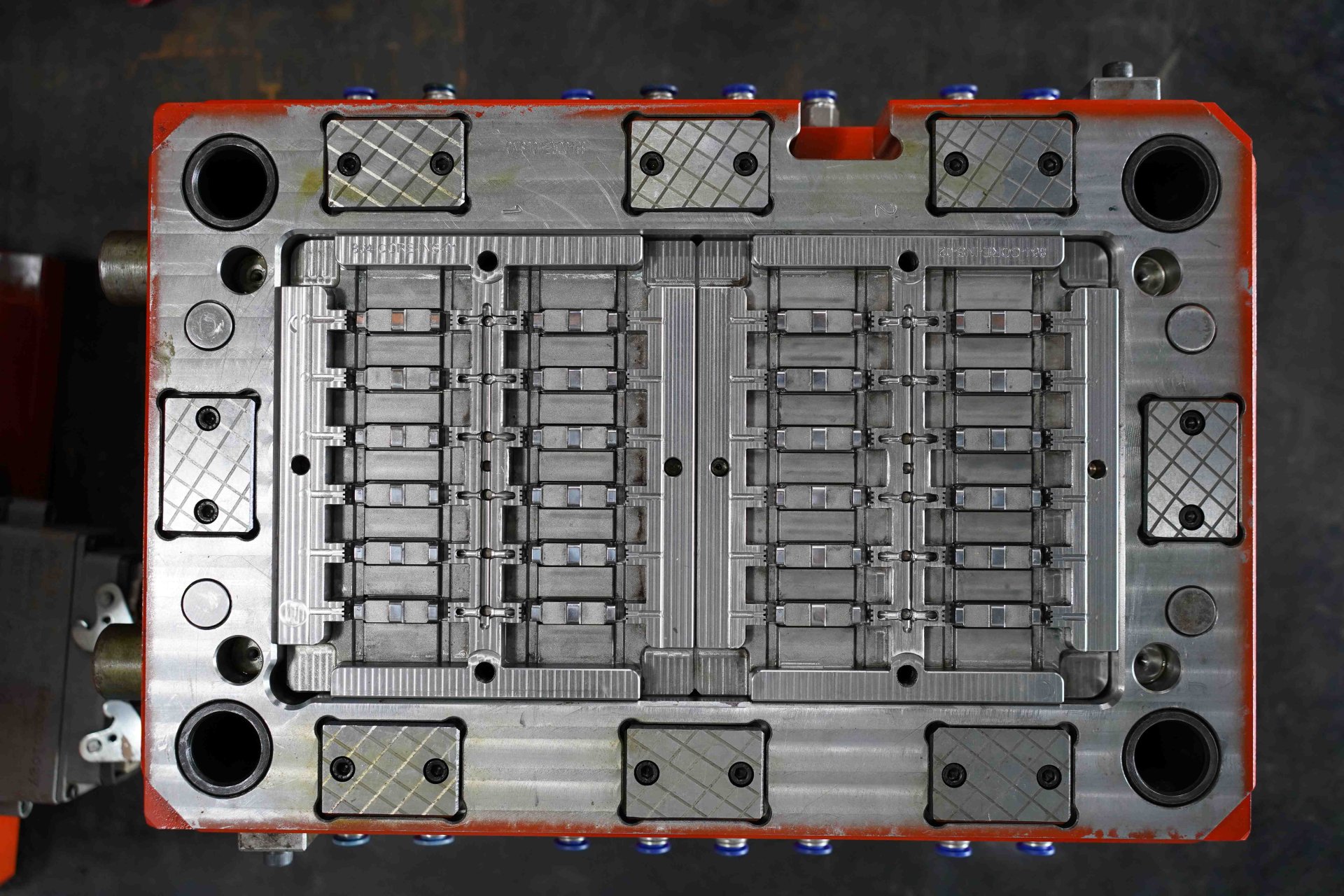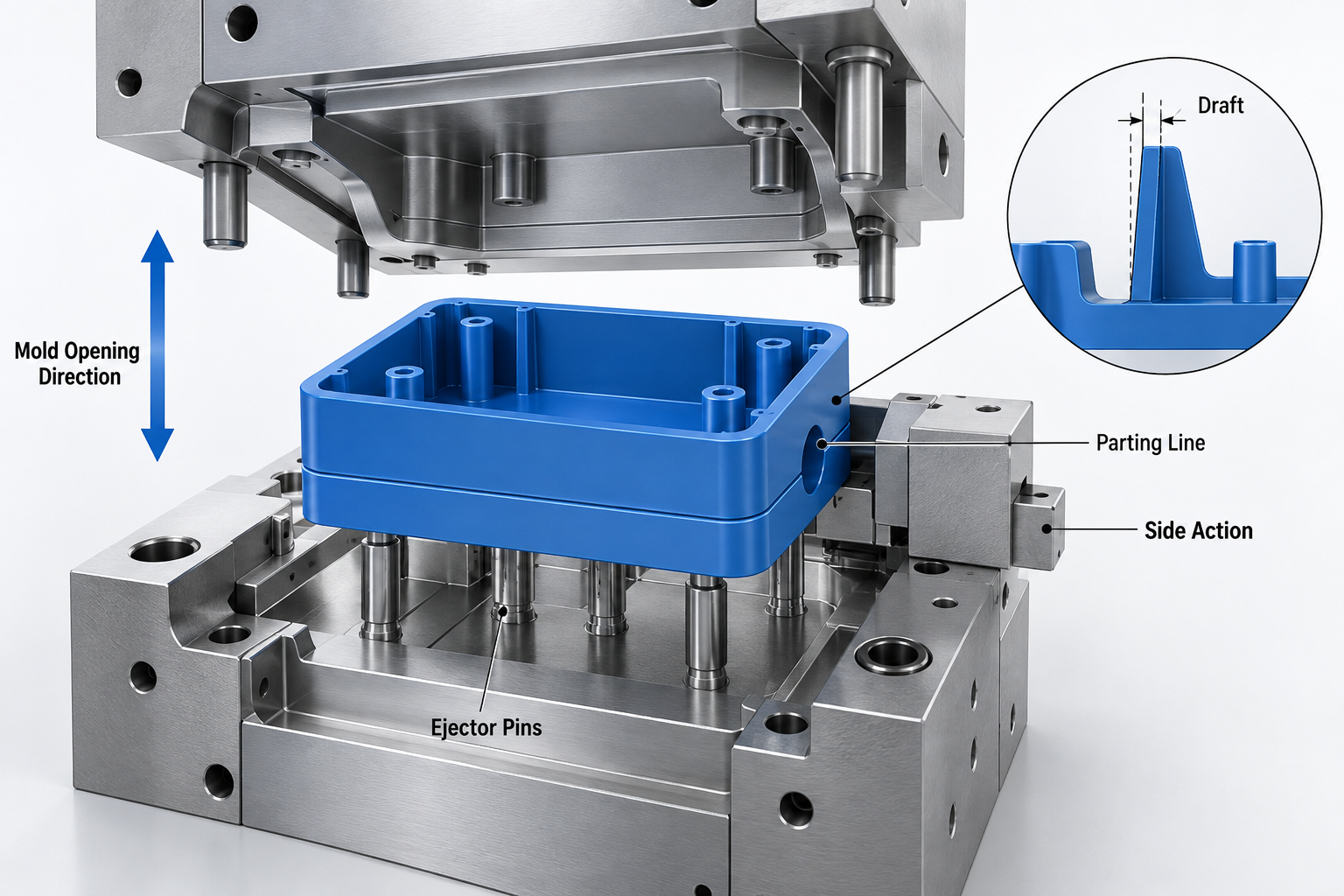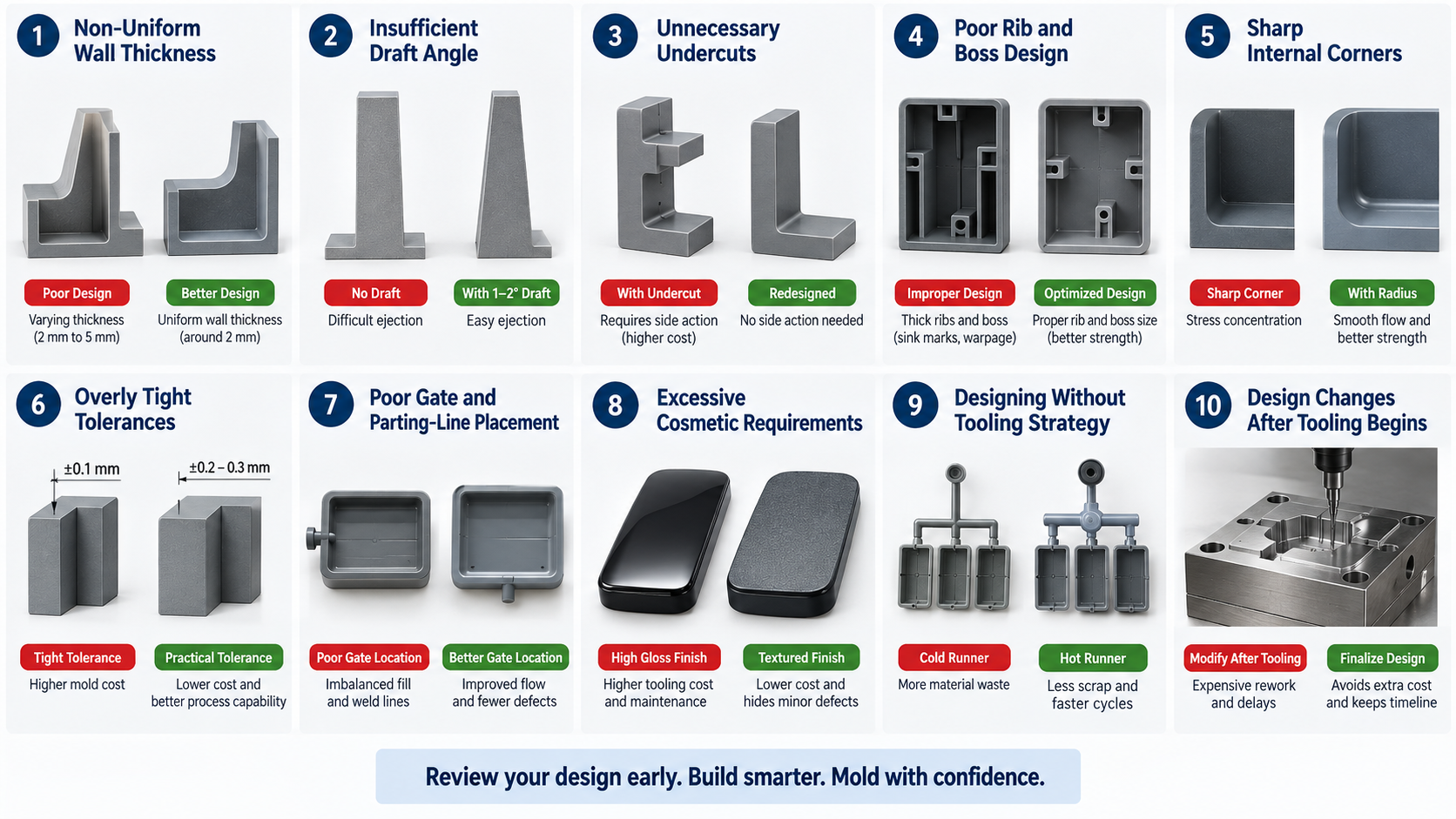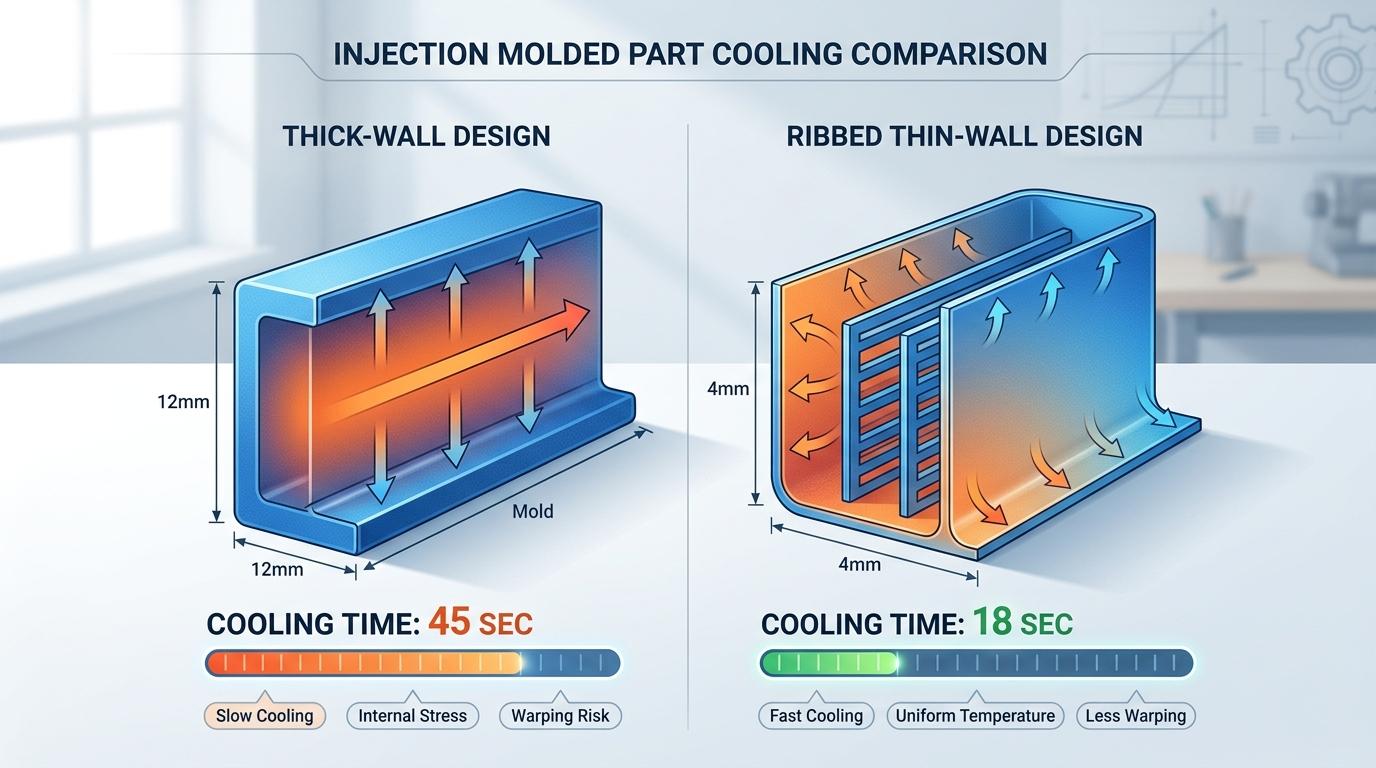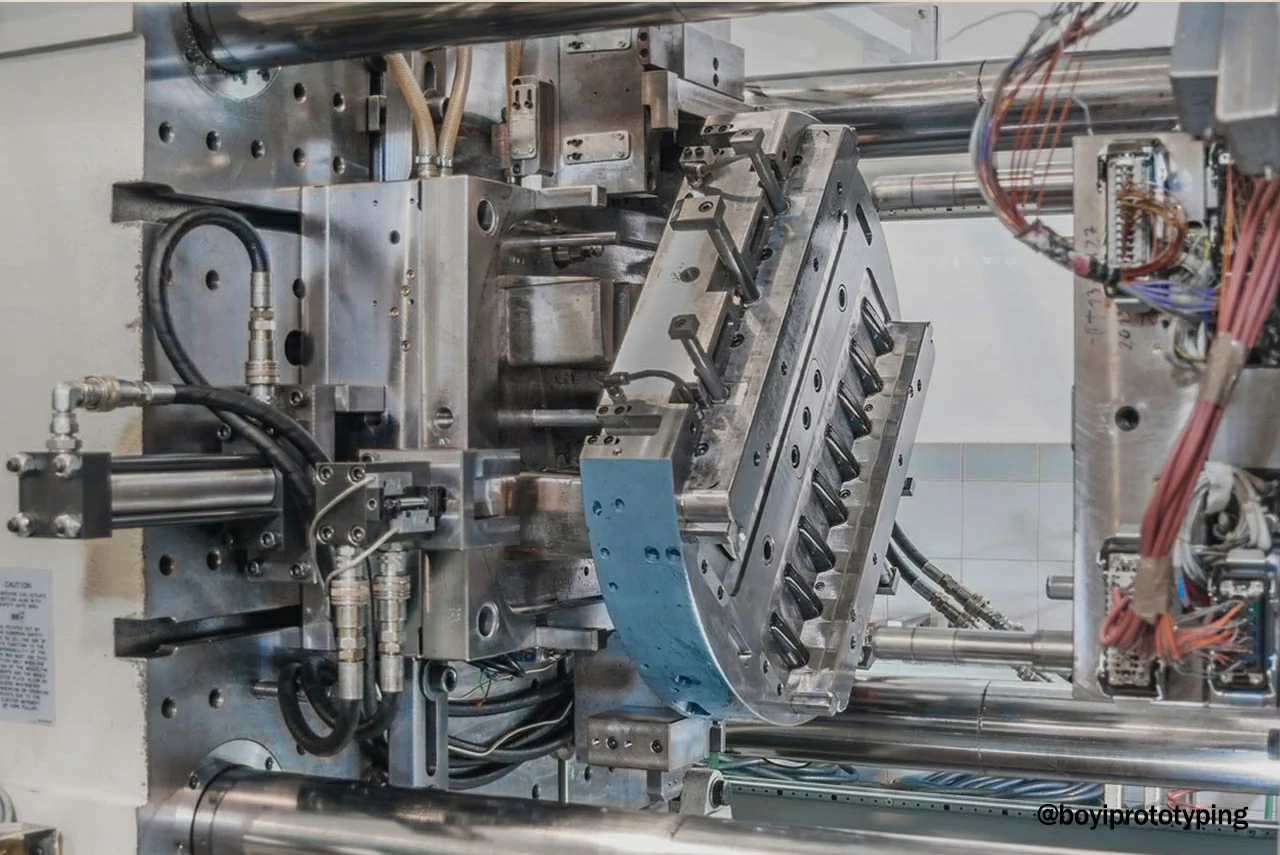
A single-cavity mold produces one part per cycle. A multi-cavity mold produces 2, 4, 8, or more parts per cycle from one injection. Multi-cavity molds lower per-part cost at high volume—but they're more complex and more expensive to build.
Choosing the right cavity count isn't obvious. The cheapest mold quotation often isn't the lowest total manufacturing cost over the product lifetime.
Single vs. Multi-Cavity Economics
Single-cavity mold:
- Lower initial tooling cost
- Longer per-cycle time (produces 1 part/cycle)
- Higher per-part mold cost amortization
- Good for prototype, low-volume, or high-mix production
Multi-cavity mold (e.g., 4-cavity):
- Higher initial tooling cost (2–3× single-cavity)
- Shorter per-cycle time (4 parts/cycle in theory)
- Lower per-part mold cost
- Good for medium-to-high volume where cycle time and throughput matter
The calculation: If a single-cavity tool costs $15,000 and a 4-cavity tool costs $35,000, the 4-cavity mold amortizes per part faster only if you're running high volume. At 10,000 parts, the 4-cavity tool adds $3.50/part mold cost. At 100,000 parts, it adds only $0.35/part.
Your mold quotation should show cost-per-part under different cavity counts and volumes. Use that data, not just the mold price.
Cavity Balancing: The Hidden Challenge
In a perfectly balanced 4-cavity mold, all four cavities fill at the same rate, develop the same pressure, and cool at the same rate. Parts from cavity 1 are identical to parts from cavity 4.
Reality: Perfect balancing is difficult. Cavities near the gate fill faster than distant cavities. Cooling varies slightly across the mold. Unbalanced cavities produce parts with different dimensions, different cosmetics, and different shrinkage—lot variation you'll struggle to control.
Balancing strategies:
- Runner design: H-type, balanced-branch, and fishbone runner systems distribute melt evenly. This requires mold-flow analysis during design.
- Gate sizing: Gates to distant cavities are made slightly larger to equalize fill rate and pressure.
- Cooling channels: Channels positioned to cool all cavities uniformly, not just the ones near the sprue.
- Rheological modeling: Understanding how melt viscosity changes with shear rate and temperature helps predict fill imbalance and correct it before steel is cut.
Runner System Design
The runner is the network of channels that carries melt from the sprue (injection point) to each cavity gate. Runner design directly affects:
- Fill balance: Do all cavities fill simultaneously?
- Scrap: Cold runner systems waste 20–40% of resin as runner trim. Hot runners reduce scrap to <5%.
- Cycle time: Thicker runners hold more cool material; thinner runners freeze slower.
- Pressure requirement: Poorly designed runners create excessive pressure drop.
Cold runners (standard):
- Simple, low-cost
- Create runner scrap
- Good for low volumes or thermosetting materials
Hot runners:
- More expensive tooling
- Zero runner scrap
- Better for high-volume production of expensive resins
- Require heated manifold management
When Should You Choose a Multi-Cavity Mold?
Multi-cavity makes sense when:
- Annual volume is ≥50,000 parts
- Part geometry is simple (no complex undercuts that complicate balancing)
- Tight dimensional control isn't critical (some part-to-part variation is acceptable)
- Cycle time and throughput are limiting factors
Single-cavity or family mold makes sense when:
- Volume is <50,000 parts annually
- Part geometry is complex (undercuts, tight tolerances)
- Part-to-part consistency is critical
- Product mix is high (frequent mold changes)
Family Molds: Multiple Parts in One Mold
A family mold produces different parts in the same cycle (e.g., left and right handles together). Family molds are useful for assembly applications but complicate balancing and cycle management.
Advantages: Fewer mold changes, coordinated supply of related parts
Disadvantages: Longer cycles (limited by slowest-cooling part), complexity, difficulty achieving cavity balance across different parts
What Buyers Should Ask Before Approving Multi-Cavity Tooling
- How are the cavities balanced? Request runner design and mold-flow simulation showing fill-time balance and pressure distribution.
- What's the expected cavity-to-cavity variation? This is typically ±0.1–0.2 mm dimensional variation. Is this acceptable for your assembly?
- How are cooling channels positioned? Ensure all cavities cool evenly, not just the easily accessible ones.
- What's the runner scrap percentage? For cold-runner molds, 20–40% resin becomes scrap. Does the per-part savings justify that waste?
- What's the cycle time with this cavity count? Confirm the projected cycle time and throughput. Sometimes a 4-cavity mold with long cycle time offers no throughput advantage over a 2-cavity mold.
- What's the maintenance plan? More cavities = more complexity. Ask about maintenance intervals, expected tool life, and costs for cavity repair.
- Can cavity count be changed later? Usually not without rebuilding the mold. Confirm you're confident in your volume forecast.
Cost Isn't Just Mold Price
A $40,000 multi-cavity mold might deliver lower per-part cost than a $15,000 single-cavity mold—but only at sufficient volume. The all-in cost includes:
- Mold amortization
- Machine hourly cost
- Material and scrap
- Cycle time
- Labor for setup and running
- Inspection and rework
Your molder or toolmaker should model these for your specific volume and timeline.
MULTI-CAVITY MOLD DFM CHECKLIST
- Part geometry is suitable for cavity balancing (no extreme undercuts)?
- Runner design and balancing strategy is specified?
- Mold-flow simulation shows even fill and pressure across cavities?
- Cooling channels position for uniform cooling of all cavities?
- Expected cavity-to-cavity dimensional variation is acceptable?
- Cycle time projection with selected cavity count meets throughput need?
- Maintenance and repair procedures are documented?
- Tool life expectancy is realistic for your volume?
FD GROUP PERSPECTIVE
Multi-cavity decisions are critical. Get it wrong and you'll either overpay for tooling you don't need, or force yourself into a tool that doesn't deliver the economics you expected. Our engineering team evaluates part geometry, volume forecast, and timing to recommend the cavity count that delivers lowest total cost—not just the cheapest mold.
We use mold-flow simulation to validate cavity balance before steel is cut, ensuring all parts meet your spec from all cavities. Discuss your multi-cavity requirements with FD Group.
FREQUENTLY ASKED QUESTIONS
A: Not automatically. If cycle time is already short (20–30 seconds), adding cavities doesn't improve throughput proportionally. You may need only 2 cavities and lower tooling cost.
A: Typically ±0.1–0.2 mm for uncontrolled dimensions. Gate position, cooling, and cavity location create natural variation. Tighter control requires more precise tooling and process management.
A: No. You'd rebuild the mold from scratch. Choose cavity count based on best-case volume forecast.
A: A 4-cavity mold makes 4 identical parts. A family mold makes 4 different parts (or variations). Family molds are harder to balance and typically have longer cycles.
A: Yes, typically 30–50% more than cold-runner molds. But for high-volume, expensive-resin projects, the scrap savings justify the cost.
A: Highly viscous materials (filled nylons, LCP) are sensitive to pressure and temperature changes, making balancing harder. Low-viscosity materials (PP, unfilled ABS) balance more easily.
A: No. Unused cavity capacity means you're paying for complexity you don't need. A future tooling revision is usually cheaper than paying for excess capability today.
A: Mold-flow simulation typically takes 1–2 weeks. It's worth the time—fixing imbalance after steel is cut is very expensive.