Featured Snippet Answer
AI and simulation are changing mold design by shifting decisions such as gate location, cooling channel layout, and process parameter selection from manual iteration to algorithm-assisted optimisation. Modern platforms including Moldex3D 2025/2026, Autodesk Moldflow, and emerging AI-driven optimisation tools use machine learning, surrogate modelling, and multi-objective optimisation to recommend mold designs and process windows in hours rather than weeks — reducing tryout iterations, cutting time-to-first-good-part, and enabling profitable processing of variable materials such as post-consumer recycled resins.
Introduction
For most of injection molding's history, mold design has been a discipline of experienced judgment. A senior mold designer with fifteen years of gate location experience could look at a part geometry and make choices that a simulation package would take days to verify. In 2026, that dynamic is being reshaped — not because experience matters less, but because AI-assisted simulation is now capable of exploring the design space at a scale no individual engineer can match, and returning recommendations that align remarkably well with what those senior designers would have chosen anyway.
The result is neither the replacement of the mold designer nor the "push a button, get a mold" fantasy of a decade ago. It is something more interesting: a workflow in which simulation and AI expand the designer's capacity to consider more options, catch more issues earlier, and validate decisions faster.
Industry Context
The economic case for better mold design has always been stark. Mold tooling is expensive, tryouts are expensive, and every iteration between "first shot" and "acceptable part" burns machine time, engineering time, and material. Cooling alone accounts for 50–80% of the injection molding cycle time, according to a peer-reviewed 2025 review published in Polymers — meaning that cooling channel design has a first-order impact on both part quality and production economics.
At the same time, the challenges are increasing. Variable-viscosity recycled and biobased resins are harder to process than virgin materials. Part geometries are more complex. Cycle-time targets are tighter. And skilled mold designers are increasingly scarce, particularly in high-cost manufacturing regions.
Into that gap has come a new generation of simulation and AI-assisted design tools. Moldex3D released its 2025 version in March 2025 with an AI Optimization Wizard and two intelligent data-driven modules (Gate Design Discovery and Mold Design Discovery), and followed with a 2026 release organised around three pillars: Automation, Optimization, and Intelligence. Autodesk Moldflow continues to be integrated into broader Autodesk simulation environments. Emerging academic research demonstrates AI models capable of optimising injection molding processes in real time, including for challenging recyclate feedstock.
Current Market Trends
Four trends are reshaping mold design workflows in 2026.
AI-assisted parameter optimisation is now a standard simulation feature. Where simulation platforms once required engineers to run manual design-of-experiments studies, current-generation tools use AI optimisation wizards to explore parameter ranges automatically and recommend settings that satisfy multi-objective quality criteria.
Historical data is becoming a design asset. Platforms such as Moldex3D's iSLM (Intelligent Solution Lifecycle Management) are structuring past mold design and tryout data into knowledge bases that inform new-design recommendations. This turns institutional experience from a personal asset (in the head of the senior designer) into an organisational asset (queryable by any engineer on the team).
Surrogate models are cutting simulation time by orders of magnitude. Traditional finite-element mold-flow analysis can take hours or days for complex geometries. Surrogate models — Kriging, response surface methodology, and artificial neural networks — approximate the underlying physics well enough to enable near-real-time evaluation of design alternatives, at accuracy sufficient for early-stage decisions.
LLM-based multi-agent frameworks are entering research pilots. Academic work published in 2025 describes LLM-based frameworks integrating tool-calling and knowledge transfer for injection molding, including systems capable of answering process engineering questions grounded in sensor data and design history. Production deployment is a matter of when, not if.
Technical Analysis: What Simulation and AI Actually Do
To understand where AI and simulation fit in mold design, it helps to break the workflow into the decisions they actually influence.
Gate design. Number, location, and type of gates determine flow pattern, weld line placement, packing effectiveness, and cosmetic appearance. Moldex3D's Gate Design Discovery module uses AI to rapidly estimate viable gate positions and quantities based on part geometry and material behaviour. This is not a replacement for engineering judgment — it is a pre-filter that lets engineers evaluate ten candidate gate strategies in the time it once took to evaluate one.
Cooling channel design. The 2025 Polymers review makes the point explicitly: cooling accounts for 50–80% of cycle time, and conformal cooling channels — particularly those enabled by additive manufacturing of mold inserts — deliver measurable cycle-time and quality improvements. Optimisation algorithms including evolutionary algorithms, simulated annealing, and multi-objective methods are increasingly used to size and route cooling channels for uniform temperature distribution.
Runner and manifold layout. Hot runner design has significant impact on colour changeover, pressure loss, and material residence time. Current simulation tools including Moldex3D 2025 have improved hot runner pressure simulation, allowing better front-loaded decisions about manifold sizing and gate balancing.
Warpage prediction and compensation. Predicting how a part will warp on ejection — and reshaping the mold to compensate — is one of the highest-value applications of mold flow simulation. AI-driven pattern recognition across past programs is beginning to reduce the trial-and-error component of warpage compensation.
Process parameter recommendation. For a given mold and material, the Moldex3D AI Optimization Wizard and equivalent tools recommend melt temperature, injection speed profile, pack pressure, and cooling time to satisfy a set of quality targets. Recent research from German engineering institutes has extended this approach to challenging materials, demonstrating an AI model capable of optimising injection molding processes for variable recyclate content in real time.
Real Manufacturing Applications
Five applications where AI and simulation are delivering measurable value today:
Reducing mold tryout iterations. Digital validation of gate position, cooling layout, and process window before steel is cut cuts the number of tryout iterations required to reach production. For a complex mold, this can mean the difference between three tryouts and eight — with corresponding impact on time-to-market and program cost.
Enabling conformal cooling. Simulation-driven design of cooling channels that follow part geometry, combined with additive manufacturing of mold inserts, delivers cycle-time reductions of 20–40% for the parts where it is technically viable. Simulation is what makes the business case defensible before the additive tooling investment is committed.
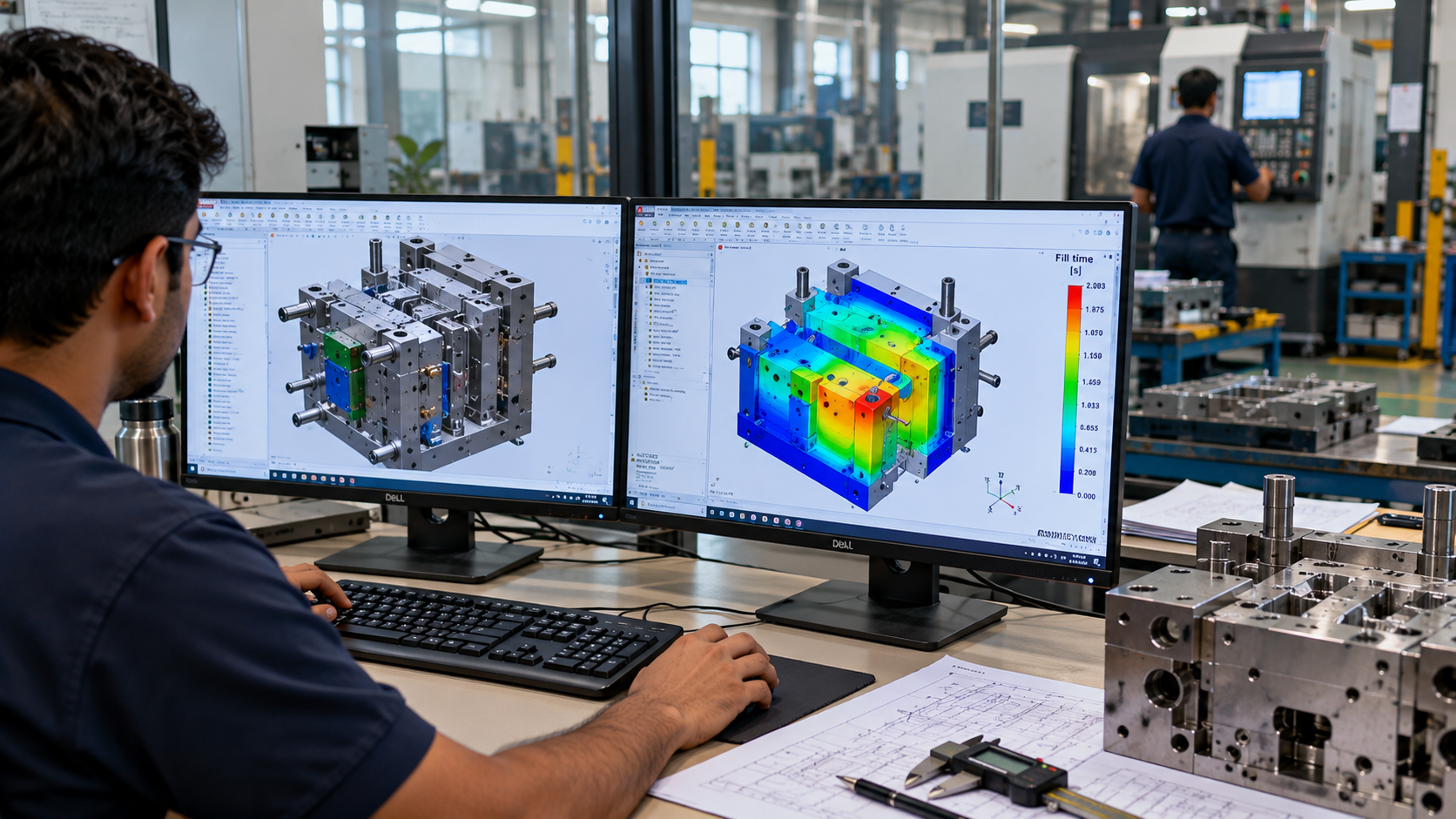
Supporting DFM discussions with OEMs. Simulation output — flow front animations, weld line locations, warpage predictions — is now standard supporting material for design-for-manufacturability reviews with product design teams. It moves the conversation from opinion to data.
Qualifying variable materials. AI-driven adaptive process control, informed by simulation-derived process windows, allows mold shops to run PCR and biobased grades within acceptable quality bands despite the material variability that would defeat fixed-parameter processing.
Knowledge preservation. As senior mold designers retire, platforms that capture and structure their design decisions extend institutional knowledge beyond individual careers. This is a strategic capability, not just an operational one.
Advantages
Where AI and simulation are deployed well, the advantages are measurable:
- Faster time to first good part through digital validation before physical tryout
- Higher first-time-right rate on new molds, reducing tooling rework cost
- Better cooling and cycle-time performance through simulation-optimised cooling design
- Improved process robustness for variable materials through AI-assisted parameter selection
- Reduced dependence on individual senior expertise through structured design-history knowledge bases
- Better DFM engagement through simulation-supported conversations with OEM design teams
- Sustainability benefits through cycle-time reduction, scrap reduction, and enabling of recycled-content materials
Challenges
The barriers to full realisation of these benefits are real:
- Simulation is only as good as its inputs. Material data quality, boundary condition assumptions, and mesh quality all affect result accuracy. Bad inputs produce confident-looking wrong answers.
- AI recommendations require validation. Optimisation wizards can suggest parameter sets that a simulation says will work but that a process engineer will recognise as impractical. Judgment remains essential.
- Skilled simulation engineers remain scarce. The tools are more accessible than ever, but interpreting their outputs still requires training and experience.
- Data infrastructure is a prerequisite. AI models trained on historical mold design data need that data to be structured, tagged, and accessible — which most mold shops' historical records are not.
- Vendor tool selection carries lock-in cost. Moldex3D, Autodesk Moldflow, and other platforms are each strong in different areas; switching later is expensive.
- Simulation costs and licenses are significant. Full-featured commercial simulation suites are enterprise-scale investments.
Future Outlook
Three developments will shape AI-driven mold design through 2028.
Simulation will become continuously running, not project-triggered. Rather than running a mold flow study at the start of a program and never re-running it, expect cloud-based simulation platforms to continuously re-evaluate as design changes are made — turning simulation from a checkpoint activity into an always-on advisor.
LLM interfaces will change how engineers interact with simulation. Recent research pointing toward LLM-based multi-agent systems for injection molding suggests that within eighteen months, mold designers will be asking conversational questions of their simulation platforms — "why is this warping?" — and receiving contextual answers grounded in the simulation results.
Generative mold design will emerge for specific segments. Just as generative structural design has moved from research to production for aerospace brackets, generative approaches to cooling channel routing and gate placement are emerging in academic research. Full generative mold design remains further out, but specific decision points are already being automated.
Expert Perspective
For mold design teams and manufacturing engineering leaders planning AI and simulation investment in 2026:
- Adopt simulation broadly before adopting AI selectively. AI-assisted optimisation is most useful on top of a well-established simulation practice. Skipping the foundation weakens the value of the layer above.
- Structure your historical design data now. The organisations that will benefit most from AI-driven design tools over the next five years are the ones that have their past mold designs, tryout results, and process parameters in a queryable form. Start capturing that data even before the AI tools are in place.
- Use AI to expand the design space, not shortcut it. The point of AI optimisation is to evaluate more alternatives, not fewer.
- Preserve engineering review. Every AI-recommended design or process window should pass through experienced engineering review before it reaches steel or first shot.
- Invest in your simulation engineers. Tools are commoditising; the people who interpret them are not. Training and retention matter more than software licenses.
- Involve simulation in DFM conversations with OEMs. Simulation-supported DFM is a differentiator with sophisticated product design teams — and often reveals cost-saving opportunities in the part design that pay back the simulation investment several times over.
Key Takeaways
- AI and simulation are reshaping mold design as an assistive layer, not a replacement for engineering judgment
- Moldex3D, Autodesk Moldflow, and academic AI research are converging on AI-assisted parameter optimisation, gate design, and cooling design
- Cooling accounts for 50–80% of cycle time, making cooling-channel simulation one of the highest-value applications
- Historical design data structured into knowledge bases turns institutional experience into an organisational asset
- Adaptive AI process control extends the range of materials — particularly PCR and biobased — that can be economically processed
- The next 18–24 months will see LLM-based conversational interfaces enter production mold design workflows
Conclusion
Mold design is not becoming automated. It is becoming augmented — with the designer at the centre, but with a set of tools that make it possible to explore more options, catch more problems earlier, and preserve knowledge across generations of engineers. The mold shops and OEMs that treat AI and simulation as force multipliers for skilled engineers, rather than as replacements for them, will define the next decade of competitive tooling and process capability. The technology is real. The results are measurable. The engineering judgment still matters.
Work With FD Group
FD Group combines experienced mold design and toolmaking with modern simulation and process engineering capability to deliver production-ready tooling for demanding OEM programs. Our team engages from concept-stage DFM through mold flow simulation and production validation.
Frequently Asked Questions
1. How is AI being used in mold design today?
AI is being used in mold design for gate position and quantity recommendation, cooling channel optimisation, process parameter selection, warpage prediction, and — increasingly — for structuring historical design data into queryable knowledge bases that inform new mold designs.
2. What is the difference between simulation and AI in mold design?
Simulation solves the underlying physics of the injection molding process to predict flow, cooling, and part quality. AI uses machine learning and optimisation algorithms on top of simulation (or on historical data) to recommend design and process choices without requiring engineers to manually iterate through every option.
3. Which simulation tools are most commonly used for injection mold design?
Moldex3D and Autodesk Moldflow are the two dominant commercial mold flow simulation platforms. Both have added AI-assisted optimisation capabilities in recent releases, with Moldex3D 2025 introducing an AI Optimization Wizard and Moldex3D 2026 organising around Automation, Optimization, and Intelligence pillars.
4. Can AI-driven mold design replace experienced mold designers?
No. AI-driven tools augment mold designers by evaluating more design alternatives faster and structuring historical knowledge, but the interpretation of simulation output, engineering judgment about manufacturability, and design review remain human activities.
5. Why is cooling channel design so important in mold flow simulation?
Cooling accounts for 50–80% of injection molding cycle time. Optimising cooling channel layout — particularly with conformal cooling enabled by additive manufacturing of mold inserts — directly reduces cycle time and improves part quality by ensuring uniform temperature distribution.
6. Can AI improve processing of recycled and biobased materials?
Yes. Recent academic research has demonstrated AI models capable of optimising injection molding processes in real time for variable-viscosity recyclate content, making previously uneconomic PCR-heavy materials viable in production.
7. Is AI-driven mold design cost-effective for small mold shops?
The value depends on program mix. For shops running many similar programs where historical data can inform new designs, and for shops running challenging materials or tight cycle-time requirements, the return can be substantial. For smaller shops running one-off tools, commercial simulation licenses may exceed the benefit — though cloud-based per-simulation pricing is changing that calculus.