If you are developing a plastic component, one decision shapes your cost, timeline, and quality more than almost any other: how you actually make the part. For most engineering and procurement teams, the choice comes down to injection molding or 3D printing. Both are excellent technologies. Neither is universally "better." The right answer depends on your volume, your part geometry, your material requirements, and where you are in your product's life cycle.
At FD Group, we manufacture precision molds and injection-molded components from our two plants in Pune, India, and we work with international OEMs who need parts that perform the same way on unit 10 as they do on unit 1,000,000. This guide explains how the two processes really compare — honestly — so you can brief your team and your supplier with confidence.
The core difference in one minute
3D printing builds a part layer by layer directly from a CAD file. There is no tooling. You send a file, and a printer produces the geometry. That makes it fast to start and easy to change.
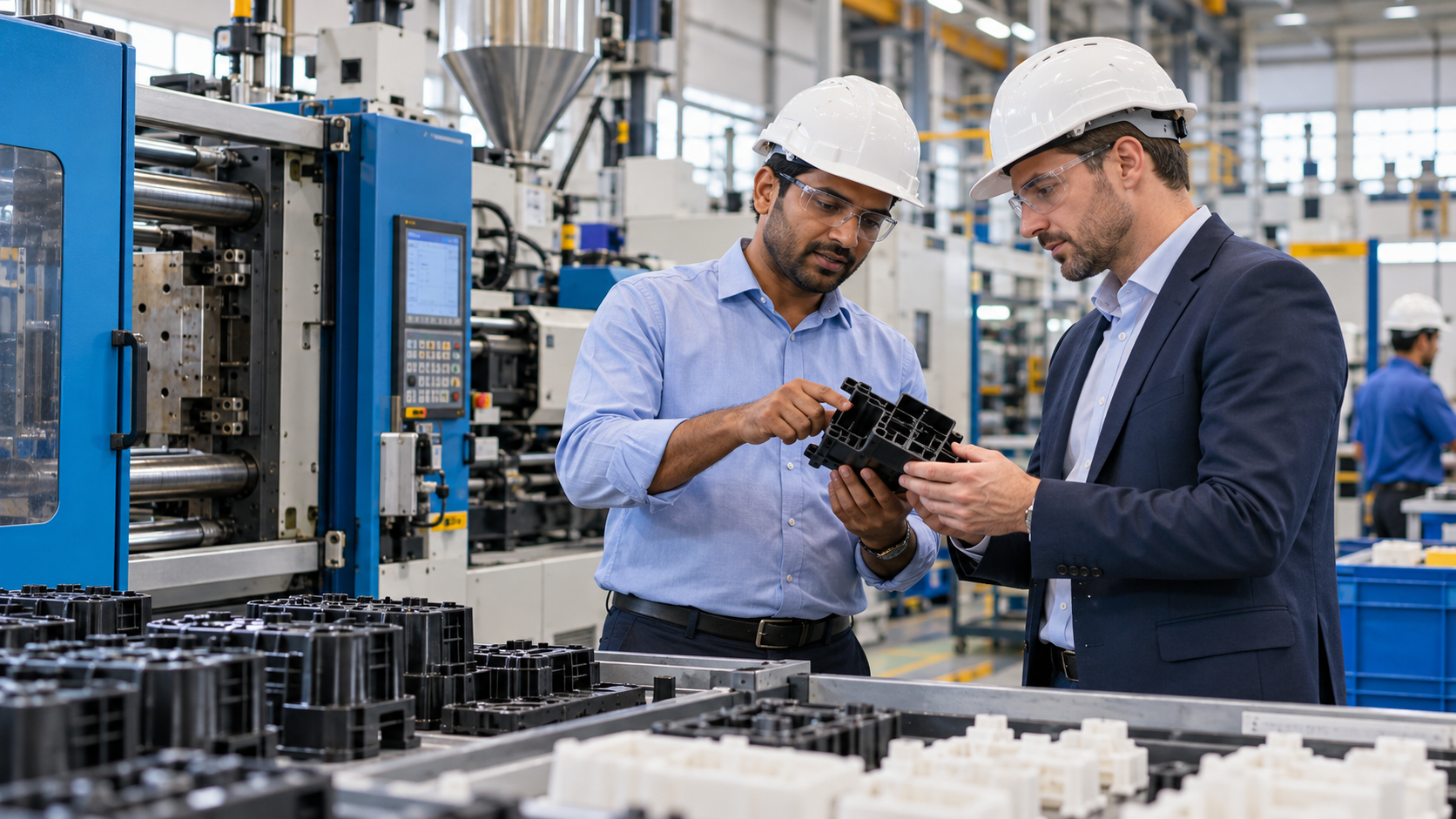
Injection molding works differently. A precision steel mold (the tool) is manufactured first, then molten polymer is injected into that cavity under high pressure, cooled, and ejected as a finished part. The tooling is an upfront investment, but once it exists, every subsequent part is fast, repeatable, and inexpensive.
Put simply: 3D printing has a low starting cost and a high per-part cost. Injection molding has a higher starting cost and a very low per-part cost. Everything else follows from that.
When 3D printing is the right call
We recommend 3D printing to our own clients in specific situations, because sending you to the wrong process helps no one. It is the smart choice when:
- You are still iterating. Early design validation, fit checks, and ergonomic reviews benefit from printing a version overnight and revising it the next day.
- Volumes are very low. For a handful of units, or a one-off jig or fixture, tooling rarely makes economic sense.
- Geometry is highly complex. Internal channels and lattice structures that would be difficult to mold can sometimes be printed directly.
- Speed matters more than cost per part. When you need a physical object this week, printing removes the tooling lead time entirely.
The trade-offs are real, though. Printed parts often show visible layer lines, have anisotropic strength (weaker along the build layers), a narrower range of production-grade materials, and a per-part cost that never falls with volume.
When injection molding wins
For any product heading toward real production, injection molding is almost always the destination. It is the right process when:
- You need volume. Whether you are ordering 10,000 units or scaling toward 10 million, molding is built for repeatable, high-throughput output.
- Consistency is non-negotiable. With process-controlled molding, statistical process control (SPC), and CMM dimensional inspection, every part matches the last within tight tolerances.
- Surface finish and cosmetics matter. Molding delivers A-class cosmetic surfaces — no sink marks, no visible weld lines — straight off the machine.
- You need engineering-grade materials. Molding runs the full spectrum of production polymers, including ABS, PP, PC/ABS, FR-ABS V0 (flame-retardant), PA6,6 (nylon), food-grade PP, and BPA-free PC.
- Per-part cost drives your business case. As volume rises, the tooling cost is spread across every unit, and your landed cost per part drops dramatically.
This is why virtually every plastic product you own — from automotive components to appliance housings and medical device parts — is injection molded, not printed.
A simple way to decide
Ask yourself three questions:
- How many parts do I actually need? Dozens point toward printing. Thousands and up point toward molding.
- Where am I in development? Concept and iteration favor printing. A frozen, production-ready design favors molding.
- How critical are consistency, strength, and finish? The higher the stakes, the stronger the case for molding.
Most successful products use both. Teams prototype and validate with 3D printing, then transition to injection molding for production. The key is planning that transition early — because a design optimized only for printing can be expensive to re-engineer for a mold later.
Why the transition is where partners earn their keep
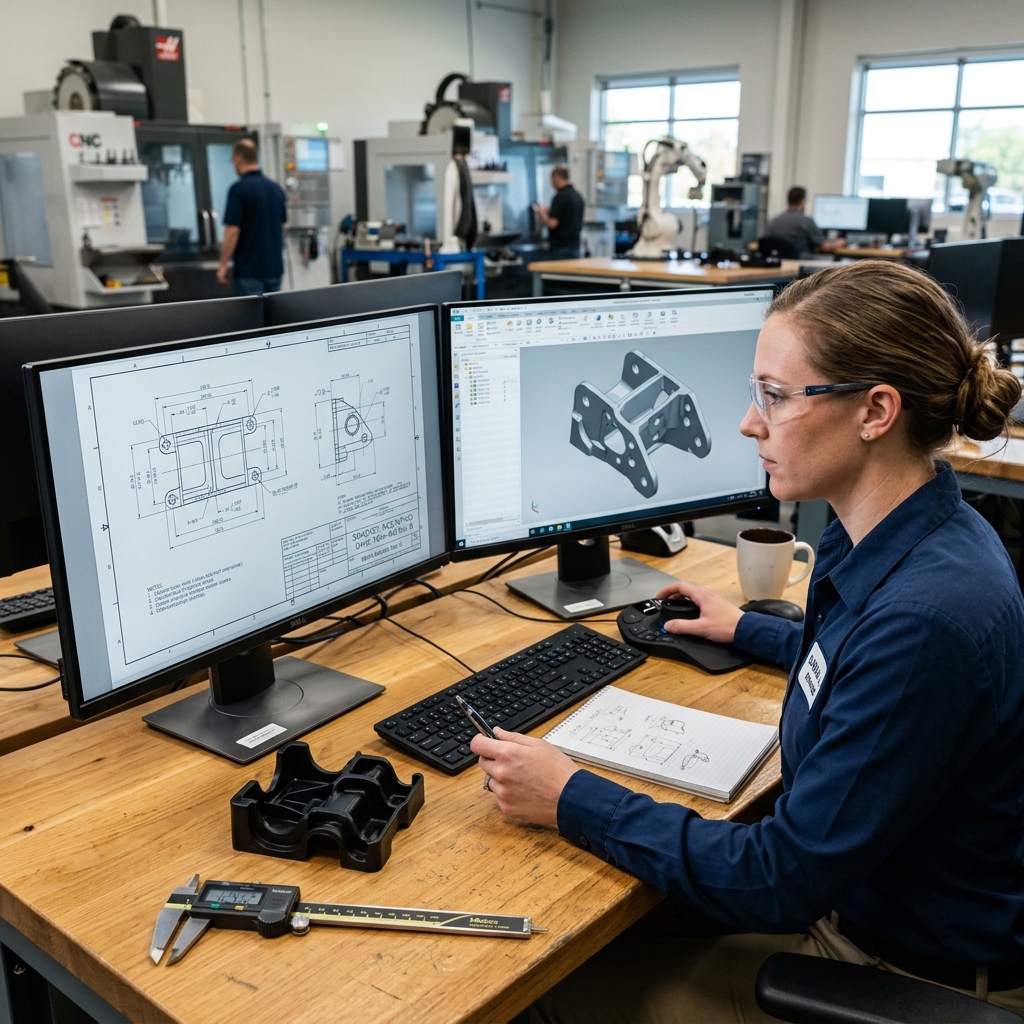
The riskiest moment in a plastic product's life is moving from a validated prototype to a production tool. Small design choices — wall thickness, draft angles, gate location, rib design — determine whether your mold produces flawless parts or fights you for months.
This is exactly where FD Group adds value before any steel is cut. Our engineering team reviews your drawings for Design for Manufacturability (DFM) at the paper stage, where a fix costs a fraction of what the same issue costs once tooling is underway. We also run mold flow analysis and support reverse engineering using industry-standard CAD/CAM tools, so your first production parts are right the first time.
Why choose FD Group
International buyers work with FD Group because we behave like an engineering partner, not a job shop:
- Established, certified, and proven — operating since 2015, ISO 9001:2015 certified, with 1,200+ molds delivered and clients across 7+ countries in automotive, consumer goods, healthcare, defence, and toys.
- End-to-end under one roof — design, in-house tooling (VMC, EDM, CNC wire), injection molding, assembly, quality inspection, and dispatch, which means fewer handoffs and fewer delays.
- Built for scale — production capacity that spans 10,000 to 10 million units, with a shot weight range from 0.5 g to 2,000 g on modern Shibaura and FCS machines, including 2K (two-shot), insert, and over-molding.
- Quality built in, not inspected in — CMM inspection, process capability (Cpk) tracking, and full traceability from raw material to finished component.
Conclusion
There is no single winner in injection molding vs. 3D printing — only the right tool for where your product is today. Print to explore and validate. Mold to produce, scale, and deliver consistent quality to your customers. The manufacturers who get this right plan the whole journey from the start.
If you are weighing the two for your next component, our engineers are happy to review your design, advise on the most economical path, and show you what production-ready looks like. Talk to our engineers or request a quote at www.fdgroup.co.in — or email director@fdgroup.co.in to start your OEM project with a partner built for precision and scale.